
 By Nayra Roy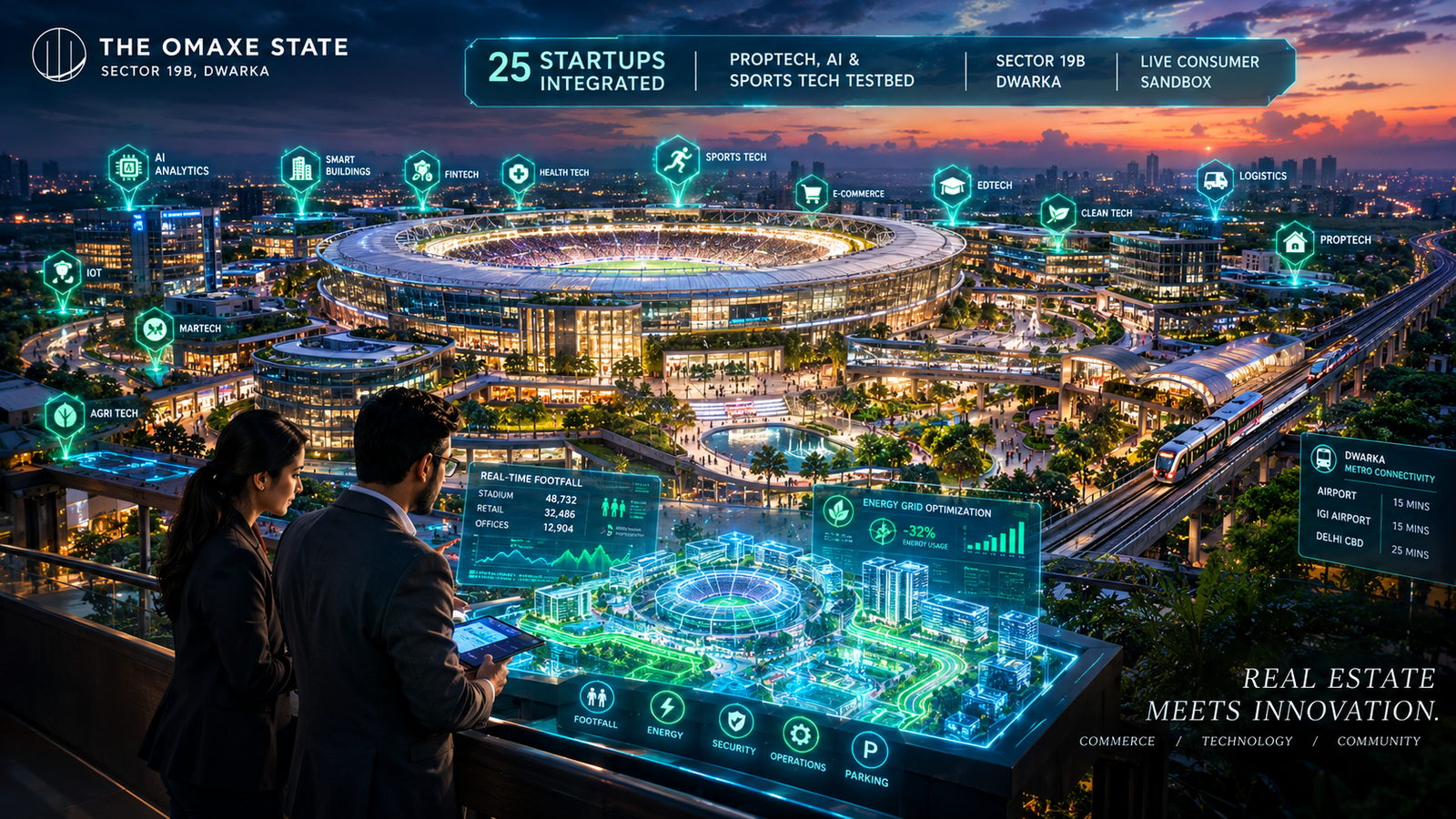
Real estate developers historically treated technology startups merely as corporate office tenants paying monthly square-foot rent. Builders leased cold floorplates, collected security deposits, and took no interest in the startup’s underlying technology.
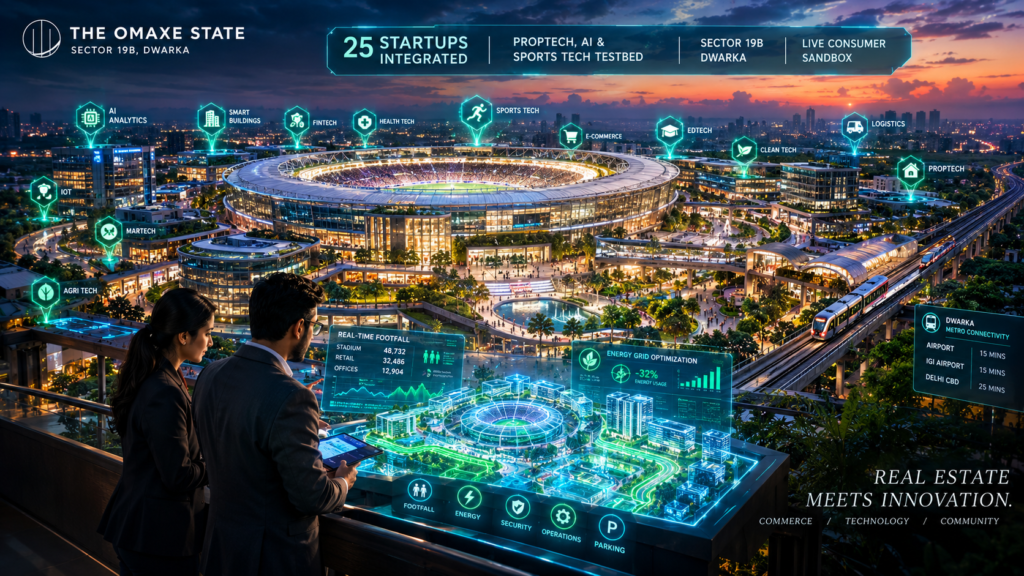
However, in October 2026, real estate major Omaxe inverted that dynamic. The company opened the doors of its flagship commercial destination The Omaxe State in Sector 19B, Dwarka to 25 new-age startups spanning PropTech, artificial intelligence, sports tech, e-sports, wellness, and shared spaces.
Consequently, the project marks a shift toward developer-startup collaboration. Rather than treating commercial destinations as passive retail malls, developers are transforming large-scale complexes into live testbeds where startups deploy cutting-edge consumer and operational technologies.
What The Omaxe State Actually Builds
The Omaxe State in Dwarka represents one of the largest integrated sports, retail, and hospitality destinations in North India. Developed at an estimated investment exceeding ₹2,500 crore, the project integrates an international cricket and football stadium with high-street commercial retail and luxury hospitality.
To power a facility of this scale, conventional facilities management is insufficient. The complex requires real-time crowd analytics, automated energy management, autonomous cleaning robotics, and interactive consumer experiences.
Therefore, Omaxe invited startups across key frontier sectors to co-create solutions. By integrating new-age businesses directly into the destination’s operational blueprints, the developer future-proofs its commercial asset.
Why Startups Need Physical Testbeds
For artificial intelligence, sports tech, and PropTech startups, laboratory testing can only advance software to a limited threshold. Founders often struggle to find large-scale physical environments to validate their algorithms in real-world conditions.
Deploying software inside an operational sports stadium with 30,000 live visitors provides an unmatched data sandbox. Computer vision startups can test crowd density modeling, automated parking navigation, and queue management under intense peak traffic.
Furthermore, physical commercial hubs provide immediate distribution. Startups in wellness, e-sports, and experiential retail gain direct exposure to millions of affluent Delhi-NCR consumers without spending immense capital on digital customer acquisition.
The Developer as a Venture Ecosystem Builder
The collaboration reflects the broader transformation of leading Indian real estate developers. Builders are establishing in-house venture arms, incubation centers, and strategic pilot programs.
When a developer integrates a startup’s smart energy platform or digital ticketing infrastructure, both sides win. The property reduces operational overhead by up to 25%, while the startup secures a blue-chip enterprise reference customer that unlocks international sales pipelines.
Additionally, the development elevates Dwarka’s status within the National Capital Region. Positioned close to the Indira Gandhi International Airport and Yashobhoomi convention center, Sector 19B is evolving into a premier innovation corridor.
The boundary between commercial real estate and venture tech has dissolved. The Omaxe State proves that India’s next commercial destinations will be built collaboratively with the startup founders redefining everyday life.
Tags: Omaxe Dwarka, The Omaxe State, PropTech Startups, AI Testbed, Delhi Real Estate, Commercial Hub 2026, Sports Tech Startups, Real Estate Innovation Author CTA: Follow Flairius News — sharp takes on AI, business, and India’s startup economy — flairiusnews.com
 Ahana Verma
  Aditya Agarwal