
 By Ahana Verma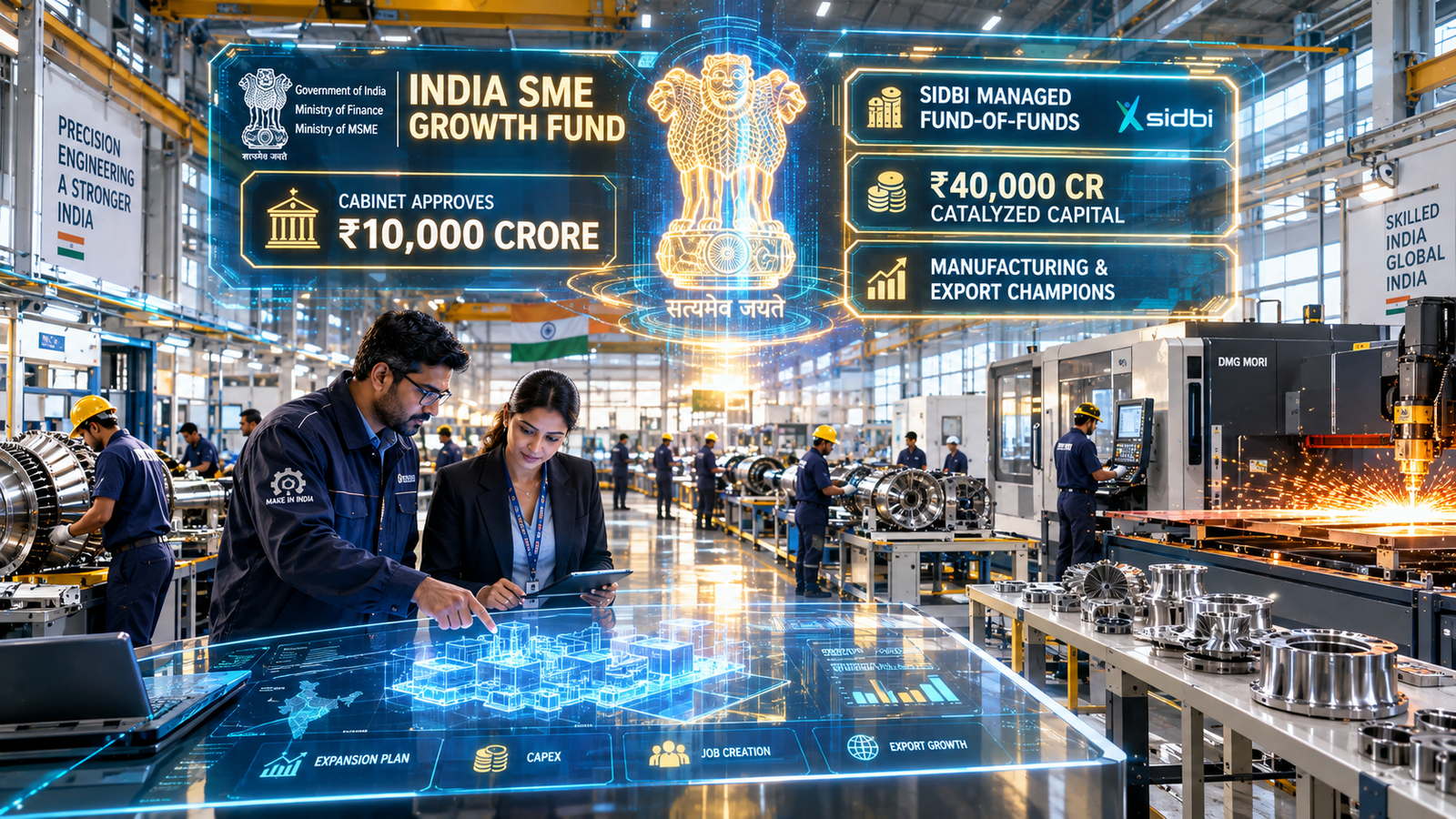
India’s manufacturing heartland has secured a transformative equity infusion. In October 2026, the Union Cabinet cleared the new India SME growth fund under the Self-Reliant India initiative.
Managed through SIDBI, the ₹10,000 crore fund-of-funds anchors private alternative investment funds. Consequently, the program aims to mobilize more than ₹40,000 crore in total risk capital for domestic manufacturers. Furthermore, the initiative addresses the chronic equity gap that historically trapped ambitious Indian enterprises at small operating scales. Rather than relying solely on high-interest commercial bank loans, domestic manufacturers gain growth equity to scale exports.
How the India SME Growth Fund Bridges Financing Gaps
India’s corporate financing landscape previously exhibited a severe imbalance. Early-stage digital startups raised venture capital easily, while giant industrial conglomerates tapped public bond markets.
However, established manufacturing enterprises generating ₹25 crore to ₹100 crore in annual turnover struggled to access patient risk capital. Commercial banks demanded physical collateral for term loans, restricting expansion into new fabrication machinery.
The India SME growth fund directly bridges this financing gap. By injecting patient equity capital, the government enables small businesses to modernize factory infrastructure without choking on debt servicing.
Prioritizing Manufacturing and Export Substitution
The deployment of equity capital follows disciplined industrial priorities. Capital allocations are channeled toward enterprises driving import substitution and high-value exports across critical supply chains.
Specifically, the fund targets precision engineering, defense components, green electronics, and pharmaceutical active ingredients. These sectors possess high export potential, but they require precision machinery to satisfy international buyer standards.
Furthermore, receiving institutional equity backing mandates modern corporate governance standards. Beneficiary enterprises adopt transparent financial auditing and digital ERP systems, significantly de-risking their operations.
Creating a Pipeline for Public Market Listings
The strategic endpoint of the government fund is not permanent state ownership. Rather, the architecture serves as an institutional springboard toward domestic public stock markets.
With India’s SME exchanges and mainboard markets absorbing record liquidity, equity-backed SMEs are groomed for public listings within four years.
As listed public entities, these enterprises access public capital markets directly. Therefore, the India SME growth fund can exit profitably and recycle capital into the next generation of industrial innovators.
Tags: India SME Growth Fund, SME Fund India 2026, Cabinet Approval, MSME Manufacturing, SIDBI Equity Fund, Self Reliant India, Make In India, SME IPOs
Author CTA: Follow Flairius News — sharp takes on AI, business, and India’s startup economy — flairiusnews.com
 Aditya Agarwal