
 By Nayra Roy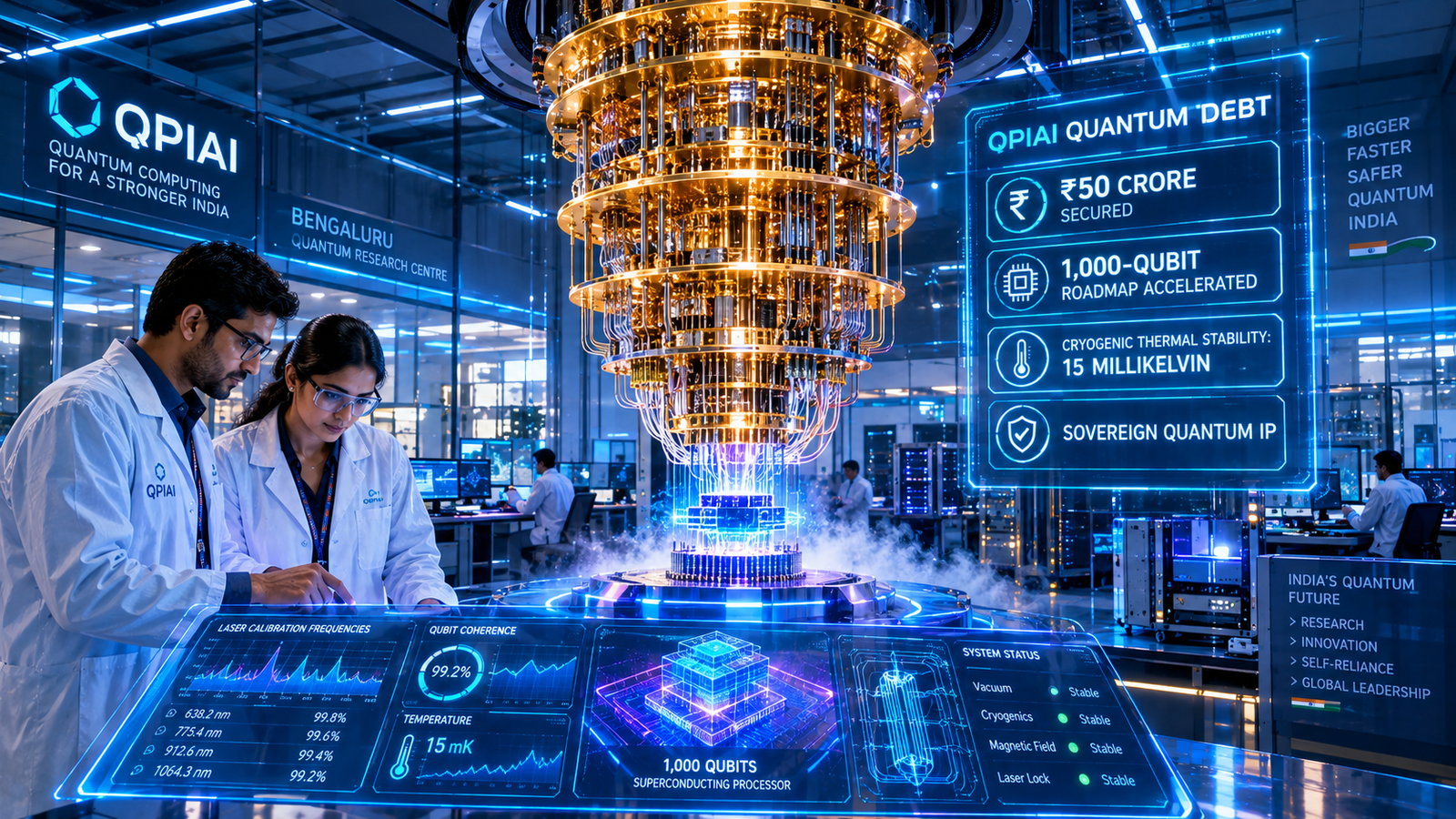
India’s frontier deeptech ecosystem is utilizing sophisticated debt instruments to accelerate physical hardware scaling. In October 2026, the new QpiAI quantum debt round secured ₹50 crore in structured financing.
The capital infusion carries a maturity timeline due two years ahead of the company’s scheduled commercial launch of its 1,000-qubit quantum processor. Consequently, the transaction highlights a bold operational strategy.
Specifically, the company utilizes debt to procure capital-intensive cryogenic dilution refrigerators without diluting founder equity. Furthermore, the funding validates Bengaluru’s emergence as an international deeptech hardware cluster.
Why Deeptech Founders Choose QpiAI Quantum Debt
Developing quantum computers requires immense upfront capital expenditures. For example, a single dilution refrigerator capable of cooling superconducting circuits costs upwards of $1 million.
Traditionally, deeptech founders financed hardware purchases by raising successive equity rounds. As a result, founders gave away 20% to 30% of their ownership at early valuations, leaving cap tables heavily diluted.
The structure of this QpiAI quantum debt provides an alternative playbook. By leveraging venture debt against verified intellectual property assets, the company secures non-dilutive liquidity. Therefore, the founding team retains control as commercialization approaches.
The Architectural Path to 1,000 Qubits
The central goal of QpiAI’s engineering roadmap is the realization of a fault-tolerant, 1,000-qubit quantum processor. Classical supercomputers take millennia to calculate complex molecular bonds or optimize massive global logistics matrices.
In contrast, quantum computers solve those problems in seconds. Specifically, QpiAI is developing a hybrid architecture uniting quantum processing units with specialized artificial intelligence models.
Consequently, classical machine learning algorithms correct quantum bit error drift in real time. Moreover, the company is constructing full-stack quantum software environments to model pharmaceutical molecules and simulate battery chemistry easily.
Aligning with India’s National Quantum Mission
QpiAI’s engineering progress represents a major milestone for India’s sovereign technological capabilities. The central government committed over ₹6,000 crore under the National Quantum Mission to establish domestic design facilities.
By partnering with academic institutions like the Indian Institute of Science, domestic startups are domesticating critical hardware components. Therefore, securing QpiAI quantum debt supports a sovereign supply chain that protects India against overseas export restrictions.
Tags: QpiAI, QpiAI Quantum Debt, Quantum Computing India, Venture Debt 2026, Deeptech Startups, 1000 Qubit Roadmap, Bengaluru Tech Hub
Author CTA: Follow Flairius News — sharp takes on AI, business, and India’s startup economy — flairiusnews.com
 Aditya Agarwal