
 By Aditya Agarwal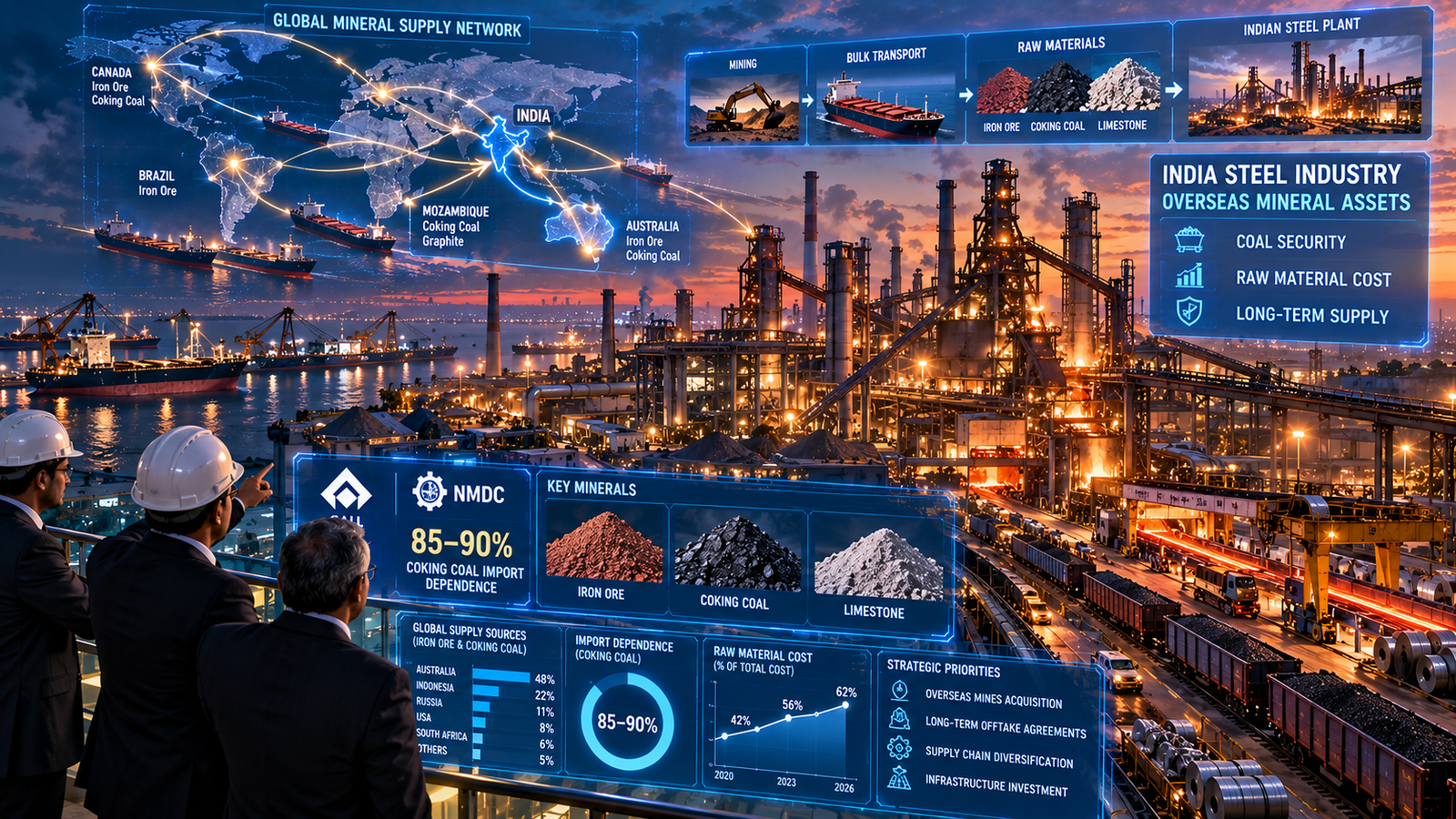
The India steel industry is looking beyond the country’s borders for its next source of raw materials.
The Steel Ministry has asked state-run steel companies SAIL and NMDC to explore mineral assets overseas. The objective is to secure long-term supplies and reduce the cost pressure created by imported raw materials.
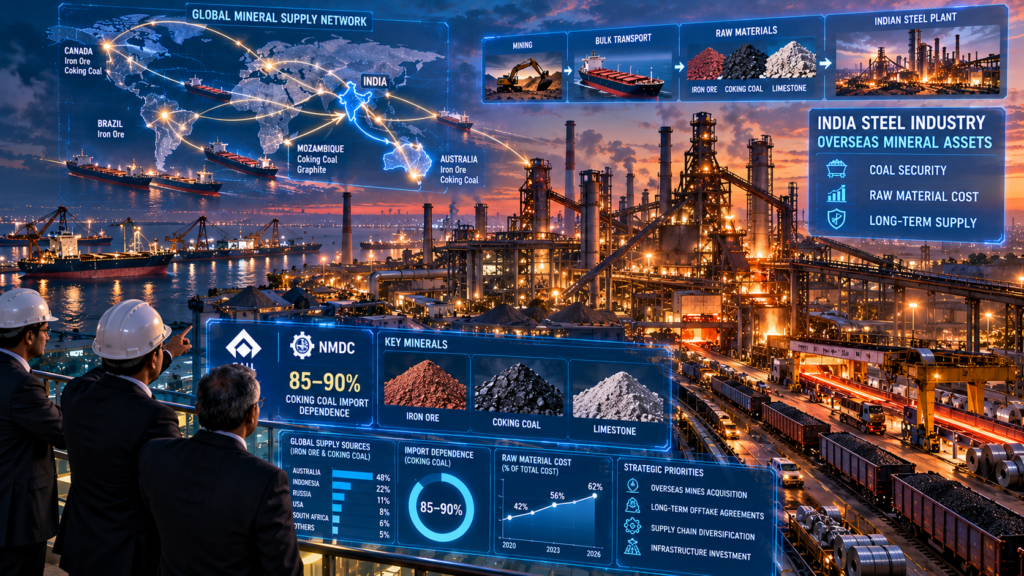
The move comes as Indian steelmakers remain heavily dependent on imported coking coal. According to a senior ministry official cited by Business Standard, Indian producers import around 85–90% of their coking coal requirements from countries including Australia and Mozambique.
Consequently, overseas mineral ownership is becoming more than a diversification strategy. It is increasingly becoming a supply-chain security tool.
India Steel Industry Faces a Raw Material Challenge
Iron ore is relatively abundant in India.
Coking coal presents a different problem.
Steel production requires several critical inputs, including iron ore, coking coal, limestone and pulverised coal injection coal. While domestic iron ore availability gives Indian producers an important advantage, the dependence on imported coking coal creates exposure to international prices, freight rates and geopolitical disruptions.
Therefore, securing mineral assets outside India could help companies gain greater control over their input costs.
A captive overseas mine can provide a long-term source of raw material. In addition, it can reduce dependence on spot-market purchases when international commodity prices become volatile.
That matters because steel is a capital-intensive industry.
Even a relatively small change in raw-material costs can affect the profitability of large production volumes.
Why SAIL and NMDC Are Exploring Overseas Assets
SAIL and NMDC have different positions within India’s mineral ecosystem.
SAIL is India’s largest public-sector steel producer. Meanwhile, NMDC is the country’s leading iron-ore producer.
For SAIL, overseas mineral assets could strengthen the company’s access to critical steelmaking inputs.
NMDC, on the other hand, is already looking beyond iron ore.
The company’s chairman Amitava Mukherjee has said that NMDC aims to generate at least 20% of its revenue from minerals other than iron ore by 2030.
As a result, the overseas exploration plan fits into a broader diversification strategy.
The company could eventually participate in a wider range of minerals required by India’s expanding industrial economy.
Global Mining Is Becoming Strategic for India
Indian steel companies are not the only players looking overseas.
JSW Steel has already acquired overseas coking-coal assets as part of its strategy to meet a larger share of raw-material requirements through captive sources.
That provides a useful indication of where the industry could be heading.
Instead of buying every tonne of raw material from global markets, large Indian producers can increasingly seek direct control over mines and mineral resources.
Such ownership does not eliminate commodity-price risk.
However, it can reduce exposure to sudden supply disruptions.
Furthermore, long-term access can improve planning for production expansion.
This becomes particularly relevant as India’s infrastructure, construction and manufacturing sectors continue to require large volumes of steel.
The Cost Advantage Could Be Significant
The economic logic behind the policy is straightforward.
If steel companies can secure reliable raw materials through captive assets, they can potentially reduce procurement volatility.
That does not mean every overseas acquisition will automatically lower costs.
Mining projects require significant investment. They also involve geopolitical, regulatory and operational risks.
Nevertheless, strategic ownership can provide an advantage over complete dependence on external suppliers.
For the India steel industry, the issue is therefore broader than finding cheaper minerals.
It is about creating a more resilient supply chain.
India’s Steel Strategy Is Moving Beyond Production
India has spent years increasing domestic steel capacity.
The next stage is about securing the inputs required to operate that capacity competitively.
Consequently, mineral security is becoming an important part of industrial strategy.
SAIL and NMDC’s overseas exploration plans indicate that India is increasingly willing to compete for resources globally rather than relying entirely on international commodity markets.
The result could be a more vertically integrated Indian steel ecosystem.
India’s steel industry is no longer thinking only about how much steel it can produce.
It is increasingly thinking about who controls the minerals needed to produce it.
Tags: India Steel Industry, SAIL, NMDC, Steel Industry India 2026, Coking Coal, Mineral Security, Indian Manufacturing, Raw Materials
Author CTA: Follow Flairius News — sharp takes on business, AI, real estate, entrepreneurship and India’s startup economy — flairiusnews.com
 Ahana Verma
  Nayra Roy