
 By Aditya Agarwal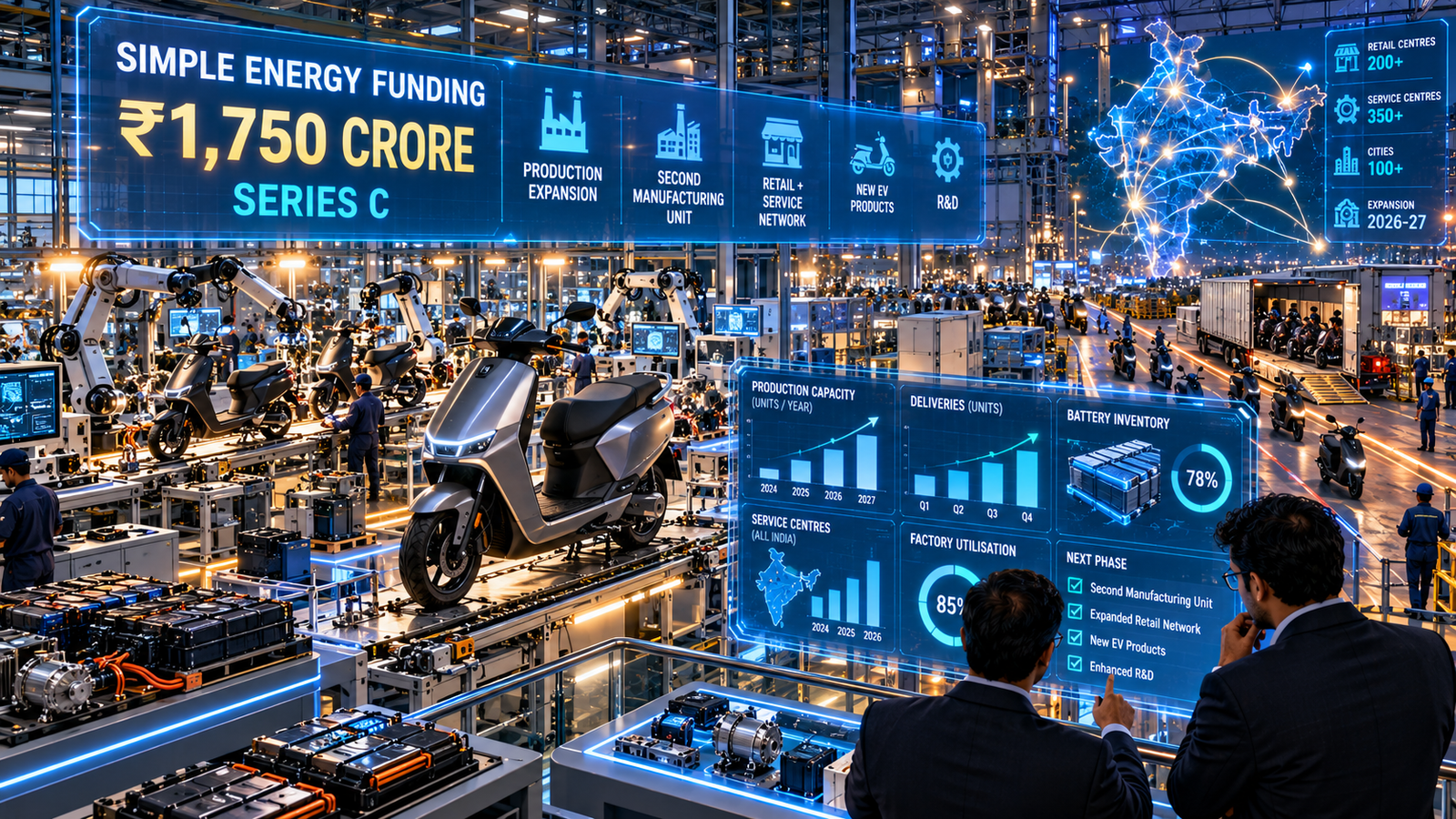
Simple Energy funding has reached a new scale.
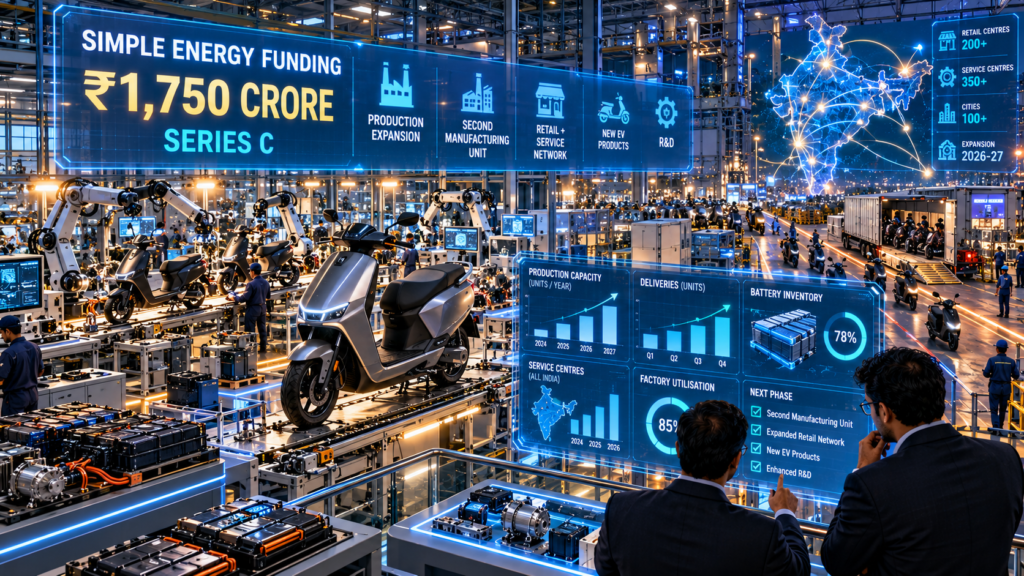
The Bengaluru-based electric two-wheeler manufacturer has raised ₹1,750 crore in Series C funding. The company plans to use the capital to increase production, expand its retail and service network, develop products and establish another manufacturing facility.
The round is significant for another reason.
Simple Energy is now moving from product development toward large-scale execution.
That changes the company’s central challenge.
The question is no longer whether it can build an electric scooter.
The question is whether it can manufacture, deliver and support those scooters at scale.
Simple Energy Funding Will Expand Manufacturing
Simple Energy funding will support a major manufacturing expansion.
The company plans to establish a second manufacturing unit while increasing production capacity. It also intends to expand its retail and service network across India.
This matters because EV manufacturing requires substantial working capital.
Companies need batteries, electronic components, motors, controllers and other parts.
They also need inventory.
Furthermore, they need service infrastructure after vehicles reach customers.
Therefore, scaling an EV company requires significantly more capital than simply launching a software product.
Why Simple Energy Funding Matters for India’s EV Market
India’s electric two-wheeler market has become increasingly competitive.
Dedicated EV startups compete with established automotive manufacturers.
Consequently, product quality is only one part of the competition.
Manufacturing reliability matters.
So does delivery speed.
Service coverage matters as well.
A customer buying an electric scooter expects access to spare parts and technicians after the sale.
Therefore, a large retail and service network can become an important competitive asset.
Simple Energy is using the new funding round to build precisely that infrastructure.
The Company Is Targeting Higher Production
Reports indicate that Simple Energy wants to significantly increase its monthly production capacity.
The company is also targeting expansion across India’s major markets.
That creates a new operating challenge.
Higher production only creates value if demand and distribution can keep pace.
A factory running below capacity can increase fixed costs per vehicle.
Meanwhile, aggressive expansion can create inventory pressure.
Therefore, Simple Energy’s next phase will depend on balancing manufacturing capacity with actual customer demand.
Simple Energy Funding Also Supports Product Expansion
The company is not limiting the new capital to manufacturing.
Simple Energy plans to expand its product portfolio and continue research and development.
That strategy reflects a wider shift in India’s EV market.
Consumers increasingly have more electric scooter choices.
Therefore, manufacturers need products for different price points and use cases.
A broader portfolio can help companies reach more customers.
However, it also increases engineering and supply-chain complexity.
That makes capital allocation important.
The IPO Question Is Emerging
Moneycontrol reported that Simple Energy is targeting an IPO in FY28 rather than immediately seeking another funding round.
If that plan continues, the next two years could become an important operating period.
Public-market investors will eventually examine production volumes, revenue, margins and cash requirements.
Consequently, the latest Simple Energy funding round gives the company capital.
The next stage requires measurable execution.
India’s EV Startup Race Is Moving Toward Scale
The first phase of India’s EV startup market focused heavily on technology and consumer adoption.
The next phase is different.
Manufacturing scale now matters more.
Distribution matters.
Service infrastructure matters.
Battery supply matters.
And capital efficiency matters.
Simple Energy funding illustrates this transition clearly.
A ₹1,750 crore round gives the company substantial resources to expand.
However, capital alone does not guarantee scale.
The company now needs to convert that capital into production, deliveries and customer support.
India’s electric mobility market is entering a more industrial phase.
The companies that can combine product technology with manufacturing execution will define the next stage.
Tags: Simple Energy Funding, ₹1750 Crore, EV Startup India, Electric Scooter India, EV Manufacturing, Series C Funding, Electric Mobility 2026
Author CTA: Follow Flairius News — sharp takes on startups, AI, business, real estate and India’s technology economy — flairiusnews.com
 Raghav Sharma
  Ahana Verma