 By Raghav Sharma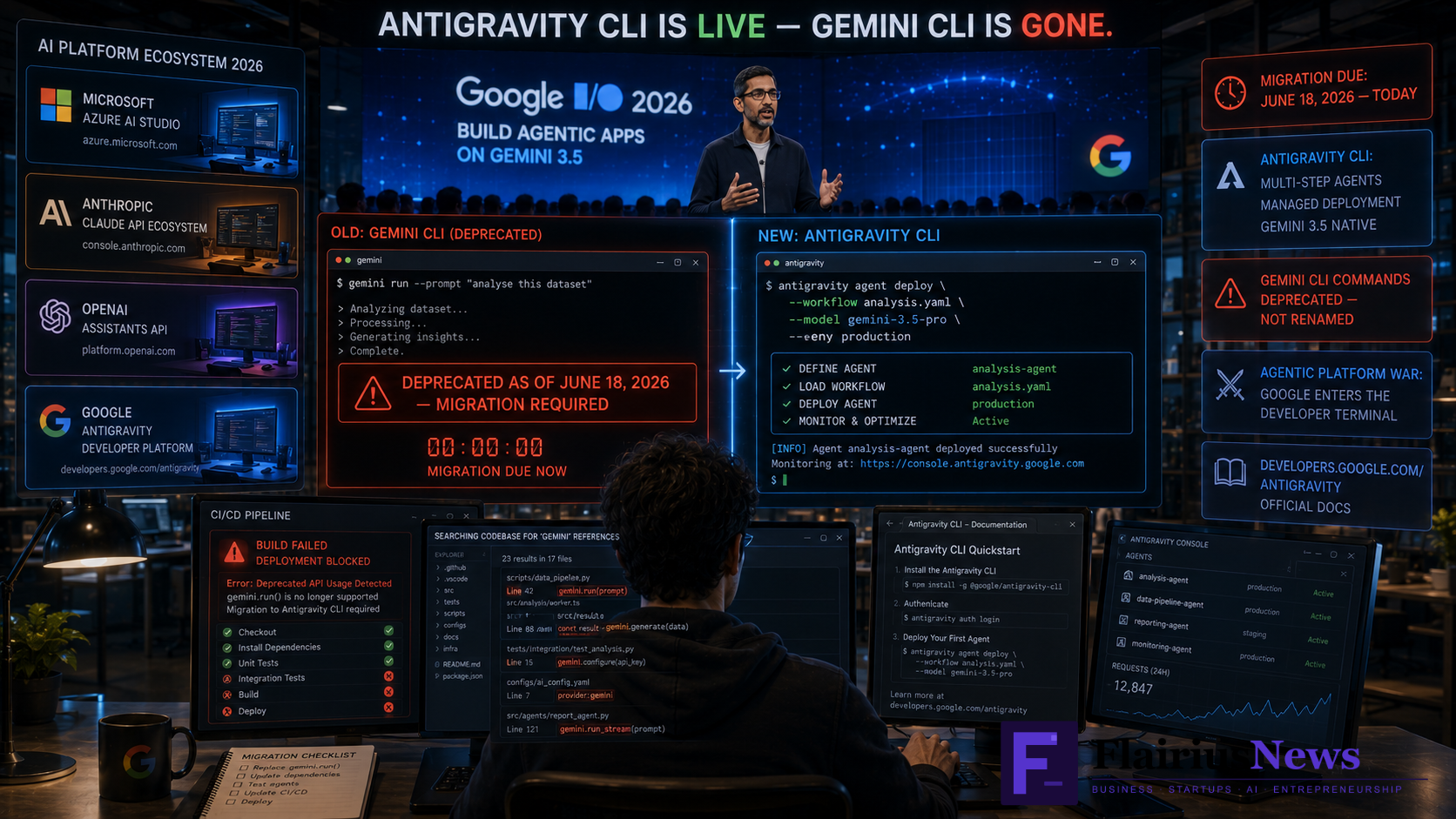
Today is the day Google’s Gemini CLI stops being the default. Furthermore, if you have built any workflow, CI/CD pipeline, or automated process around the Gemini CLI command set, you need to act right now.
Google confirmed in its Gemini 3.5 Pro launch guide published May 28, 2026 that the Antigravity CLI will replace the Gemini CLI on June 18, 2026. Specifically, that date is today. Therefore, developers who have not yet migrated to the Antigravity CLI will find their existing Gemini CLI-based workflows broken the moment Google completes the switchover.
The Antigravity CLI is not simply a renamed version of the Gemini CLI. Specifically, it is a fully redesigned command-line interface built for the Gemini 3.5 agentic model family with a new command structure, new authentication flow, new agent orchestration primitives, and a new managed deployment environment. Moreover, it is the entry point to Google’s broader Antigravity platform Google’s answer to the agentic AI development ecosystems that Microsoft, Anthropic, and OpenAI are each building in 2026.
What Antigravity Is and Why Google Built It
Antigravity is Google’s AI-assisted software development and vibe coding platform, launched at Google I/O 2026 alongside Gemini 3.5 Flash in May 2026. Specifically, it replaces the older ad-hoc Gemini API call pattern with a structured, integrated development environment that handles agentic application building, managed agent deployment, and multi-step AI workflow orchestration through a unified SDK and CLI.
Moreover, the platform targets a specific gap in Google’s developer ecosystem. Specifically, the previous Gemini CLI was designed for single-step API calls ask the model something, get a response. However, the Gemini 3.5 model family is built for multi-step agentic behaviour the model can plan, use tools, take actions, and iterate across a session. Therefore, the Gemini CLI’s architecture was fundamentally mismatched with the model’s actual capability. Consequently, Antigravity was built from scratch to express what Gemini 3.5 can actually do.
Additionally, the CLI migration is part of a broader platform consolidation. Specifically, Google is moving developers from independent API calls toward the Antigravity ecosystem app, CLI, managed agents, and SDK which provides a more integrated environment for building AI-native applications. Furthermore, this consolidation mirrors what Microsoft did with Azure AI Studio and what Anthropic did with the Claude API evolution: bring developers into a managed platform where Google controls the full stack.
What Breaks Today if You Have Not Migrated
If your workflow uses any of the following, it will break on June 18, 2026. Specifically, that includes: any script using gemini CLI commands directly, any CI/CD pipeline calling Gemini CLI endpoints, any application using the old Gemini CLI authentication token format, and any agent workflow built on the previous Gemini CLI command set without the Antigravity SDK upgrade.
Moreover, the migration is not automatic. Specifically, Google requires developers to install the Antigravity CLI separately, re-authenticate using the new OAuth flow for Antigravity, and update any command references from gemini to antigravity in their scripts. Furthermore, the command structure is not a one-to-one replacement several Gemini CLI commands have been consolidated, renamed, or replaced with higher-level Antigravity abstractions.
Therefore, for any developer or DevOps engineer reading this on June 18: stop, open your repository, search for gemini in your automation scripts, and begin the Antigravity CLI migration today. The official migration documentation is available at developers.google.com/antigravity.
What Antigravity Enables That Gemini CLI Could Not
Beyond the migration urgency, Antigravity represents a genuine capability upgrade. Specifically, it enables agentic application development in a way that the Gemini CLI never could. Specifically, developers can now define multi-step agent workflows declaratively, deploy them as managed agents with persistent memory, and connect them to tools, APIs, and data sources through the Antigravity SDK’s built-in integration library.
Furthermore, the platform’s connection to Gemini 3.5 Pro the upcoming flagship model means that agents built on Antigravity will automatically benefit from model capability improvements without requiring workflow redesign. Moreover, Antigravity’s managed deployment layer handles scaling, rate limiting, and session management removing infrastructure overhead that previously required separate orchestration tools.
Consequently, Google’s Antigravity is not just a developer tool migration. It is Google’s bid to become the default platform for agentic AI application development competing directly with Microsoft’s Azure AI Studio, Anthropic’s Claude API ecosystem, and OpenAI’s Assistants API. Therefore, the stakes of today’s CLI migration extend far beyond a command-line change. This is where the agentic AI platform war moves to the developer’s terminal.
Tags: Google Antigravity CLI, Gemini CLI Deprecated June 18 2026, Google AI Developer Tools, Gemini 3.5 Pro Migration, Google I/O 2026 Antigravity, Agentic AI Platform, Developer Migration Guide, Google Antigravity SDK, CI/CD AI Pipeline 2026, Vibe Coding Google Author CTA: Follow Flairius News — sharp takes on AI, business, and India’s startup economy — flairiusnews.com
 Aditya Agarwal