
 By Ahana Verma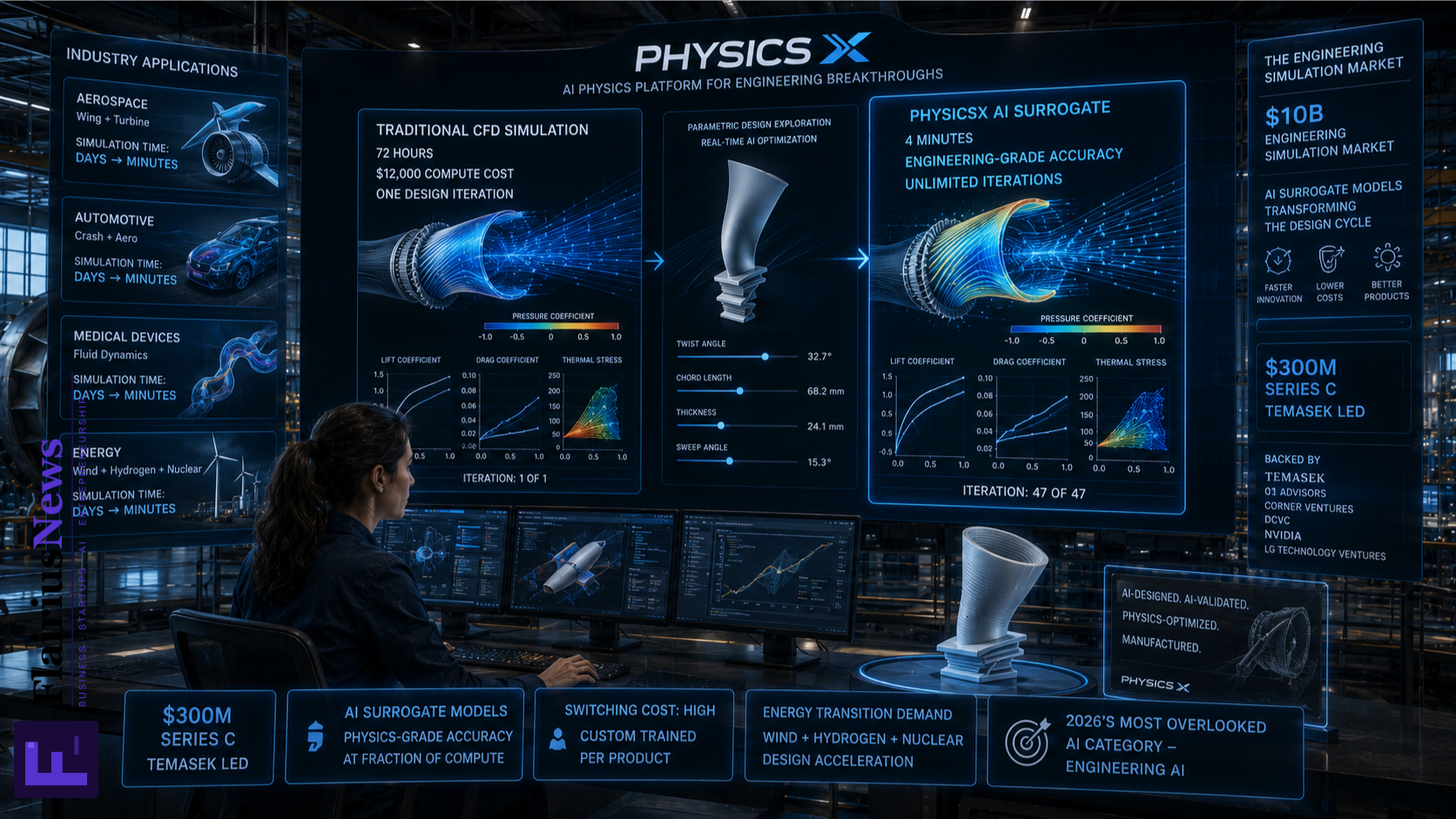
Every week, the AI startup headlines celebrate another chatbot, coding tool, or enterprise workflow platform. However, the most technically extraordinary AI companies of 2026 are not building products you can type into. Furthermore, they are simulating the physical world and doing it faster than classical physics ever allowed.
PhysicsX just raised $300 million in a Series C led by Temasek Singapore’s sovereign wealth fund and one of the world’s most selective technology investors. Specifically, PhysicsX builds AI-powered physics simulation tools for engineering teams in aerospace, automotive, medical devices, and energy. Moreover, its platform does not replace physics. Instead, it accelerates physics using AI surrogates to simulate complex fluid dynamics, structural mechanics, thermal systems, and electromagnetic interactions orders of magnitude faster than traditional simulation software.
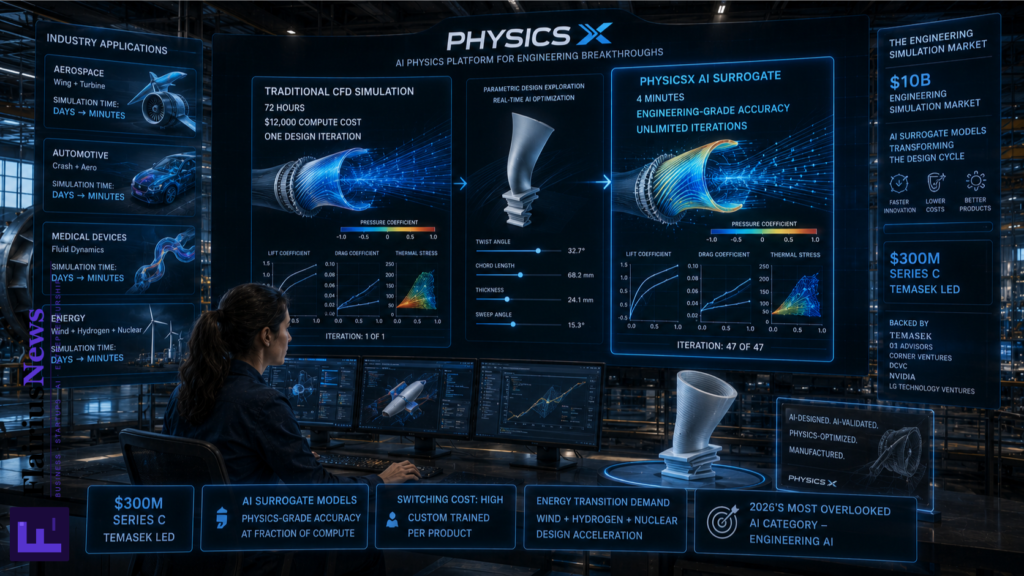
For engineers who have spent their careers waiting days for a Computational Fluid Dynamics (CFD) simulation to complete, PhysicsX offers something genuinely transformative. Specifically, the same simulation that previously required 72 hours of high-performance computing can now be completed in minutes enabling iterative design testing at a speed that was physically impossible before AI simulation existed.
What PhysicsX Has Built That Traditional Simulation Cannot
Traditional engineering simulation tools ANSYS, Siemens NX, COMSOL use finite element methods and computational fluid dynamics algorithms that are mathematically rigorous but computationally expensive. Specifically, high-fidelity simulations of a turbine blade, a vehicle aerodynamics model, or a drug delivery device can require thousands of CPU hours and days of wall-clock time. Moreover, the cost of that compute limits how many design iterations an engineering team can test before the product moves to physical prototyping.
PhysicsX’s AI surrogate models break this constraint. Specifically, by training AI models on the outputs of high-fidelity simulations, PhysicsX builds surrogate models that approximate the physics with engineering-grade accuracy while requiring a fraction of the compute. Furthermore, these surrogates update in real time as a designer adjusts parameters creating an interactive simulation experience where an aerospace engineer can test a wing shape change and see the aerodynamic response in seconds rather than days.
Additionally, the accuracy claim is central to adoption. Specifically, PhysicsX’s models are not fast approximations that sacrifice precision. Instead, they are calibrated against high-fidelity simulation data to maintain engineering-grade accuracy across the parameter space they are trained on. Therefore, an aerospace engineer using PhysicsX can trust the results enough to advance a design to physical testing a bar that previous fast simulation approaches could not reliably meet.
Who Is Buying PhysicsX and Why
PhysicsX’s customer base spans the engineering industries where simulation time directly translates to product development cost. Specifically, aerospace companies use it to accelerate aerodynamic design iteration for aircraft components and spacecraft systems. Moreover, automotive OEMs use it to speed up crash simulation, thermal management, and aerodynamics testing during the design phase. Additionally, medical device companies use it for fluid dynamics modelling in drug delivery systems and cardiovascular implant design.
Furthermore, the energy sector represents one of the largest near-term opportunities. Specifically, the energy transition is driving enormous engineering demand from wind turbine blade optimisation to hydrogen fuel cell thermal management to next-generation nuclear reactor design. Moreover, each of these engineering challenges involves physics simulations where faster iteration directly translates to faster product development and lower capital expenditure.
The $300 million Temasek-led round reflects a specific conviction: the engineering simulation market currently valued at approximately $10 billion annually and growing will be fundamentally transformed by AI surrogates over the next five years. Furthermore, the companies that establish trusted, engineering-grade AI simulation platforms now will capture the bulk of that transformation. Consequently, PhysicsX is not a bet on a niche technical product. It is a bet on the AI platformisation of the entire engineering design cycle.
Image
Why Engineering AI Is 2026’s Most Overlooked Category
PhysicsX sits in a category engineering AI that receives less media attention than consumer AI, coding AI, or enterprise workflow AI. However, its commercial and strategic importance may ultimately exceed all of them. Specifically, the industries PhysicsX serves aerospace, automotive, energy, medical devices collectively represent trillions of dollars in annual R&D expenditure and product development investment.
Furthermore, the switching cost once a PhysicsX surrogate model is embedded in an engineering design workflow is extremely high. Specifically, engineers train the AI model on their specific product geometry, material properties, and operating conditions creating a custom simulation capability that is deeply integrated with their particular design workflow. Therefore, the product creates long-term, high-retention enterprise relationships rather than the month-to-month subscription dynamics of consumer AI tools.
Therefore, if you want to understand where AI is genuinely transforming industries in 2026 not augmenting them, but fundamentally changing what is possible watch PhysicsX, not ChatGPT.
Tags: PhysicsX, $300M Series C, Temasek AI Investment, AI Physics Simulation, Engineering AI 2026, CFD AI Surrogate Models, Aerospace Automotive AI, Deep Tech AI Startup, PhysicsX Freiburg, AI Engineering Design 2026 Author CTA: Follow Flairius News — sharp takes on AI, business, and India’s startup economy — flairiusnews.com
 Nayra Roy
  Aditya Agarwal