
 By Aditya Agarwal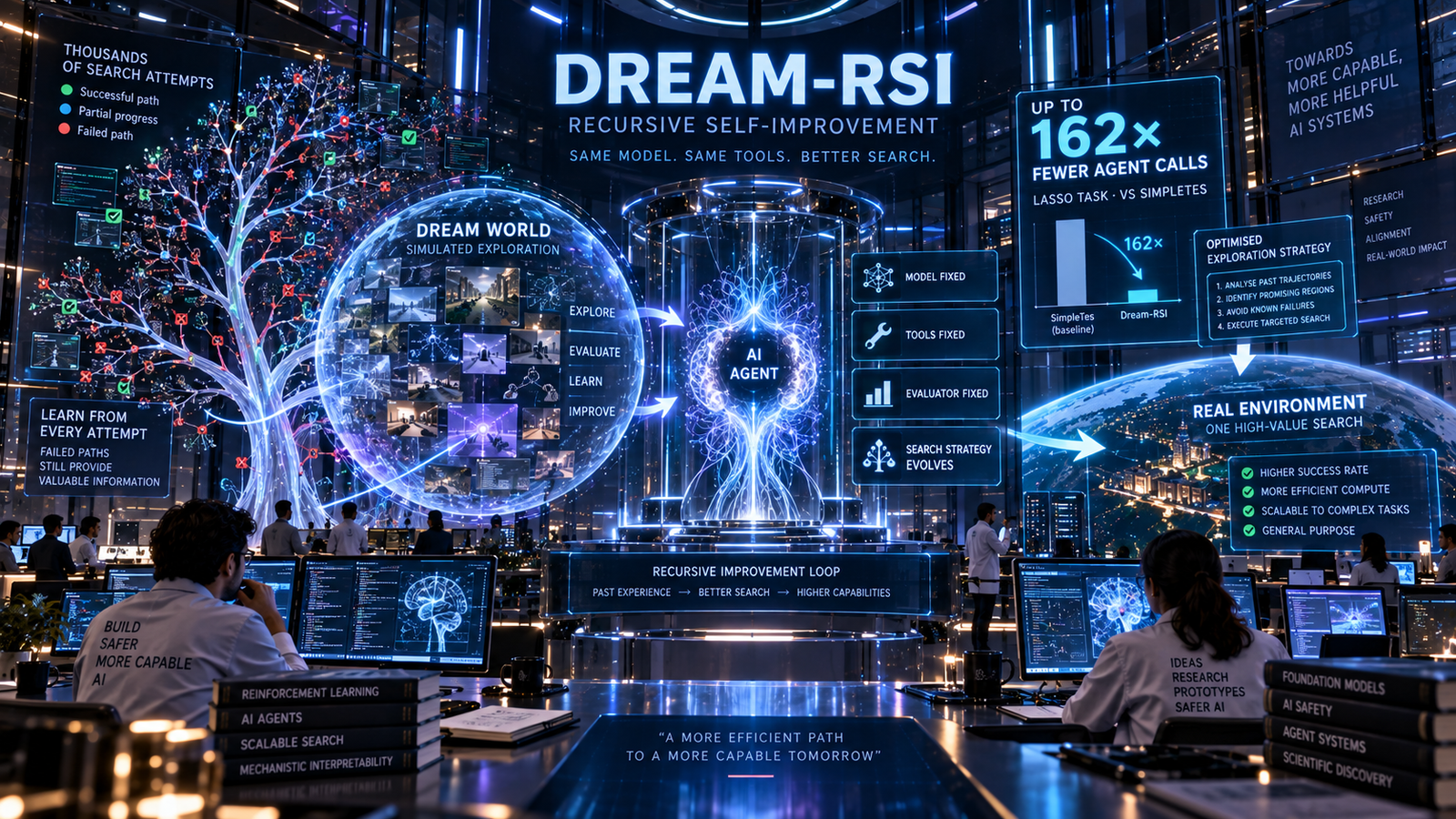
Google DeepMind researchers have introduced a new approach to one of AI’s most important problems:
How can an AI system become better at solving problems without simply making the underlying model bigger?
The answer is Dream-RSI, short for Recursive Self-Improvement through Evolving Worlds.
The research was posted to arXiv on September 14, 2026.
Importantly, Dream-RSI is not a new foundation model.
Instead, it is a framework for improving how AI agents explore problems.
The system keeps the underlying model, evaluator and tools fixed while changing the strategy used to search for solutions. (Venturebeat)
What Is Dream-RSI?
AI agents often need to explore many possible solutions.
That exploration can become expensive.
An agent may repeat paths that have already failed.
Consequently, large numbers of model calls can be wasted.
Dream-RSI approaches the problem differently.
The system records previous exploration.
Then, it uses those records as a kind of simulated environment.
New exploration strategies can be tested against that history before the agent uses them in the real world. (CellCog)
The Important Difference
Traditional AI improvement often focuses on the model itself.
Researchers may train larger models.
They may add more data.
They may also improve the model’s reasoning capabilities.
Dream-RSI focuses on another layer.
It improves the search strategy.
Therefore, the underlying AI does not necessarily need to change.
The system instead asks:
What is the smartest way for the agent to explore?
The 162× Number
One result has attracted significant attention.
On a Lasso solver task, Dream-RSI used up to 162 times fewer discovery-agent calls than SimpleTES, one of the comparison baselines. (Venturebeat)
That number needs context.
It does not mean AI became 162 times more intelligent.
Instead, it refers to a reduction in the number of costly agent calls required in that experimental comparison.
Against another fixed-exploration baseline, the reduction was much smaller.
Therefore, the benchmark and baseline matter when interpreting the result.
Why Search Efficiency Matters
AI agents can consume substantial computing resources.
Every additional search branch can require model calls.
Every failed experiment can consume tokens and compute.
Consequently, better exploration strategies could reduce the cost of advanced AI systems.
That becomes increasingly important as agents take on more complex tasks.
What Remains Fixed?
This is one of the most interesting parts of the research.
Dream-RSI does not simply modify the model’s weights.
According to descriptions of the paper, the underlying models, evaluators and execution interfaces remain fixed.
The system instead evolves the exploration-policy code. (CellCog)
The experiments used Gemini models through the Gemini CLI.
Therefore, the research is better understood as recursive improvement of the agent’s strategy, rather than conventional model training.
Why This Could Matter for AI Agents
AI agents are increasingly being designed to perform long tasks.
Coding is one example.
Research is another.
Scientific discovery could eventually become another major application.
In all these cases, exploration matters.
An agent needs to decide which path to investigate next.
Therefore, improving the search strategy could become as important as improving the model.
Is This Full Recursive Self-Improvement?
The phrase needs careful interpretation.
Dream-RSI demonstrates a form of recursive improvement.
However, it does not mean that an AI system is independently redesigning its entire intelligence.
The model itself remains fixed in the reported setup.
Instead, the system improves the strategy that controls exploration.
That distinction is crucial.
What Comes Next
The research raises a bigger question.
If AI agents can learn better ways to explore using records of their previous attempts, similar methods could potentially be applied to increasingly complex environments.
That could include software engineering.
It could also include mathematical discovery.
Eventually, researchers may explore whether similar strategies can optimise scientific research or autonomous experimentation.
However, those applications remain future possibilities.
The current research demonstrates a more specific result.
AI can improve the way it searches without necessarily changing the model doing the searching.
That may become an important building block for more efficient AI agents.
The next AI breakthrough may not always be a bigger model.
Sometimes, it may be a smarter way for the model to decide what to try next.
Tags: Google Dream-RSI, Google DeepMind, Recursive Self Improvement, AI Agents, Gemini, AI Research 2026, Self Improving AI
Author CTA: Follow Flairius News — sharp takes on AI, business, and India’s startup economy.
 Raghav Sharma
  Ahana Verma