
 By Aditya Agarwal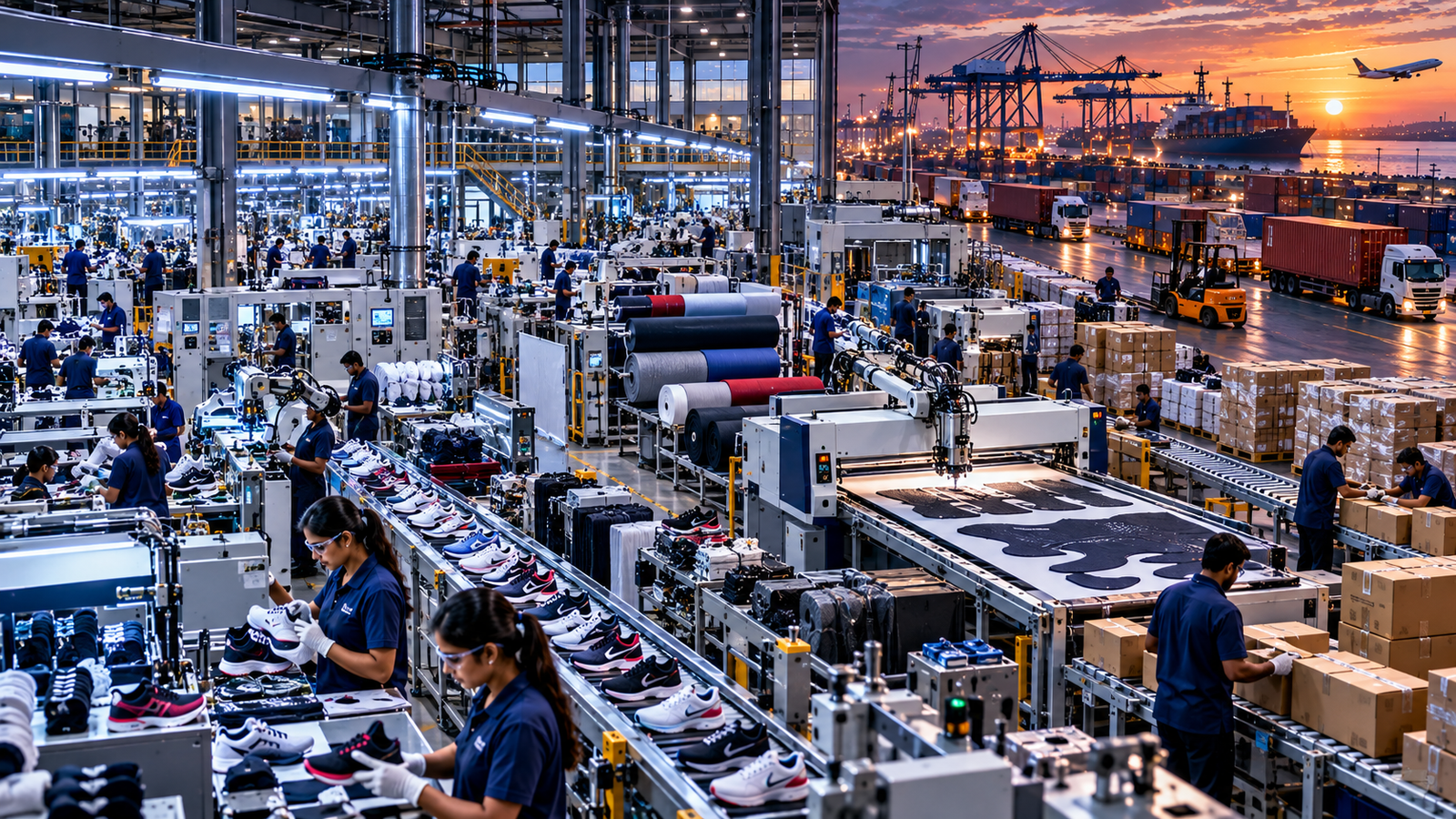
Decathlon expands its India manufacturing strategy
Decathlon is increasing its manufacturing commitment in India as the sports retailer looks to combine domestic demand with export opportunities.
Decathlon Sports India is investing €100 million to build and strengthen its manufacturing ecosystem in the country.
The company reported revenue of ₹4,133.10 crore in FY25. Meanwhile, its Indian business is currently growing at a rate slightly above double digits, according to CEO Sankar Chatterjee. (Business Standard)
The investment comes as Decathlon seeks to increase the share of products made in India.
Chatterjee said around 50% of the quantity sold in Decathlon’s Indian stores this year is Made in India.
That represents a significant change in the company’s operating model.
Instead of treating India primarily as a retail market, Decathlon is increasingly using the country as a manufacturing base.
Manufacturing is moving beyond basic products
The company’s manufacturing strategy is also becoming more sophisticated.
Footwear is one of the major focus areas.
Decathlon is investing in manufacturing technology and talent, including product managers and engineers, to strengthen its capabilities.
That matters because footwear requires more than simple assembly.
Design, materials, tooling, testing and quality control all influence the final product.
Therefore, deeper local manufacturing can potentially give Decathlon greater control over the supply chain.
It can also create opportunities for exports.
The company is watching the India-European Union trade relationship closely because lower trade barriers could affect the economics of manufacturing sports products in India. (Business Standard)
For Indian suppliers, this could create additional opportunities if global brands expand sourcing from the country.
Running becomes a major growth category
Decathlon is simultaneously targeting India’s expanding running market.
The company currently generates slightly less than ₹500 crore from its running segment.
It expects that business to reach more than ₹1,000 crore within four years.
The company has also introduced its Kiprun running brand more aggressively in India.
This year, Decathlon plans to introduce 35 new running products, including 17 high-performance running shoes. (Business Standard)
The strategy reflects a broader change in Indian consumer behaviour.
Running has moved beyond a niche sporting activity.
Large numbers of organised running events are creating a wider ecosystem around shoes, apparel, wearable technology and training.
According to Decathlon, India hosted around 2,000 running events in 2025, compared with roughly 500–600 in 2018. (Business Standard)
That growth gives specialised sports brands a larger addressable market.
Store expansion continues
Manufacturing is only one part of Decathlon’s India strategy.
The retailer currently operates 132 stores.
It is targeting 200 stores by 2030, with more than half a dozen new outlets expected in the next quarter. (Business Standard)
The company is also expanding outside India’s traditional metropolitan markets.
Decathlon recently opened its first store in Guwahati.
It is also developing wholesale and reseller relationships across the Northeast, including Shillong and other cities.
That approach can help the company reach consumers without relying entirely on large-format stores.
India becomes both market and supply chain
Decathlon’s strategy highlights an important development in India’s consumer economy.
International brands increasingly have two reasons to build operations in the country.
The first is India’s large consumer base.
The second is its potential as a manufacturing and export hub.
Those two opportunities can reinforce one another.
A larger domestic market can support local factories.
Meanwhile, export demand can improve manufacturing scale.
However, building a deeper manufacturing ecosystem requires long-term investment.
Suppliers need equipment.
Workers need specialised skills.
Quality systems must meet international standards.
Logistics also need to remain competitive.
Therefore, the €100 million investment should be viewed as part of a broader supply-chain strategy rather than simply a retail expansion.
The larger business signal
Decathlon’s India strategy illustrates how global companies are reassessing the role of the country in their supply chains.
The company is simultaneously increasing stores, expanding product categories and strengthening domestic manufacturing.
That creates a three-part growth model.
Retail creates demand. Manufacturing creates supply capability. Exports can potentially add scale.
The success of that model will depend on execution and cost competitiveness.
For now, however, Decathlon’s investment signals that India is becoming more important to the company’s global manufacturing strategy.
And for Indian suppliers, the expansion could create opportunities well beyond sports retail.
Tags: Decathlon India, manufacturing, sports retail, Made in India, Indian business, footwear manufacturing, retail expansion
Flairius CTA: Follow Flairius News — sharp takes on AI, business, and India’s startup economy — flairiusnews.com