
 By Aditya Agarwal
Two projects add fresh residential supply
Prestige Estates Projects is expanding its Bengaluru residential portfolio with two new housing developments carrying a combined revenue potential of ₹2,850 crore.
The projects together include 2,443 homes across roughly 22 acres.
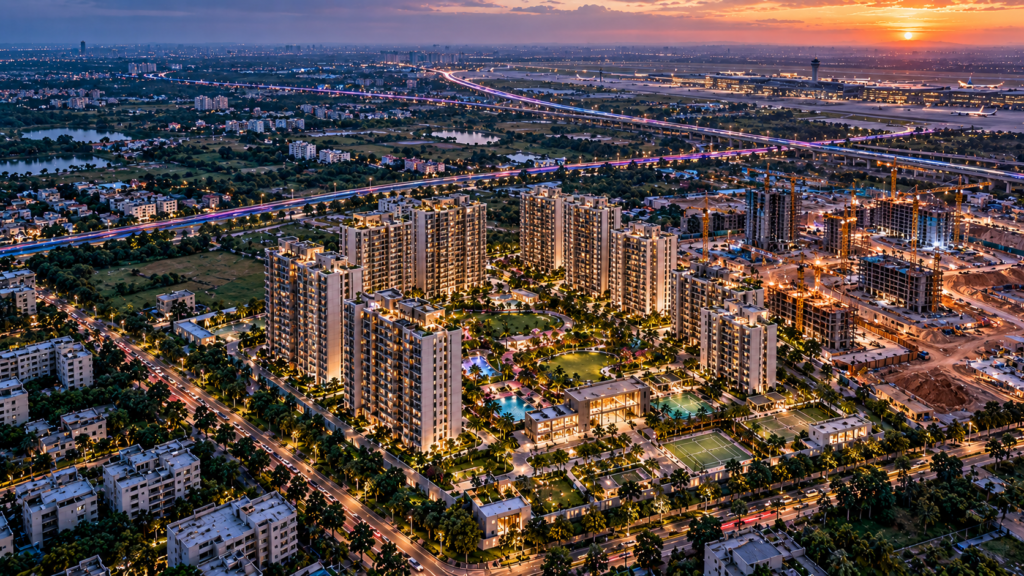
The largest development is Prestige Parklane in Devanahalli.
It occupies 12 acres and includes 1,788 residences. The project has approximately 1.7 million square feet of saleable area and an estimated revenue potential of ₹1,750 crore. (The Economic Times)
The second project covers 10 acres.
It includes 655 premium apartments with approximately 0.93 million square feet of saleable area.
The company estimates revenue potential of ₹1,100 crore from that development.
Devanahalli remains strategically important
The location of Prestige Parklane is significant.
Devanahalli sits in northern Bengaluru and has become an important development zone as the city expands beyond its established central corridors.
The area’s growth has been supported by its proximity to Bengaluru’s airport and major transport infrastructure.
That has encouraged residential and commercial development.
However, large housing launches also depend on sustained demand.
Developers therefore need to balance land acquisition, construction timelines, pricing and absorption.
For buyers, the location story is equally important.
Infrastructure can influence commuting patterns, employment access and long-term residential demand.
Yet the impact varies significantly by micro-market.
Premium housing remains a major developer focus
The second project’s positioning as a premium residential development reflects another feature of Bengaluru’s housing market.
Developers continue to target buyers seeking larger homes, better amenities and established brand credentials.
This segment can offer higher ticket sizes.
However, premium housing also requires careful demand assessment.
The market cannot be evaluated only through headline sales potential.
Developers must convert inventory into actual bookings and collections.
Therefore, the ₹2,850 crore figure should be understood as estimated revenue potential rather than realised revenue.
That distinction is important for readers and investors.
Prestige enters the expansion with a large existing portfolio
Prestige Estates said that, as of June 2026, the group had delivered 319 projects covering 216 million square feet.
Its portfolio spans residential, commercial, retail, hospitality and integrated township developments. (The Economic Times)
The new projects therefore add to an established development platform rather than representing an isolated market entry.
That can provide advantages in procurement, project management and brand recognition.
Nevertheless, execution remains critical.
Construction costs, financing conditions, labour availability and regulatory approvals can all affect project economics.
Bengaluru’s housing equation is changing
Bengaluru continues to attract technology companies, global capability centres and high-skilled workers.
That creates structural demand for housing.
At the same time, the city faces infrastructure constraints and long commuting distances.
As a result, development is increasingly spreading into peripheral corridors.
This creates both opportunities and risks.
New residential projects can bring supply closer to emerging employment and infrastructure nodes.
However, their success depends on whether supporting roads, public transport, schools and services develop at a comparable pace.
For buyers, therefore, the project itself is only one part of the decision.
The surrounding urban ecosystem matters just as much.
What the launch says about India’s housing market
The two projects illustrate how large developers are continuing to commit capital to residential supply.
They also show the importance of premium and upper-middle housing in current development strategies.
At the same time, the broader affordability challenge remains.
Higher land and construction costs can make new homes increasingly expensive.
That creates a gap between strong developer demand and the needs of first-time buyers.
The next stage of Bengaluru’s property cycle will therefore depend not only on new launches but also on affordability, infrastructure and actual absorption.
Prestige’s latest projects add significant supply.
The more important question will be how quickly that supply is converted into sustainable demand.
Tags: Prestige Estates, Bengaluru real estate, Devanahalli, housing, property market, residential projects, real estate India
Flairius CTA: Follow Flairius News — sharp takes on AI, business, and India’s startup economy — flairiusnews.com