
 By Aditya Agarwal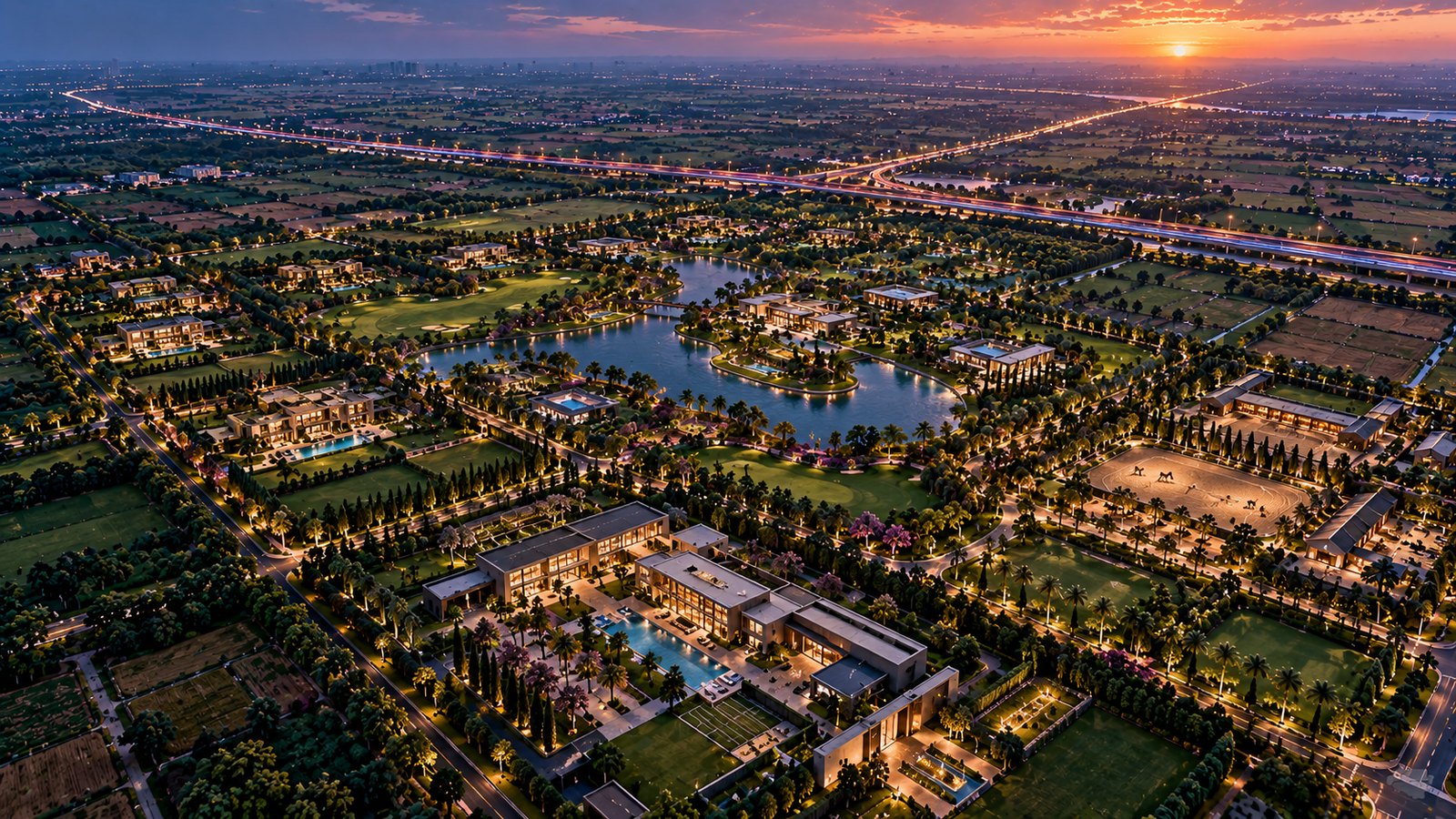
Signature Global expands into Gurugram West
Signature Global is expanding its presence in Gurugram with a major residential development in Farrukhnagar.
The developer has secured and partnered for a combined 194.22 acres of land.
The planned project is positioned as an ultra-luxury farmhouse villa destination.
The company estimates a gross development value of ₹5,500–6,000 crore.
The development has approximately 6.77 million square feet of developable potential. (The Economic Times)
The land is structured through two arrangements.
Signature Global has acquired 25 acres for ₹150 crore.
It has also entered a collaboration agreement covering another 169.22 acres. (The Economic Times)
Why Farrukhnagar is attracting developers
Farrukhnagar has become increasingly relevant to Gurugram’s western expansion.
The area offers access to major transport corridors, including the Dwarka Expressway and KMP Expressway.
That connectivity is important for large-scale residential development.
Gurugram’s traditional premium residential markets have become increasingly expensive.
Developers are therefore exploring larger land parcels on the city’s expanding edges.
Those locations can support lower-density developments that are difficult to build in established urban districts.
However, peripheral development comes with its own requirements.
Infrastructure must expand alongside housing.
Roads, utilities, schools, healthcare and commercial services influence the attractiveness of a new residential destination.
The project targets a different housing format
Signature Global is not describing the development as a conventional apartment project.
Instead, it is positioning the development around luxury farmhouse villas and low-density living.
That reflects a segment of India’s housing market that has expanded alongside rising high-net-worth wealth.
Affluent buyers increasingly seek larger homes with private outdoor areas.
The pandemic also strengthened interest in space and low-density living.
However, the segment remains relatively narrow compared with mainstream housing.
Consequently, developers must carefully match supply with demand.

Signature Global enters with a stronger balance sheet
The company has been expanding while reducing leverage.
Signature Global reported that its net debt declined 77% during FY26, from ₹880 crore to ₹200 crore.
It also reported ₹2,522 crore in cash and cash equivalents as of June 30, 2026.
Around ₹1,700 crore of that amount was held in RERA and escrow accounts. (The Economic Times)
These figures provide context for the company’s land strategy.
Large land acquisitions require substantial capital.
A stronger balance sheet can provide more flexibility.
At the same time, developers must avoid overcommitting capital before projects generate cash flows.
Sales momentum remains significant
Signature Global reported ₹8,250 crore in sales bookings during FY2025–26.
It recorded ₹1,970 crore in bookings during the first quarter of the current fiscal year.
The company said it had delivered 19.2 million square feet of real estate.
It currently has 45 projects under development covering more than 320 lakh square feet.
Nearly four-fifths of that development area has already been sold, according to company figures reported by The Economic Times. (The Economic Times)
These numbers show why the developer is increasing its land pipeline.
However, bookings are not identical to revenue.
Developers still need to execute projects and collect payments.
Therefore, project delivery remains a critical part of the business model.
Land strategy becomes increasingly important
Signature Global had earmarked ₹1,200–1,500 crore for land acquisitions in FY27.
That is more than double its spending in the previous year.
The company said land prices had become more attractive in some areas following changes in the property market. (The Economic Times)
For developers, timing land purchases can significantly influence project economics.
Buying too early can lock capital into unproductive assets.
Waiting too long can increase acquisition costs.
The challenge is identifying corridors where infrastructure and demand are likely to develop together.
What the Gurugram expansion signals
The Farrukhnagar project reflects the continuing outward expansion of Gurugram.
As established districts become denser and more expensive, developers are searching for larger parcels on the metropolitan edge.
That process can reshape the geography of the NCR.
It can also create new residential nodes.
However, the long-term value of those nodes depends heavily on infrastructure.
For Signature Global, the project represents a substantial land and development opportunity.
For Gurugram, it is another indication that the city’s real estate growth is moving westward.
The next phase will depend on approvals, construction, infrastructure delivery and actual buyer absorption.
Tags: Signature Global, Gurugram, Farrukhnagar, real estate India, luxury housing, Haryana property, NCR real estate
Flairius CTA: Follow Flairius News — sharp takes on AI, business, and India’s startup economy — flairiusnews.com