
 By Aditya Agarwal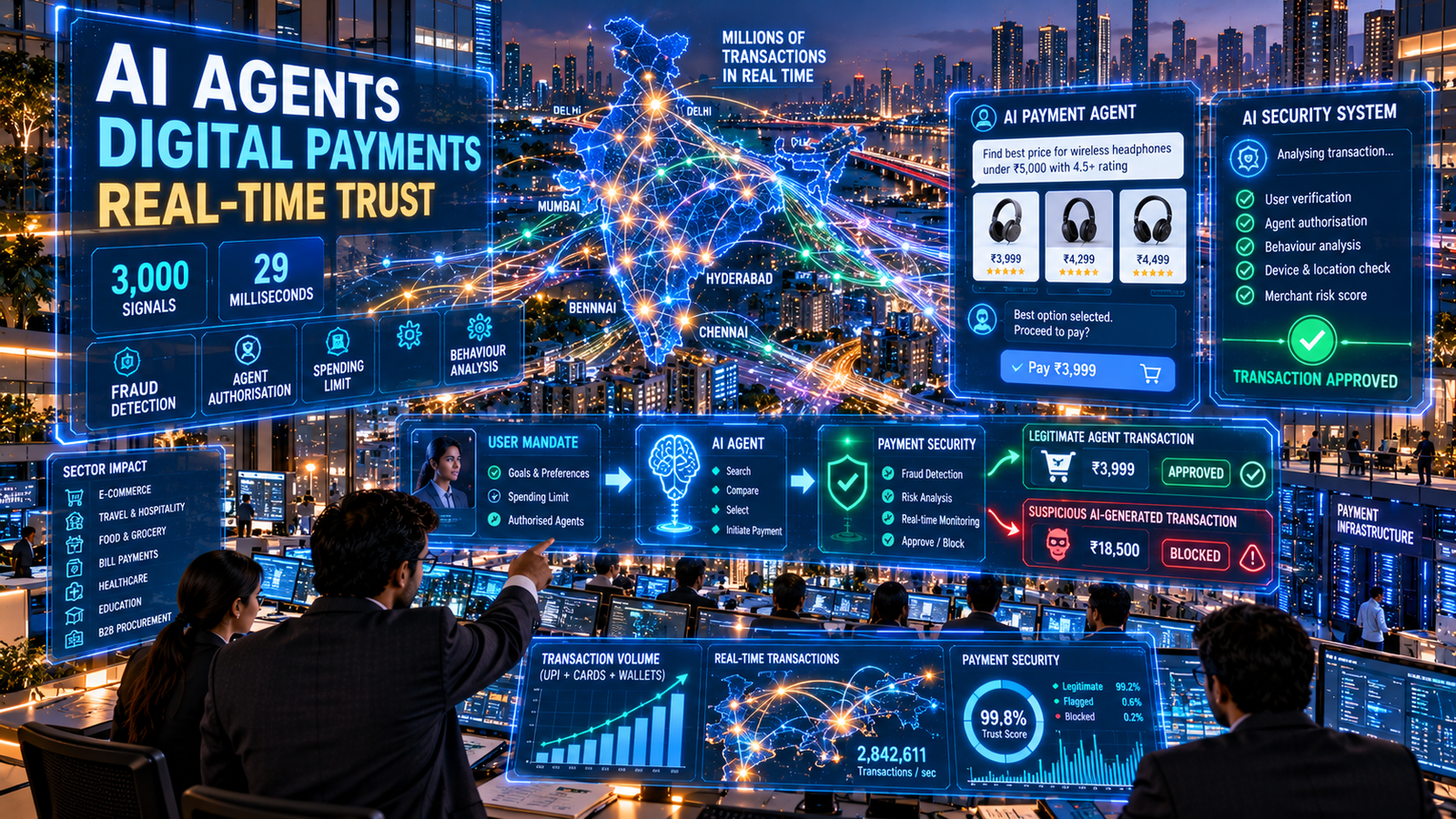
The next major change in India’s digital payments ecosystem may not come from faster transactions.
It may come from AI agents digital payments systems that allow software to make purchases on behalf of users.
Indian payments are already almost instantaneous. Now, the challenge is determining whether an automated transaction is legitimate, authorised and consistent with the customer’s behaviour.
Moneycontrol’s latest AI Edge analysis highlights this emerging security problem.
AI is already being used by payment companies to assess transactions in real time. However, agentic payments introduce a fundamentally different challenge because legitimate transactions themselves will increasingly look automated.
Consequently, payment security may need to evolve from detecting automation to understanding intent.
AI Agents Digital Payments Create a New Security Problem
Traditional fraud systems rely heavily on predefined signals.
A new device can trigger a warning.
An unusual location can trigger another.
A large transaction or sudden change in spending behaviour can also raise an alert.
However, those signals become harder to interpret when an AI agent is legitimately acting for the customer.
Imagine a user instructing an AI agent to purchase an airline ticket.
The agent searches different websites, compares prices and completes the transaction.
From the payment system’s perspective, the behaviour is automated.
Yet the transaction is legitimate.
Therefore, payment companies need to determine not only whether automation is present.
They must determine whether the automation is authorised.
AI Is Already Being Used to Detect Fraud
Payment companies are already moving beyond simple rule-based fraud detection.
Moneycontrol reported that AI systems can combine thousands of behavioural signals to determine whether a transaction makes sense for an individual customer.
Razorpay’s payments foundation model, Vulcan, reportedly uses around 3,000 signals for each transaction and is designed to make decisions in approximately 29 milliseconds.
That illustrates how quickly payment risk analysis is evolving.
Instead of asking whether a single event looks suspicious, AI can examine the broader context.
For example, it can consider device behaviour, transaction history, location and other signals together.
As a result, the system can make a more contextual risk assessment.
Fraudsters Are Using AI Too
The security race has another side.
Fraudsters can also use artificial intelligence.
AI can help generate convincing identities. It can automate attacks. It can also produce realistic documents and social-engineering content.
Consequently, both sides of the payments ecosystem are becoming faster.
A BioCatch survey cited by Moneycontrol found that 95% of Indian banking and financial executives were concerned about the increasing speed of fraud. Nearly 66% identified scams through instant-payment systems as the primary source of rising fraud.
Therefore, payment security cannot simply rely on slower manual reviews.
The detection system must operate at the same speed as the payment itself.
Agentic Payments Change the Definition of Trust
The next stage is more complicated.
An AI agent could receive permission to spend money within a defined limit.
For example, a customer might allow an agent to spend ₹20,000 on travel.
The agent could then search, compare and purchase automatically.
But what happens if the agent is compromised?
What happens if it attempts to spend more than the approved amount?
More importantly, how does the payment system know that the request still represents the customer’s intention?
These questions create a new layer of financial security.
Payment companies will need to understand the relationship between the customer, the AI agent and the transaction.
AI Will Have to Protect AI
The most important development may be the emergence of AI systems that supervise other AI systems.
Moneycontrol’s analysis suggests that payment systems and AI agents may eventually need to communicate with each other in real time.
Suppose an agent has permission to spend ₹20,000.
The payment system needs to know whether the transaction falls within that mandate.
If the agent suddenly behaves differently, another AI system may need to determine whether the request should be blocked.
Consequently, payment security could become an AI-to-AI decision process.
The customer may not even see the payment happening.
The transaction could become almost invisible.
India’s Payment Infrastructure Is Entering a New AI Era
India already has one of the world’s most advanced instant-payment ecosystems.
The next challenge is therefore not simply increasing transaction speed.
It is creating trust around autonomous transactions.
AI agents could eventually book flights, order products, pay bills and manage recurring purchases.
However, that convenience will only work if payment systems can distinguish authorised automation from malicious automation.
Therefore, the future of digital payments may depend on a new security architecture.
AI agents will make payments.
Other AI systems may have to protect those payments.
The result could be a financial ecosystem where AI does not simply move money faster — it decides when money should move at all.
Tags: AI Agents Digital Payments, Agentic Payments, AI Payments India, UPI Security, AI Fraud Detection, Digital Payments India, Fintech AI, Payment Security
Author CTA: Follow Flairius News — sharp takes on AI, business, real estate, entrepreneurship and India’s technology economy — flairiusnews.com
 Ahana Verma
  Raghav Sharma