
 By Aditya Agarwal
Adani Enterprises and US-based engineering and manufacturing company Jabil have signed a non-binding memorandum of understanding to establish a 50:50 joint venture focused on manufacturing and assembling artificial intelligence and data centre equipment in India. The proposed partnership could strengthen domestic capabilities as demand for computing infrastructure expands. The Economic Times reported the development on 14 October 2026. (The Economic Times)
The announcement reflects a broader shift in the AI industry: building advanced artificial intelligence requires not only models and software but also physical infrastructure capable of supporting intensive computing workloads.
AI Data Centre India Expansion Gains Momentum
The proposed AI data centre India partnership aims to develop domestic manufacturing capabilities for equipment used in AI and data centre infrastructure.
Adani Enterprises brings experience in infrastructure development, while Jabil contributes engineering, supply-chain and manufacturing capabilities.
The companies have signed a non-binding agreement, meaning the proposed joint venture should not be treated as a completed operating business. Its implementation will depend on subsequent agreements and other requirements. (The Economic Times)
If established, the venture could support the production and assembly of equipment needed by data centre operators and other technology infrastructure businesses.
Why AI Requires More Physical Infrastructure
Modern AI systems require substantial computing resources to train models and serve users.
This demand places requirements on servers, electrical equipment, cooling systems, network connections and other infrastructure.
Data centres must manage high power consumption while maintaining reliable operation and controlling heat.
As companies deploy larger AI workloads, the equipment supporting these systems becomes increasingly important.
Domestic manufacturing could help India develop capabilities in selected parts of this supply chain.
However, manufacturing individual components does not mean a country has become fully self-sufficient in advanced AI hardware. Some components and technologies may continue to depend on international suppliers.
Adani and Jabil Bring Different Capabilities
The proposed venture combines two different areas of expertise.
Adani Enterprises operates across infrastructure and related businesses, while Jabil provides engineering and manufacturing services for customers in multiple industries.
The partnership could combine infrastructure development with manufacturing processes and supply-chain management.
Such a combination may help address the practical requirements of producing equipment at commercial scale.
However, the commercial value of the partnership will depend on its final scope, manufacturing capabilities, customer demand and the economics of producing equipment in India.
What Domestic AI Hardware Manufacturing Could Mean
Expanding domestic production of data centre equipment could create opportunities for component suppliers, engineering firms and specialised manufacturers.
It could also support the development of technical skills in electronics manufacturing, industrial automation and infrastructure engineering.
For technology companies, a more developed domestic supply chain may provide additional sourcing options.
However, AI hardware manufacturing remains technically demanding. Companies must meet strict reliability requirements, manage component availability and compete on cost and performance.
The ability to attract customers will depend on whether locally manufactured equipment meets their specifications and commercial needs.
AI Infrastructure Creates New Business Opportunities
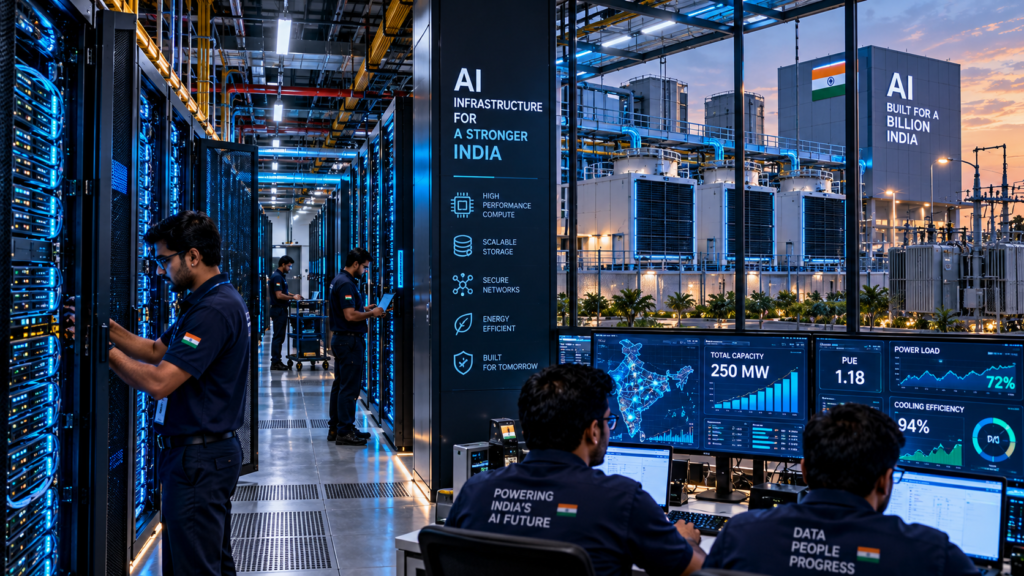
The AI data centre India opportunity extends beyond the two companies involved in the proposed joint venture.
Demand for computing infrastructure can support businesses in power distribution, cooling, networking, construction, equipment manufacturing and facility management.
Entrepreneurs may also find opportunities in specialised software and services that improve data centre efficiency.
Nevertheless, investment in AI infrastructure requires careful assessment of power availability, capital expenditure, utilisation rates and customer demand.
Not every project will achieve attractive returns simply because AI computing demand is increasing.
What Happens Next?
The next milestone is the development of definitive agreements and the implementation plan for the proposed partnership.
Investors and industry participants will watch for details about the manufacturing scope, investment commitments, facilities and expected production timelines.
The venture’s eventual impact will depend on its ability to establish commercially viable operations and serve customers reliably.
For more updates on AI infrastructure, enterprise technology and advanced manufacturing, follow Flairius News AI coverage.
Tags: AI Data Centre India, Adani Enterprises, Jabil, Artificial Intelligence, Data Centre Equipment, AI Infrastructure, Electronics Manufacturing India, Cloud Computing, Technology News
Internal Link: Flairius News — AI
Outbound Source: The Economic Times — Adani and Jabil’s proposed AI equipment joint venture.
Source: The Economic Times — Adani and Jabil AI Equipment Venture