
 By Aditya Agarwal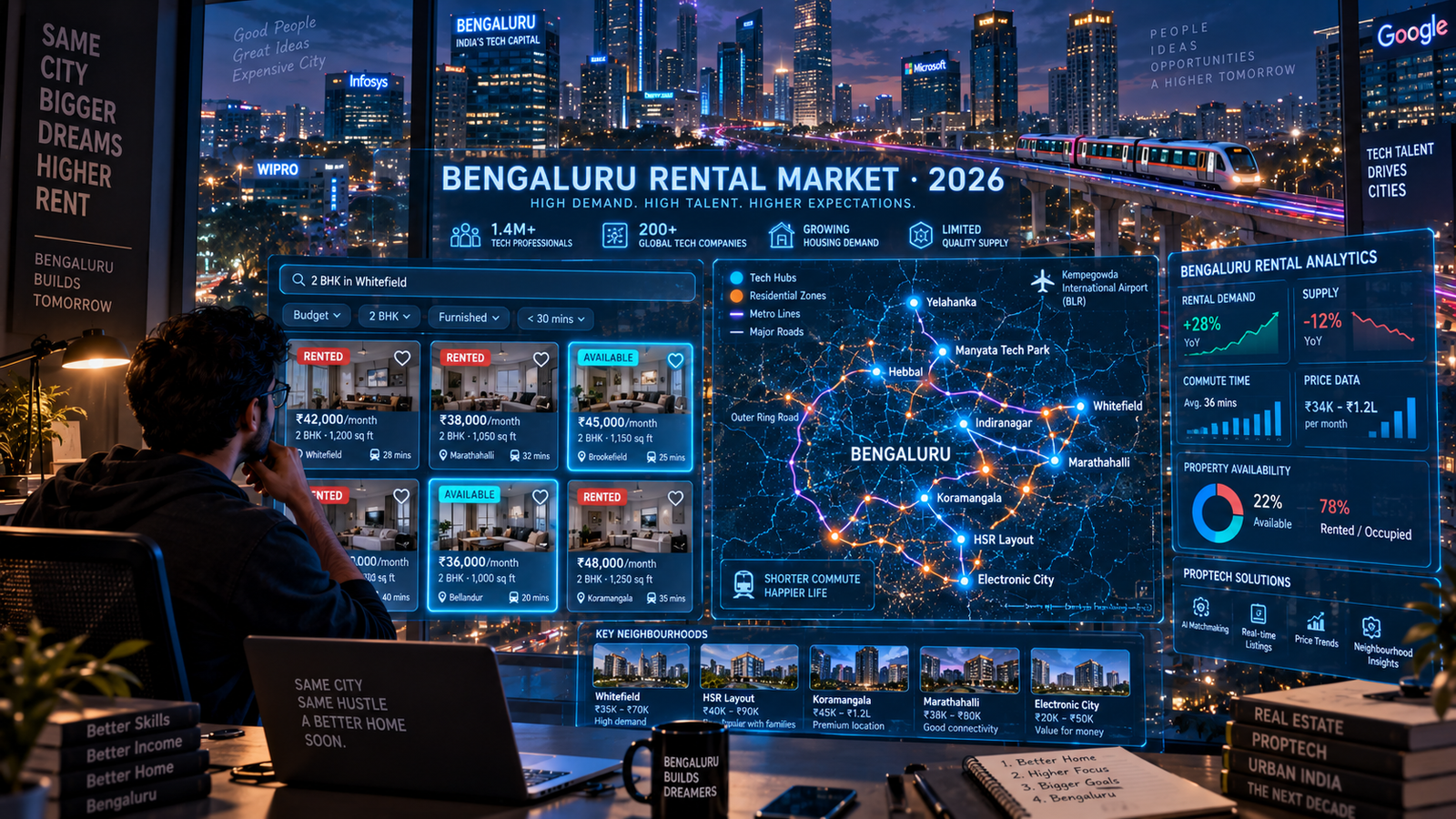
Finding an apartment in Bengaluru is becoming a project of its own.
For many professionals, the rental search now involves calls, property visits, negotiations, documentation and quick decisions.
Some tenants describe the process as a full-time job.
However, the problem is bigger than rental prices alone.
Bengaluru is experiencing concentrated demand for specific homes in specific locations.
That distinction helps explain why the Bengaluru rental market in 2026 can feel highly competitive even though the city has a large residential inventory.
Why Location Matters More Than Inventory
Bengaluru has thousands of residential properties.
Yet tenants do not consider every apartment equally useful.
A professional working near a technology corridor may not want a home several kilometres away.
Likewise, a cheaper apartment can become expensive when daily commuting takes hours.
Therefore, the practical housing supply is smaller than the city’s total inventory.
Metro connectivity can further influence decisions.
Office locations matter too.
Schools, neighbourhood infrastructure and apartment quality also affect demand.
Consequently, housing competition can become intense within specific areas.
Technology Jobs Create Housing Demand
Bengaluru remains one of India’s most important technology centres.
The city attracts technology companies, startups, global capability centres and engineering professionals.
As employment grows, residential demand often follows.
The relationship is straightforward:
Jobs → commuting → housing demand → rental competition.
However, supply cannot always adjust immediately.
New construction takes time.
Infrastructure also develops gradually.
As a result, popular neighbourhoods can experience greater pressure.
Why Tenants Feel the Pressure
The modern rental search has several stages.
First, tenants identify suitable neighbourhoods.
Next, they search listings.
Then come calls, visits and negotiations.
After that, documentation and verification can add another layer.
When several people want the same property, timing becomes important.
A tenant who waits may lose the apartment to another applicant.
Therefore, the search process can become stressful for professionals who already have demanding jobs.
Commercial Real Estate Matters Too
Residential demand does not exist separately from commercial development.
Where companies establish offices influences where employees want to live.
Consequently, changes in commercial real estate can eventually affect residential demand.
A new office cluster can create demand around surrounding neighbourhoods.
Better transportation can expand the distance employees are willing to travel.
Meanwhile, changes in workplace patterns can reshape demand again.
Therefore, residential property trends need to be viewed alongside employment and infrastructure trends.
Bengaluru Is Becoming a Data Problem
The rental market also reveals an information gap.
Tenants want accurate availability.
Landlords want reliable applicants.
Brokers want qualified leads.
Developers want demand intelligence.
Investors want pricing data.
Yet much of this information remains fragmented.
Consequently, PropTech companies have an opportunity to create better housing intelligence.
A modern platform could combine:
- verified listings
- rental price history
- commute times
- neighbourhood information
- property availability
- landlord verification
- tenant profiles
- digital documentation
That would make the rental process more structured.
AI Could Change Apartment Hunting
Artificial intelligence could take this further.
Instead of simply searching for properties, renters could describe their complete requirements.
For example:
Budget + office location + commute time + apartment size + furnishing + neighbourhood.
An intelligent platform could then filter properties according to all those constraints.
As a result, users would see fewer but more relevant options.
That changes the role of a property platform.
It becomes more than a listing directory.
It becomes a housing intelligence system.
What the Rental Pressure Signals
Bengaluru’s rental market reflects the relationship between India’s technology economy and urban housing.
As employment clusters grow, demand can become concentrated.
Meanwhile, transport infrastructure can change which neighbourhoods remain practical.
Commercial development can also create new residential hotspots.
Therefore, the city’s housing market will continue to evolve alongside its economic geography.
For tenants, the challenge is finding a suitable home quickly.
For landlords, it is finding reliable tenants.
For developers, the challenge is understanding future demand.
For PropTech founders, however, the opportunity may be even broader.
Bengaluru’s rental problem is becoming an information problem.
And better information could become one of the most valuable pieces of India’s future real-estate infrastructure.
Tags: Bengaluru Rental Market 2026, Bangalore Rent, Bengaluru Real Estate, Bangalore Housing, India Property Market, Rental Property India, PropTech India
Author CTA: Follow Flairius News — sharp takes on AI, business, and India’s startup economy — flairiusnews.com