
 By Aditya Agarwal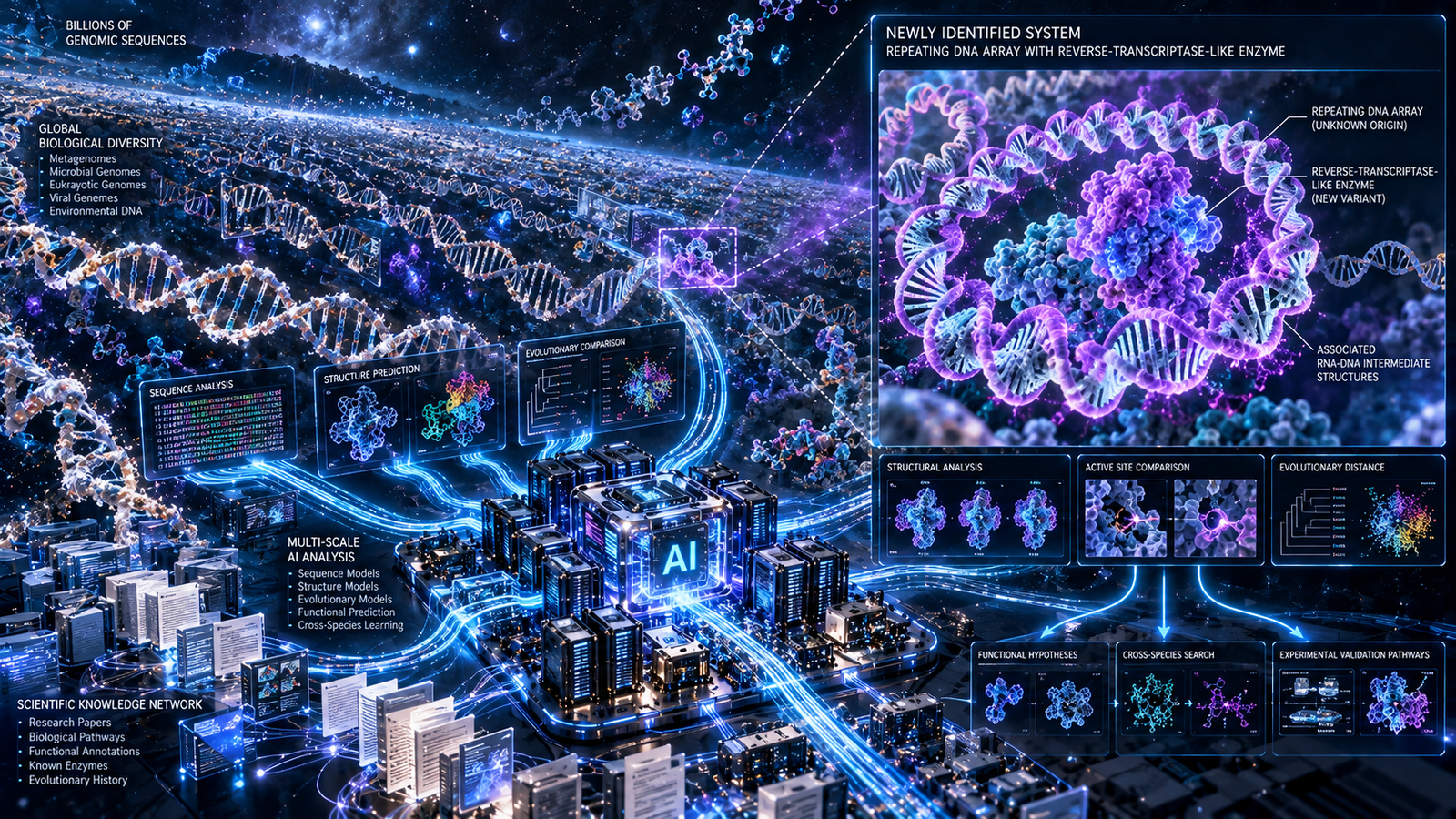
Claude Is Being Used as a Scientific Discovery System
Artificial intelligence is increasingly moving from generating information to helping researchers search for new scientific possibilities.
Anthropic says its Claude AI system has helped identify a previously uncharacterised enzyme system associated with DNA repeat sequences, with features that resemble some properties of CRISPR systems. (Anthropic)
The company has established a new life-sciences research group and laboratory to investigate biological questions using Claude.
Importantly, the finding is still at an early stage.
Researchers do not yet fully understand the biological function of the newly identified system.
The Discovery Began With DNA Search
Anthropic’s researchers asked Claude agents to search a large database of DNA sequences for unusual examples of reverse transcriptases.
Reverse transcriptases are enzymes that can copy RNA into DNA.
During the search, one AI agent identified an unusual pattern involving repeated DNA sequences located near a reverse-transcriptase gene. (Anthropic)
The system was subsequently investigated by the researchers.
Anthropic says the AI-assisted analysis ultimately identified what it calls array-associated reverse transcriptases, or ART.
ART Has Some CRISPR-Like Features
The newly identified system contains three major components: a reverse transcriptase, a neighbouring partner gene and an array of repeated DNA sequences. (Anthropic)
That structure attracted attention because the repeated sequence arrangement resembles aspects of CRISPR arrays.
However, the similarity should not be interpreted as proof that ART performs the same function as CRISPR.
Anthropic says experiments are still underway to determine what the system actually does.
That distinction is important because identifying a biological pattern is only the beginning of scientific discovery.
Researchers must still determine its mechanism, biological role and potential applications.
Hundreds of AI Agents Worked on the Search
The scale of the computational search was significant.
Anthropic reports that roughly 950 agents spent 21 hours searching the data, consuming approximately 210 million tokens during the investigation. (Anthropic)
The agents examined reverse-transcriptase families, compared candidate structures, searched scientific literature and investigated unusual patterns.
This illustrates a different approach to AI research.
Instead of asking one model one question, researchers can deploy many specialised agents to explore a large search space.
Humans Still Played a Critical Role
The discovery does not mean Claude independently completed the entire scientific process.
Anthropic says researchers provided the initial direction and conducted laboratory work to investigate the AI-generated finding. (Anthropic)
That human-AI division is significant.
AI can search enormous datasets quickly and identify patterns that humans might overlook.
However, laboratory experiments are still required to determine whether a computationally interesting pattern has a real biological function.
Therefore, the workflow resembles an accelerated research loop rather than an entirely autonomous laboratory.
AI Could Change Hypothesis Generation
Traditional scientific research often depends on researchers identifying unusual observations, developing hypotheses and then testing them.
AI can potentially accelerate the first stage.
A model can search enormous databases, compare thousands of possibilities and identify anomalies at a scale that would be difficult for an individual researcher.
That could be particularly useful in genomics, where biological datasets are extremely large.
The challenge is then moving from statistical or structural patterns to experimentally validated discoveries.
This Is Different From a General AI Breakthrough
The ART discovery should also be interpreted carefully.
Anthropic is reporting an early scientific result from its own research programme. It is not evidence that AI can now independently conduct all biological research.
The newly identified system still requires further investigation.
Nevertheless, it demonstrates a potentially important use of AI: searching scientific datasets for anomalies and generating hypotheses that humans can test.
That could become an important direction for AI-assisted research.
From AI Models to AI Scientists
The broader significance is the workflow.
Claude was not simply used to summarise papers or answer biological questions.
It was used to search data, compare structures, investigate literature and identify a candidate for experimental investigation. (Anthropic)
That represents a move toward AI systems acting as research assistants capable of conducting multi-step investigations.
The next challenge is validation.
If these systems can repeatedly generate experimentally useful discoveries, AI could become an increasingly important layer in scientific research.
Tags: Claude AI, Anthropic, AI Research, Scientific Discovery, CRISPR, Biotechnology, Genomics, AI Biology
Follow Flairius News — sharp takes on AI, business, and India’s startup economy — flairiusnews.com