
 By Aditya Agarwal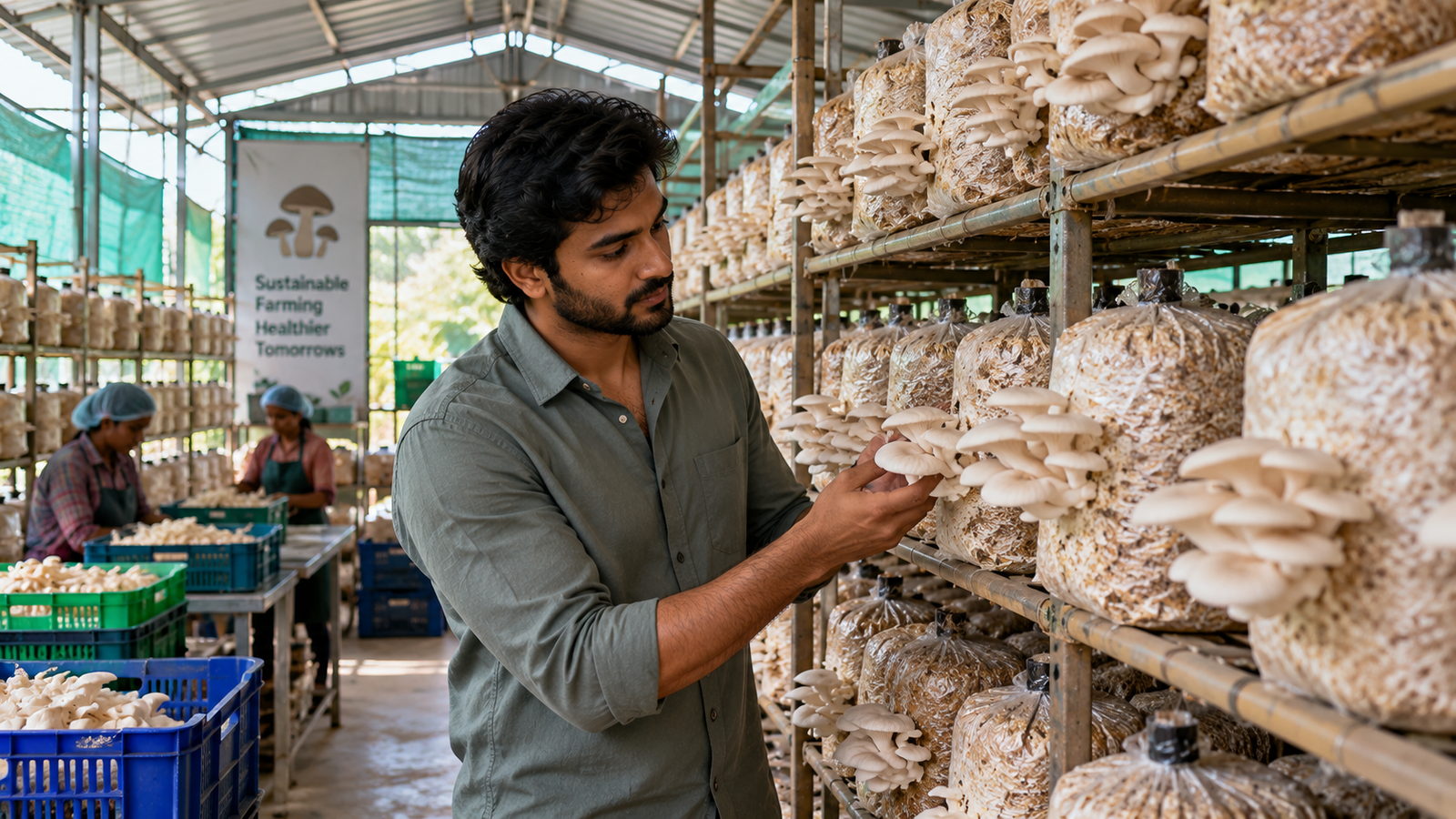
Bengaluru Entrepreneur Chooses an Unconventional Business Path
A Bengaluru entrepreneur has drawn attention for choosing mushroom cultivation over a conventional international career. According to a Times of India report published on 16 October, Prithviraj returned to India after completing a master’s degree in France, despite receiving job offers in Paris.
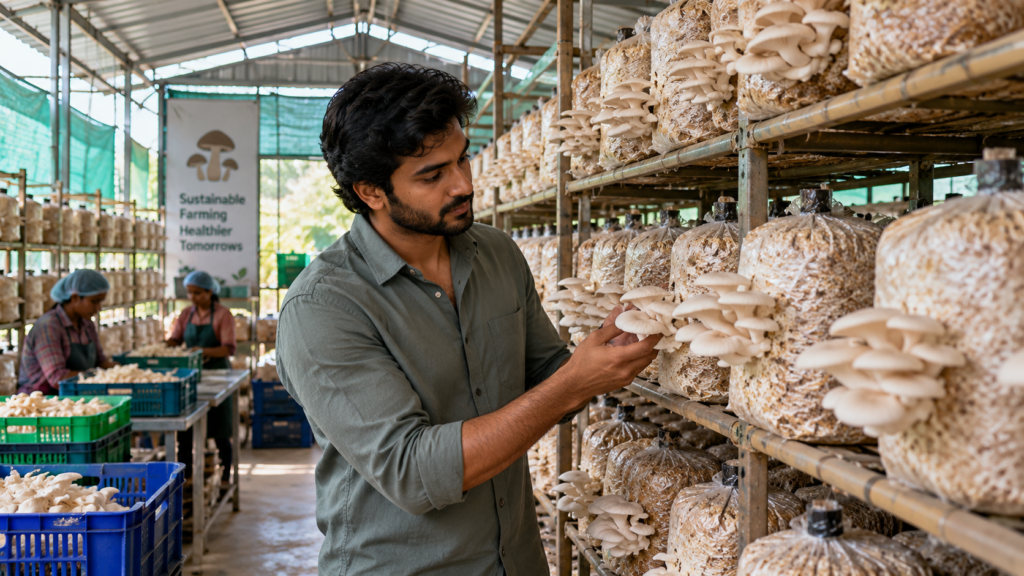
Rather than pursuing the traditional corporate route, he began experimenting with mushroom cultivation using ₹180 worth of mushroom spawn. The small experiment eventually developed into an operation involving approximately 4,000 growing bags.
His story highlights an important aspect of entrepreneurship: building a business can begin with a limited experiment, provided the founder learns how to turn an initial idea into a repeatable process. (The Times of India)
From an Abandoned Poultry Shed to Mushroom Cultivation
According to the report, Prithviraj returned to India and repurposed his family’s abandoned poultry shed for the cultivation experiment.
Using an existing structure can reduce the initial capital required to test a business idea. Instead of immediately investing in a dedicated commercial facility, an entrepreneur may be able to evaluate demand and production methods with resources already available.
Mushroom cultivation nevertheless requires practical knowledge. Temperature, humidity, cleanliness, growing conditions and contamination control can all affect production. A small experiment can help a founder understand these variables before committing additional money.
The reported growth to 4,000 growing bags illustrates the expansion of the operation. It does not, by itself, establish the business’s revenue or profitability, which depend on production yields, selling prices, labour, distribution and operating expenses.
Why Small Agricultural Businesses Can Matter
Agricultural entrepreneurship offers opportunities beyond traditional crop cultivation. Businesses can develop around specialised produce, processing, packaging, storage, distribution and direct sales to customers.
Mushrooms can be attractive to some small-scale growers because cultivation may be possible in a controlled indoor environment. However, commercial viability depends on local demand, reliable production, access to buyers and the ability to manage perishable inventory.
Entrepreneurs entering this market must also consider the cost of growing materials, energy, labour, transport and losses from contamination or unsold products.
A production operation becomes a sustainable business only when it can consistently deliver quality products at a cost that supports a viable margin.
Lessons for First-Time Entrepreneurs
Prithviraj’s reported journey offers several practical lessons for people considering entrepreneurship.
Start with a manageable experiment. Testing a product or production process on a small scale can reveal problems before major capital is committed.
Use available resources intelligently. Existing buildings, equipment and local networks may reduce the cost of testing an idea.
Understand the economics. Production volume matters, but revenue, expenses, spoilage, customer demand and cash flow determine whether the business can survive.
Scale after learning. Expanding too quickly can create operational problems. Entrepreneurs need processes that remain reliable as output increases.
These principles apply to many small businesses, from food production and agriculture to manufacturing and local services.
The Bigger Picture for Indian Entrepreneurship
India’s entrepreneurial landscape includes businesses built around technology as well as businesses rooted in local production and distribution. Agricultural enterprises can create value by connecting practical production knowledge with market demand.
However, individual success stories should not be treated as guarantees that the same model will work everywhere. Climate, local competition, access to buyers and operating costs can vary significantly.
For aspiring founders, the useful takeaway is the method: begin with a testable idea, learn from real operating conditions and expand when the economics support growth.
Outlook
The reported mushroom-growing operation demonstrates how a modest experiment can develop into a larger production activity. The next measures of business success will be the operation’s consistency, market access, profitability and ability to sustain demand.
For India’s entrepreneurs, the story is a reminder that business opportunities can emerge outside conventional career paths, including in overlooked spaces and existing local infrastructure.
Tags: Bengaluru entrepreneur, mushroom farming, Indian entrepreneurs, agriculture business, startup stories, small business India
Internal Link Suggestion: FlairiusNews — Entrepreneurs and Founder Stories
Outbound Source: Times of India — Prithviraj’s Mushroom Cultivation Story