
 By Aditya Agarwal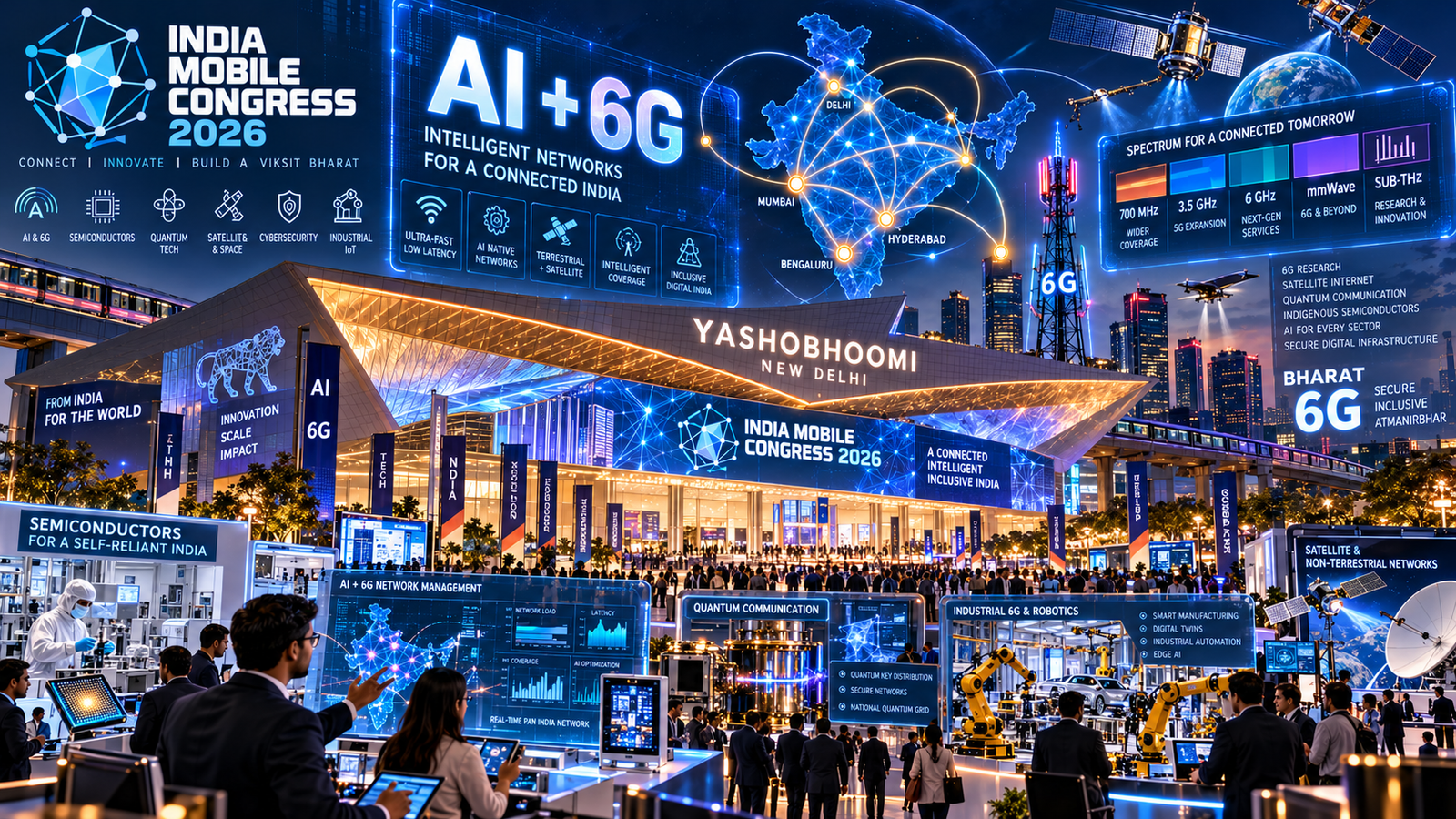
The India Mobile Congress 2026 has opened in New Delhi with artificial intelligence, 6G, semiconductors, quantum communication and next-generation digital infrastructure taking centre stage.
Prime Minister Narendra Modi inaugurated the 10th edition of the event at Yashobhoomi on October 8. The four-day congress brings together telecom companies, technology leaders, startups, investors and policymakers. (Prime Minister’s Office )
The event is particularly significant because telecom infrastructure is increasingly becoming an AI infrastructure problem.
India Mobile Congress 2026 Moves Beyond 5G
The India Mobile Congress 2026 agenda extends well beyond conventional mobile connectivity.
The event covers 5G and 6G, next-generation AI networks, semiconductors, non-terrestrial networks, cybersecurity and quantum communication.
It also introduces newer areas including industrial robotics, smart mobility and transport technology. (Prime Minister’s Office )
That combination shows how closely India’s telecom strategy is becoming connected to artificial intelligence.
Networks are no longer simply carrying data.
They are increasingly expected to process, analyse and respond to information in real time.
AI Networks Could Change Telecom Infrastructure
Traditional telecom networks were primarily designed around connectivity.
AI introduces another requirement.
Networks need to support massive amounts of data generated by connected devices, autonomous systems and cloud applications.
Consequently, network infrastructure itself is becoming more intelligent.
AI can potentially help operators predict congestion, optimise network resources and detect failures before they affect customers.
The same infrastructure can also support industrial automation and smart-city applications.
Therefore, the India Mobile Congress 2026 agenda reflects a broader convergence between telecom and computing.
6G Will Need More Spectrum
The next generation of mobile connectivity will require considerably more capacity.
GSMA’s spectrum chief Luciana Camargos said India could need around 3 GHz of additional spectrum for 6G as AI-driven network demand increases. (Economic Times )
That creates a policy challenge.
Spectrum is finite.
At the same time, AI applications are becoming increasingly bandwidth-intensive.
Connected vehicles, industrial robots, immersive applications and AI-enabled devices could all increase demand.
Therefore, spectrum planning will become an important part of India’s 6G strategy.
India Wants to Become a Telecom Manufacturing Hub
The India Mobile Congress 2026 also highlights India’s manufacturing ambitions.
Ericsson announced that it plans to export antennas manufactured in India to global markets, including Europe.
The company says it has manufactured more than 15,000 antennas and 25 million components in India since July 2025. (Indian Express )
That changes the role India can play in the global telecom ecosystem.
Instead of being primarily a large consumer market, India can increasingly become a manufacturing and export base.
The AI-Telecom Convergence Is the Bigger Story
The significance of India Mobile Congress 2026 extends beyond the four-day event.
India is attempting to build an ecosystem connecting telecom networks, AI, semiconductor manufacturing, cloud infrastructure and advanced electronics.
That creates opportunities for startups as well.
Companies developing network software, edge AI, cybersecurity, robotics and telecom hardware could benefit from the growing ecosystem.
Flairius News will continue tracking this transition through its AI coverage.
The next phase of India’s digital economy may therefore be defined not simply by faster networks, but by intelligent networks.
Tags: India Mobile Congress 2026, IMC 2026, AI Networks, 6G India, Telecom India, Semiconductors, Quantum Communication, AI Infrastructure
Internal Link: Flairius News AI coverage
Outbound Source: Prime Minister’s Office — India Mobile Congress 2026
 Raghav Sharma