 By Raghav Sharma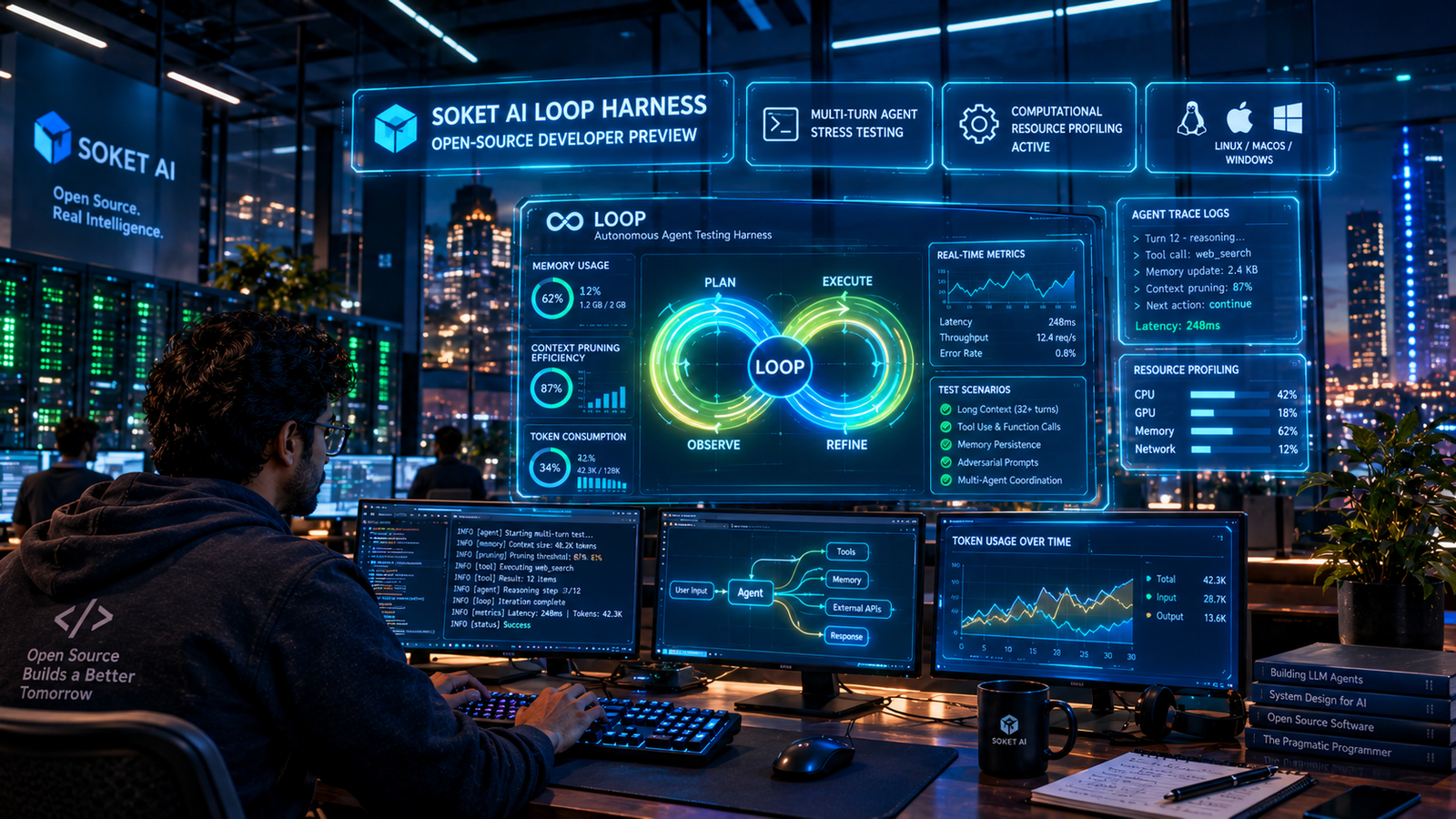
Evaluating autonomous software agents has historically been plagued by inconsistent testing benchmarks. While simple chatbots are scored on single-turn answers, complex software agents execute multi-hour tasks requiring thousands of system commands.
To bring scientific measurement to autonomous software, Bengaluru-based deeptech startup Soket AI launched the Soket AI LOOP harness. The project arrived in October 2026 as an open-source evaluation suite designed to benchmark long-running autonomous agents. Consequently, developers gain objective measurements of memory leaks, token costs, and compute spikes during sustained agent execution. Furthermore, the initiative reflects India’s growing ambition in sovereign infrastructure tools. Therefore, modern engineering teams can stress-test autonomous workflows before pushing code into production.
Why Long-Running Software Agents Need New Metrics
Traditional machine learning benchmarks measure answer quality on static multiple-choice examinations. However, an autonomous agent operating inside an enterprise system must execute terminal commands, edit multiple software files, and recover from network errors.
When agents run continuously, subtle software bugs compound rapidly. An agent might resolve a coding problem, yet consume ten times more compute memory than necessary due to inefficient context pruning.
The Soket AI LOOP harness solves this blind spot by focusing specifically on physical resource consumption. Rather than grading subjective text style, the framework tracks system memory usage, token consumption curves, and execution latency across long horizons.
Technical Capabilities of the Open-Source Framework
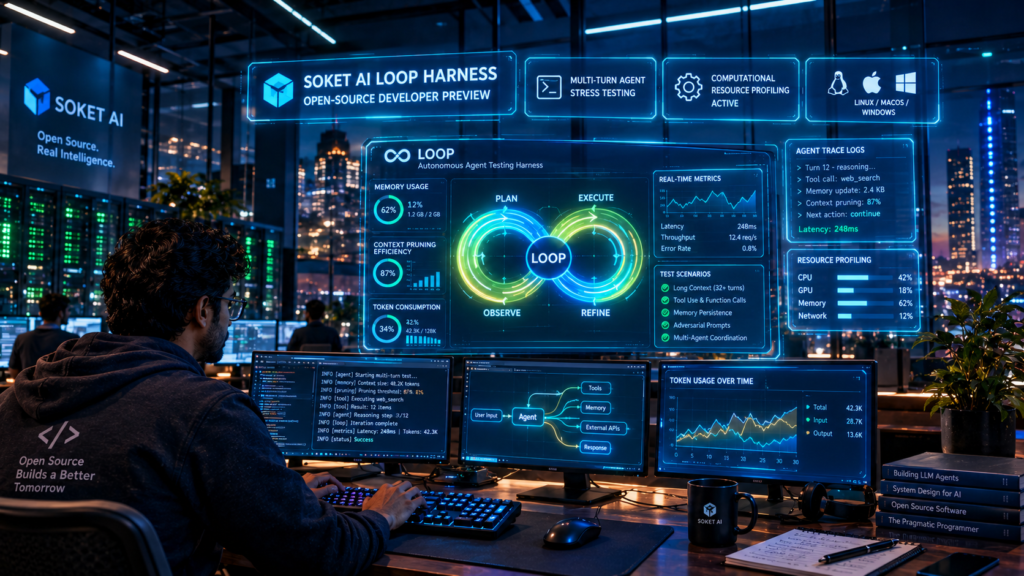
Released as a developer preview for Linux, macOS, and Windows, the testing suite integrates seamlessly into continuous deployment pipelines. Engineers configure simulated software environments to observe how agents behave under resource stress.
Specifically, the framework measures how effectively an agent prunes historical context. When processing thousand-step operational workflows, efficient agents discard irrelevant scratchpad logs while retaining core operational constraints.
Moreover, the software tracks execution stability across multiple environments. If an agent loops endlessly due to a corrupted tool call, the monitoring harness records the exact failure trace. As a result, developers diagnose agent failures without manually parsing gigabytes of raw server logs.
Sovereign Open-Source Tooling from India
The development of the Soket AI LOOP harness highlights a strategic expansion in India’s deeptech ecosystem. Rather than merely consuming proprietary overseas testing tools, domestic engineers are releasing foundational open-source testing infrastructure.
By releasing the suite publicly, Soket AI invites global researchers to standardize autonomous agent benchmarking. As organizations deploy agents across critical sectors, independent resource auditing tools become essential enterprise safeguards.
Autonomous software agents are evolving from novel experiments into enterprise workhorses. Transparent testing harnesses ensure that tomorrow’s digital workers operate with predictable computational efficiency.
Tags: Soket AI, Soket AI LOOP Harness, Open Source AI, Autonomous Agents, AI Benchmarks, Indian DeepTech, Developer Tools 2026
Author CTA: Follow Flairius News — sharp takes on AI, business, and India’s startup economy — flairiusnews.com
 Aditya Agarwal