
 By Aditya Agarwal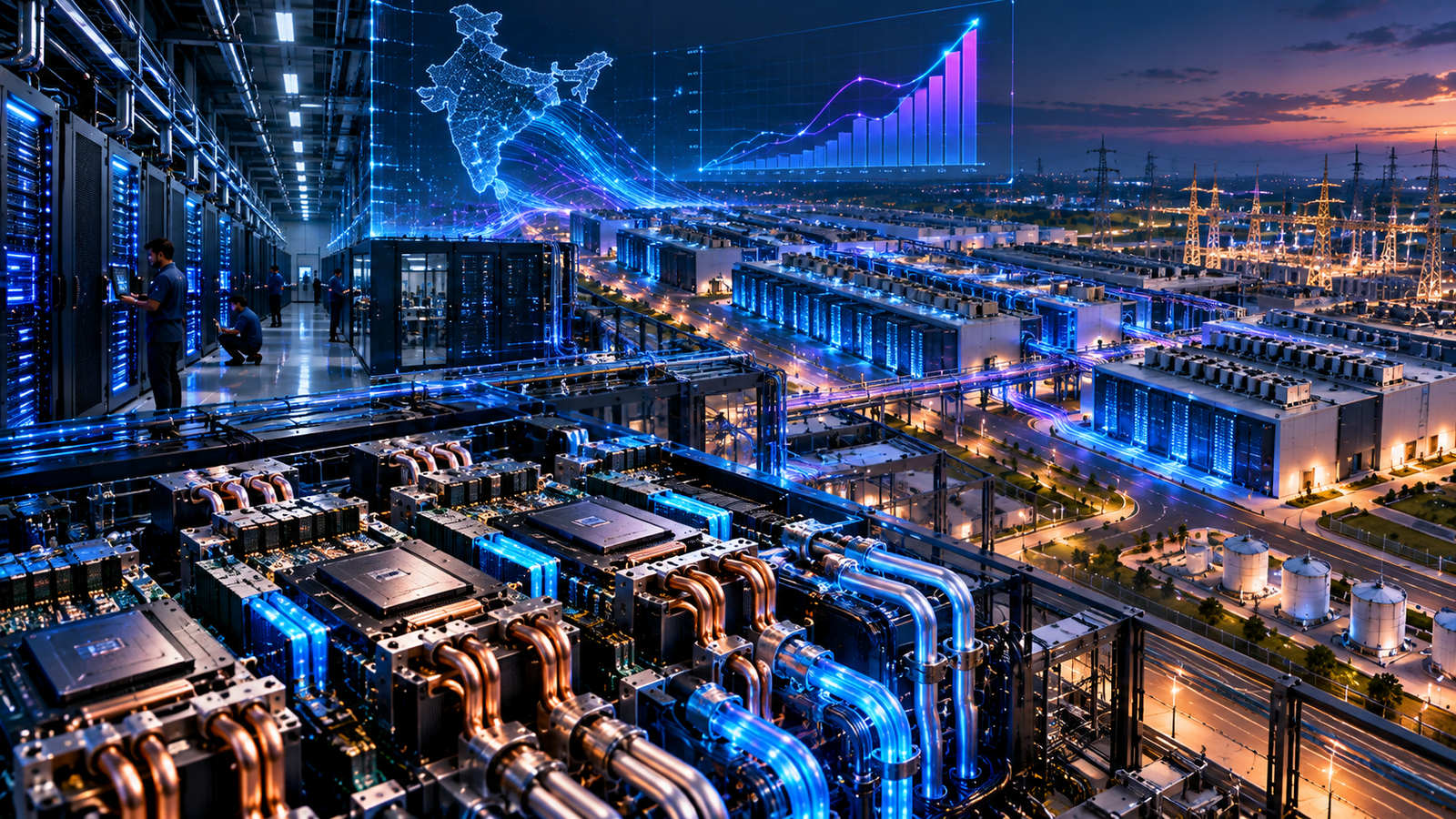
India’s effort to build a large domestic AI-compute ecosystem is facing a hardware bottleneck.
The IndiaAI Mission, launched with a five-year outlay of ₹10,371.92 crore, is encountering rising GPU and memory costs as global demand for AI infrastructure continues to accelerate.
Economic Times reports that IndiaAI currently has access to approximately 30,000 GPUs against commitments of 45,000.
Several providers have struggled to deliver their committed capacity because hardware costs have increased sharply.
The government is therefore considering fresh procurement and changes to how the programme secures compute.
Why GPUs Have Become the Bottleneck
AI models require enormous computing resources.
Training frontier models can require thousands of accelerators operating simultaneously.
Inference also requires substantial computing power once models begin serving millions of users.
That has created extraordinary demand for advanced GPUs.
At the same time, memory components used alongside those accelerators remain constrained.
According to industry reporting, the price of Nvidia H200 GPUs has risen from roughly $20,000 to more than $40,000.
AI servers that previously cost around ₹2 crore can now approach ₹4 crore, according to people cited by ET.
That dramatically changes the economics of government-subsidised compute.
IndiaAI Was Designed to Democratise Compute
The IndiaAI Mission aims to make advanced computing available to startups, researchers and public institutions.
That is important because smaller companies generally cannot afford large GPU clusters.
Instead, subsidised access allows researchers to train and deploy models without purchasing their own infrastructure.
The programme therefore acts as an infrastructure layer for India’s emerging AI ecosystem.
However, subsidised access only works if sufficient capacity exists.
A commitment to provide GPUs is not equivalent to having those GPUs physically deployed and available.
That distinction has become increasingly important.
The Government Is Reconsidering Its Approach
India initially relied heavily on private cloud and compute providers.
However, rising hardware prices and delivery constraints are pushing the government toward greater direct ownership.
ET reports that the government plans to acquire around 3,000 GPUs through C-DAC.
That capacity would be used by government institutions while also supporting startups and researchers.
The change represents a strategic adjustment.
Instead of relying entirely on private providers, India would maintain a core public compute layer.
The Cost Problem Goes Beyond GPUs
GPU prices are only one component.
High-bandwidth memory, networking equipment, electricity, cooling and data-centre infrastructure all influence AI-compute costs.
AI clusters also require significant power capacity.
As model sizes increase, these infrastructure requirements become more important.
Consequently, building sovereign AI capacity is not simply a matter of purchasing accelerators.
It requires an entire computing ecosystem.
That includes data centres, power infrastructure, networking, cooling technology, system integration and engineering talent.
India’s Hardware Strategy Is Also Changing
The compute challenge comes as India reassesses its broader electronics manufacturing strategy.
AI servers are unusually expensive because GPUs can represent a very large share of total system value.
That limits the effectiveness of incentives focused primarily on assembly.
Policy discussions are therefore shifting toward higher-value activities such as chip design, system integration and thermal engineering.
This could eventually strengthen India’s domestic AI-hardware ecosystem.
However, developing that capability will take time.
Why Compute Access Matters for Indian AI Startups
India has a large software and startup ecosystem.
Yet software talent alone does not guarantee frontier AI development.
Training advanced models requires sustained access to compute.
If startups cannot obtain GPUs at predictable prices, experimentation becomes more expensive.
Research cycles also become longer.
That can affect India’s ability to develop large models, specialised AI systems and advanced robotics technologies.
The IndiaAI Mission is therefore becoming more than a government technology programme.
It is becoming part of India’s underlying AI infrastructure.
The Next Phase Will Focus on Usable Capacity
The central question is no longer simply how many GPUs India has announced.
It is how many are operational, accessible and affordable for actual users.
That distinction will determine how effectively the IndiaAI Mission supports researchers and startups.
The hardware market remains volatile.
Therefore, India’s strategy may increasingly combine private cloud capacity, direct government-owned infrastructure and long-term procurement agreements.
The objective is straightforward: create reliable access to computing power while reducing exposure to global hardware shortages.
For India’s AI ecosystem, the outcome could be as important as the models built on top of that infrastructure.
Tags: IndiaAI Mission, GPU, AI Infrastructure, Artificial Intelligence, Nvidia, C-DAC, AI Startups India, Compute
Flairius CTA:
Follow Flairius News — sharp takes on AI, business, and India’s startup economy — flairiusnews.com
[…] Flairius News has previously examined this broader shift through its coverage of India’s AI infrastructure and GPU challenge. […]