
 By Aditya Agarwal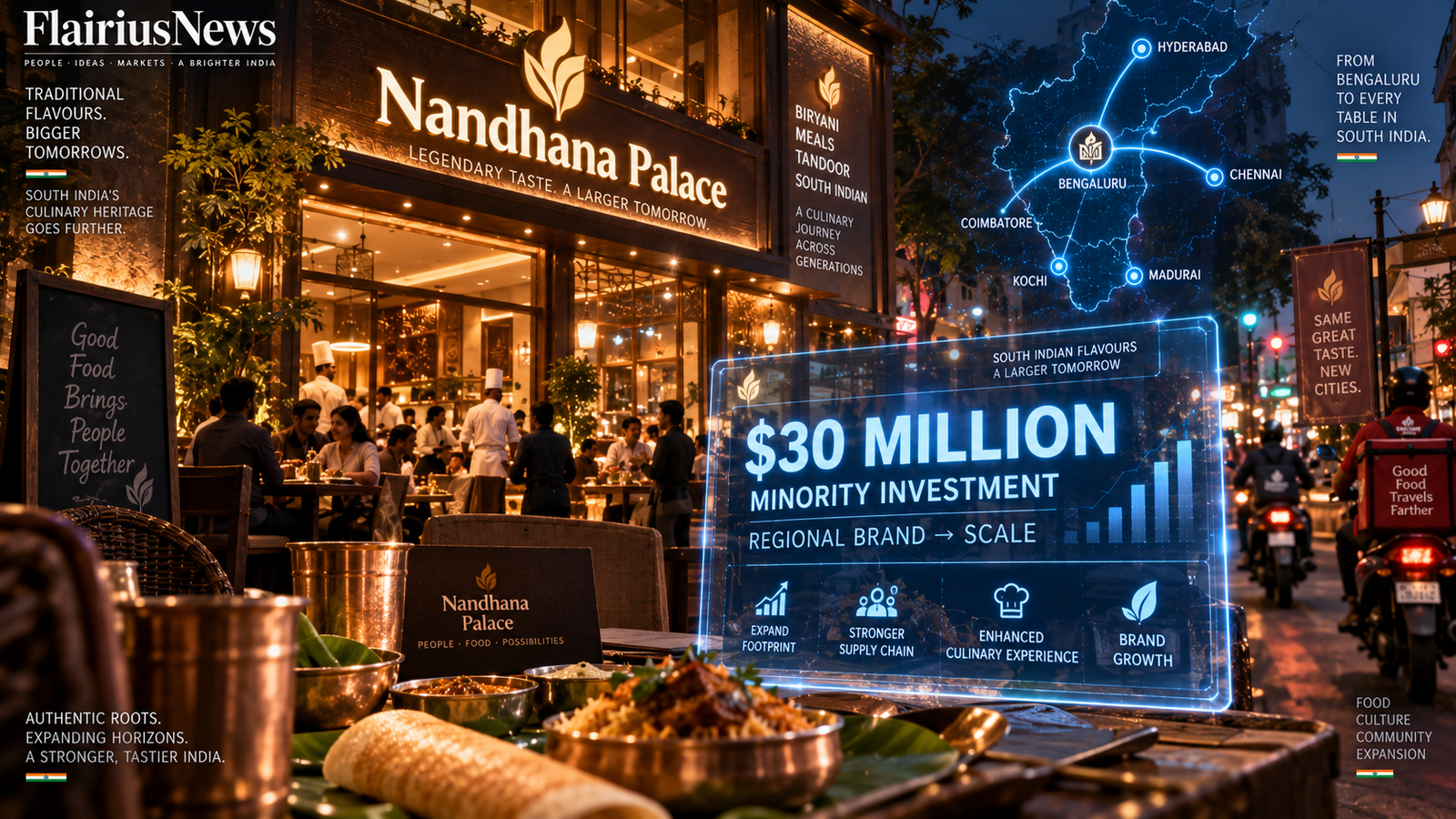
India’s consumer economy is producing a new investment story.
Global consumer-focused investment firm L Catterton has agreed to invest about $30 million in Bengaluru-based Nandhana Foods, the restaurant group behind Nandhana Palace and RNR. The deal involves a minority stake. (Moneycontrol)
At first glance, it looks like another private-equity transaction.
However, the bigger story is about regional Indian brands.
For decades, national consumer companies dominated the conversation.
Now, investors are increasingly looking at businesses that built strong positions around specific cuisines, cities and communities.
Regional Brands Are Becoming Scalable
Nandhana Foods has spent more than three decades building its restaurant business around Andhra and Karnataka cuisine.
That history matters.
The company did not emerge from a short-lived delivery trend.
Instead, it developed a consumer proposition around regional food and repeat customers.
Consequently, the investment is also a bet on whether a regional brand can expand without losing its identity.
Why L Catterton Is Interested
L Catterton has extensive experience investing in consumer and restaurant businesses.
The firm has invested in roughly 30 restaurant businesses globally, according to reporting around the transaction. (Business Standard)
Therefore, its interest in Nandhana Foods highlights the growing institutional attention toward organised restaurant businesses.
The investment is expected to support expansion and operational scaling.
Moreover, the company plans to deepen its presence in South India while exploring other markets. (Moneycontrol)
The Indian Restaurant Market Is Changing
India’s food market is highly fragmented.
Thousands of independent restaurants operate alongside national chains.
That creates a difficult environment for scaling.
A restaurant needs consistent food quality.
It needs reliable supply chains.
It also needs trained staff and repeat customers.
As a result, operational discipline becomes increasingly important when a regional brand expands.
Culture Can Become a Business Advantage
Regional cuisine has an interesting commercial advantage.
Food is closely connected to local identity.
Customers often have strong preferences for familiar flavours.
Therefore, a restaurant does not necessarily need to create an entirely new category.
Instead, it can organise and scale something customers already understand.
Nandhana Foods’ strategy illustrates that model.
The brand can retain its regional identity while developing a larger operating system around it.
The Expansion Challenge
Scaling restaurants is not easy.
A successful location does not automatically translate into a successful national chain.
Different cities have different customers.
Rental costs vary.
Staffing conditions change.
Supply chains also become more complicated.
Consequently, expansion requires more than capital.
It requires a repeatable operating model.
Why Unit Economics Matter
Investors increasingly want to know whether consumer businesses can scale profitably.
Revenue growth alone is not enough.
A restaurant must generate healthy economics at the individual-store level.
That means controlling food costs, labour, rent and customer acquisition.
Therefore, unit economics can determine how quickly a chain should expand.
The Nandhana Foods deal is interesting partly because L Catterton described the business as having attractive unit economics and a disciplined expansion history. (Business Standard)
Regional Brands Could Become National Brands
India’s consumer market is becoming more diverse.
A successful brand from Bengaluru can potentially enter Hyderabad.
A Chennai brand can move into Bengaluru.
A North Indian brand can target Mumbai.
Meanwhile, digital ordering can help customers discover regional concepts outside their traditional markets.
Consequently, technology is reducing some of the barriers between regional brands and national consumers.
What Investors Will Watch
The next stage will be execution.
How many new outlets can Nandhana Foods open?
Can quality remain consistent?
Can the company expand beyond its current geographic footprint?
Will the brands retain their regional identity?
These questions will determine whether the investment produces a larger consumer platform.
The Bigger Business Story
The Nandhana Foods transaction reflects a broader shift in India’s consumer economy.
Investors are not only looking for giant national brands.
They are also looking for businesses with strong local loyalty that can be systematically scaled.
India’s next consumer giants may not begin as national brands.
They may begin with one cuisine, one city and one loyal customer base — then build the systems needed to go much bigger.
Tags: Nandhana Foods, L Catterton India, Indian Consumer Brands, South Indian Food, Restaurant Industry India, Business News 2026
Author CTA: Follow Flairius News — sharp takes on AI, business, and India’s startup economy.