
 By Ahana Verma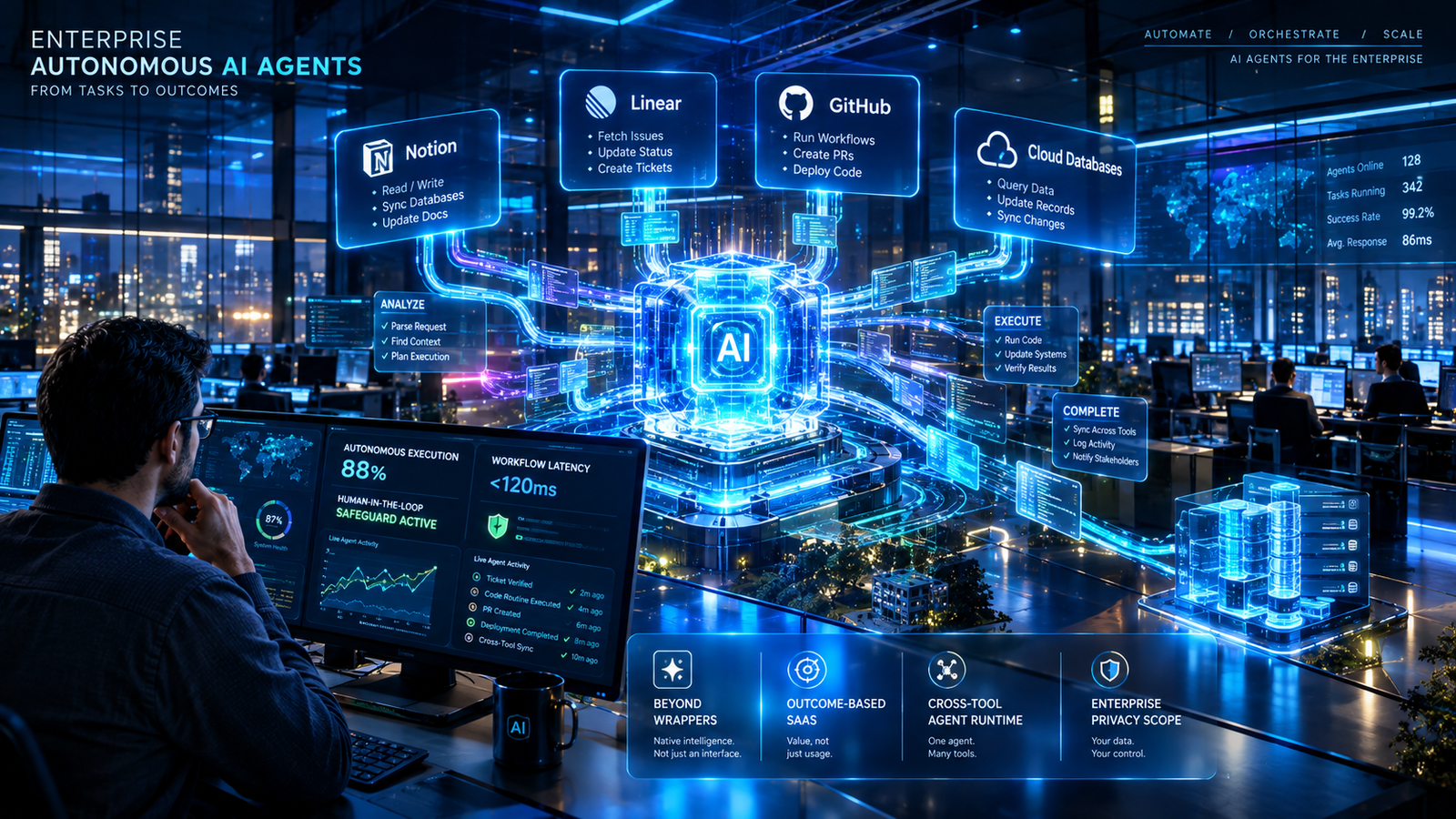
Enterprise software is undergoing an operational overhaul. For three years, corporate tech teams experimented with conversational AI copilots and generative text wrappers. However, simple prompt-and-response interfaces have reached their practical limit.
Today, enterprise demand has decisively moved toward autonomous agent infrastructure. Instead of asking a bot for summaries, modern teams require software agents that log into multiple applications, execute complex cross-platform workflows, and resolve operational bottlenecks autonomously.
Consequently, funding and product releases in late 2026 are heavily concentrating on agent orchestration platforms. The goal is no longer passive assistance. Rather, businesses want active software operators that execute work across systems like GitHub, Linear, Notion, and cloud databases without constant human supervision.
Why Chatbot Wrappers Lost Their Moat
Between 2023 and 2025, venture capital poured into horizontal AI wrappers. These tools functioned primarily as thin user interfaces sitting atop third-party large language models. However, when major foundational model providers incorporated native conversational features directly into their platforms, standalone wrapper margins rapidly deteriorated.
Furthermore, enterprise leaders realized that generating text does not equal finishing work. A summarizer tool can outline a software ticket, but an engineer still needs to assign it, pull the log files, update the database, and inform the team.
Therefore, the market demand has pivoted toward execution platforms. These systems feature persistent context stores, bidirectional API connectors, and secure permission-scoped browser agents. As a result, the software interacts with the browser exactly like a seasoned technical operator.
What Autonomous Agent Infrastructure Actually Builds
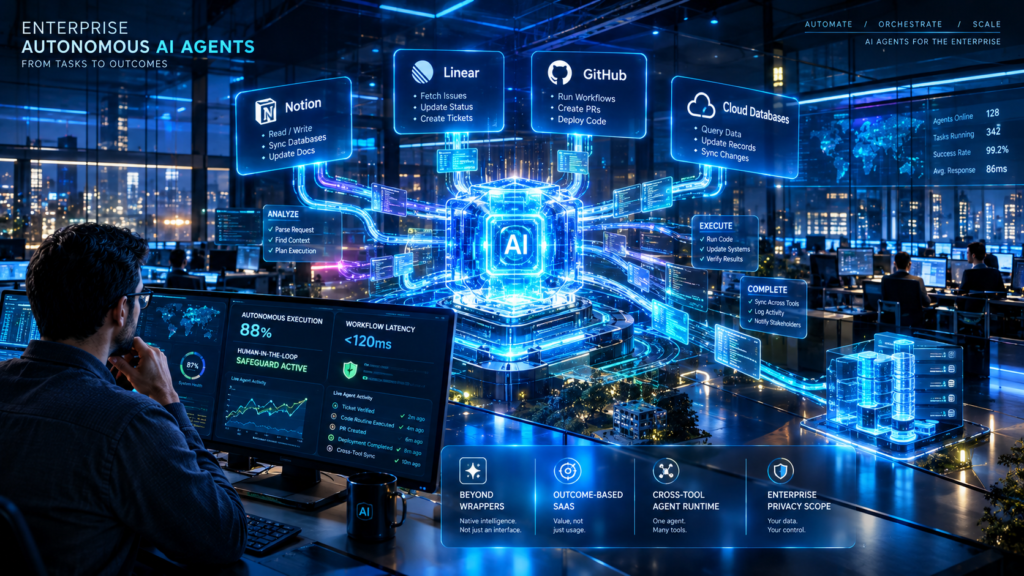
Agent platforms differ fundamentally from classical automation software. Legacy robotic process automation relied on fragile, hard-coded scripts that failed when an interface changed. In contrast, agentic AI uses visual language models to interpret user interfaces dynamically.
Specifically, these agents complete multi-step tasks across divergent enterprise tools. When an error alert triggers in monitoring software, the AI agent pulls the relevant log snippet, navigates to the team documentation repository, drafts a remediation ticket, and files a pull request.
Moreover, developers are designing these systems around strict guardrails. The software executes routine tasks independently while halting for managerial clearance on high-stakes operations. Consequently, companies achieve 80% to 90% autonomous execution without compromising institutional security.
The Emerging Revenue Model: Outcome-as-a-Service
As software shifts from conversational interfaces to autonomous execution, commercial pricing structures are adapting simultaneously. Traditional per-seat SaaS licensing assumes human workers are sitting at screens clicking buttons.
However, when software agents handle operational workloads, seat-based billing loses coherence. Therefore, tech companies are migrating toward outcome-based and volume-based pricing models. Enterprises willingly pay premium rates for verified ticket resolutions, validated invoices, or automated code deployments rather than idle user seats.
Additionally, this economic transition creates a powerful data-network effect. Every completed task improves the agent’s context and workflow precision within that enterprise. Thus, the software builds a durable operational moat that generic foundational models cannot replicate.
The chatbot hype has cleared. Autonomous, multi-tool AI infrastructure is now constructing the actual enterprise workflow engine of 2026.
Tags: AI Agents 2026, Autonomous AI Infrastructure, Enterprise Agentic AI, AI Automation, SaaS Workflows, Generative Engine Optimization, Enterprise AI Software Author CTA: Follow Flairius News — sharp takes on AI, business, and India’s startup economy — flairiusnews.com
 Raghav Sharma
  Aditya Agarwal