
 By Aditya Agarwal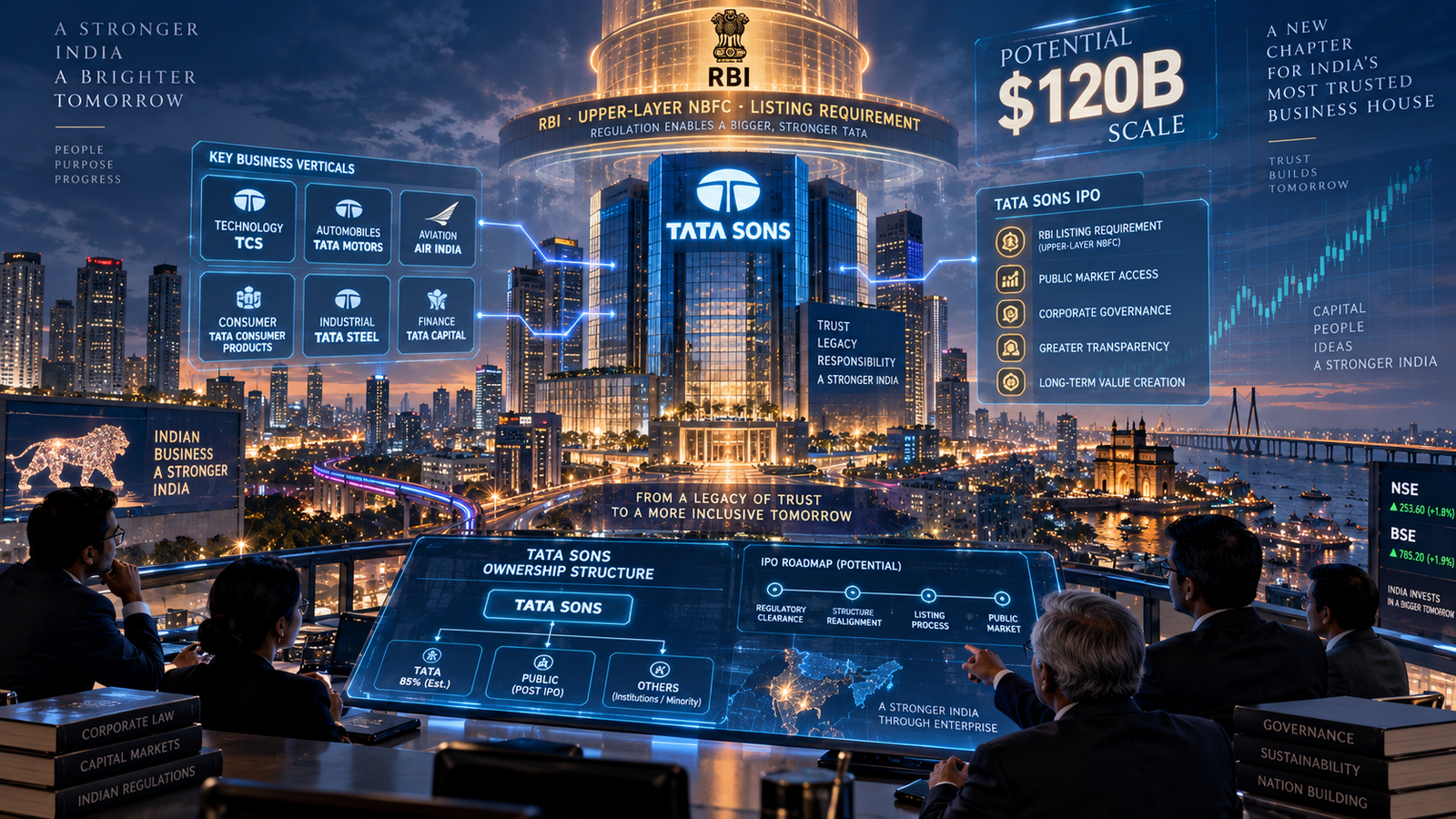
One of India’s most closely watched corporate structures is facing a major regulatory turning point.
Tata Sons sits at the centre of the Tata Group’s extensive business ecosystem. The company connects interests across technology, automobiles, aviation, consumer businesses and industrial operations.
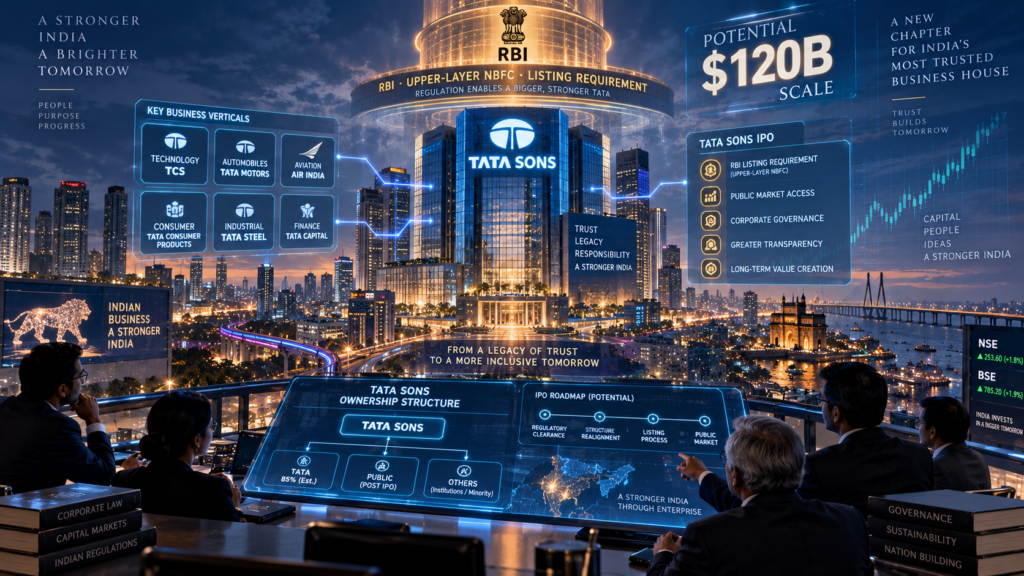
Now, regulatory requirements surrounding its upper-layer NBFC classification have brought the possibility of a public listing into sharper focus.
Consequently, the Tata Sons IPO 2026 discussion is about much more than another stock-market debut.
It is about the structure behind one of India’s largest business groups.
Why Tata Sons Matters
Tata Sons is the holding company at the centre of the Tata Group.
Its wider ecosystem includes businesses operating across several major sectors. Therefore, changes at the holding-company level can attract attention across the broader group.
A public listing could also create greater visibility into the company’s financial structure.
For investors, that means several questions become important.
How should the holding company be valued?
How should its ownership relationships be understood?
What would public-market disclosure mean for the group?
These questions make the potential transaction unusual.
Why the RBI Listing Requirement Matters
Tata Sons has been classified as an upper-layer NBFC.
That classification comes with additional regulatory requirements.
One important requirement concerns public listing.
The company had sought an exemption from the listing requirement. However, the regulatory position has kept the issue alive.
As a result, Tata Sons now faces a potential path toward the public market unless the regulatory or legal situation changes.
The exact timeline remains dependent on future developments.
Therefore, investors should distinguish between the regulatory requirement and speculation about when a potential IPO could happen.
The Valuation Question
A potential Tata Sons valuation has attracted significant attention.
Some market reports have discussed a valuation around the $120 billion level. Nevertheless, that should not be treated as a confirmed IPO valuation.
The final market value would depend on several factors.
These could include the transaction structure, market conditions, investor demand, disclosures and the amount of ownership offered.
Consequently, the headline valuation provides context rather than a final answer.
Why Tata Group Companies Matter
The potential transaction becomes more complex because Tata Sons has ownership relationships with several publicly listed Tata companies.
That creates a wider market connection.
Investors could therefore examine:
- Tata Sons ownership
- cross-holdings
- subsidiary relationships
- governance
- capital allocation
- valuation
- potential dilution
Furthermore, the market could look more closely at how value flows through the wider corporate structure.
That makes the Tata Sons story relevant beyond a single company.
The Corporate Governance Angle
Public companies operate under extensive disclosure requirements.
Consequently, a public listing can change how investors evaluate a company’s finances, governance and capital allocation.
For Tata Sons, that could create a particularly interesting transition.
The company has developed its corporate structure over decades.
Moving toward public ownership would introduce another layer of market scrutiny.
At the same time, the existing institutional framework would remain important.
Therefore, the eventual structure would determine how investors interpret the company.
What Investors Will Watch
If the listing process advances, several questions will become central.
First, what valuation will the market assign?
Second, how much ownership will be offered?
Third, how will existing cross-holdings be treated?
Fourth, what would Tata Sons do with the capital?
Finally, how would public investors assess the holding-company structure?
Each answer could influence the market’s understanding of the transaction.
What Happens Next
The regulatory and legal process will determine the eventual timeline.
Until then, the distinction between confirmed developments and expectations remains important.
Still, the broader corporate significance is clear.
India’s capital markets are becoming increasingly important to large business groups.
Meanwhile, regulators continue to focus on transparency and oversight around significant financial structures.
Tata Sons sits directly at that intersection.
If the company eventually enters the public market, the transaction could become an important case study in Indian corporate governance and holding-company valuation.
The story is therefore bigger than an IPO.
It is about bringing the architecture behind one of India’s largest business ecosystems closer to public markets.
Tags: Tata Sons IPO, Tata Group, RBI Tata Sons, Tata Sons Listing, Indian Business News, IPO India 2026, Corporate Governance India
Author CTA: Follow Flairius News — sharp takes on AI, business, and India’s startup economy — flairiusnews.com
 Nayra Roy
  Raghav Sharma