 By Aditya Agarwal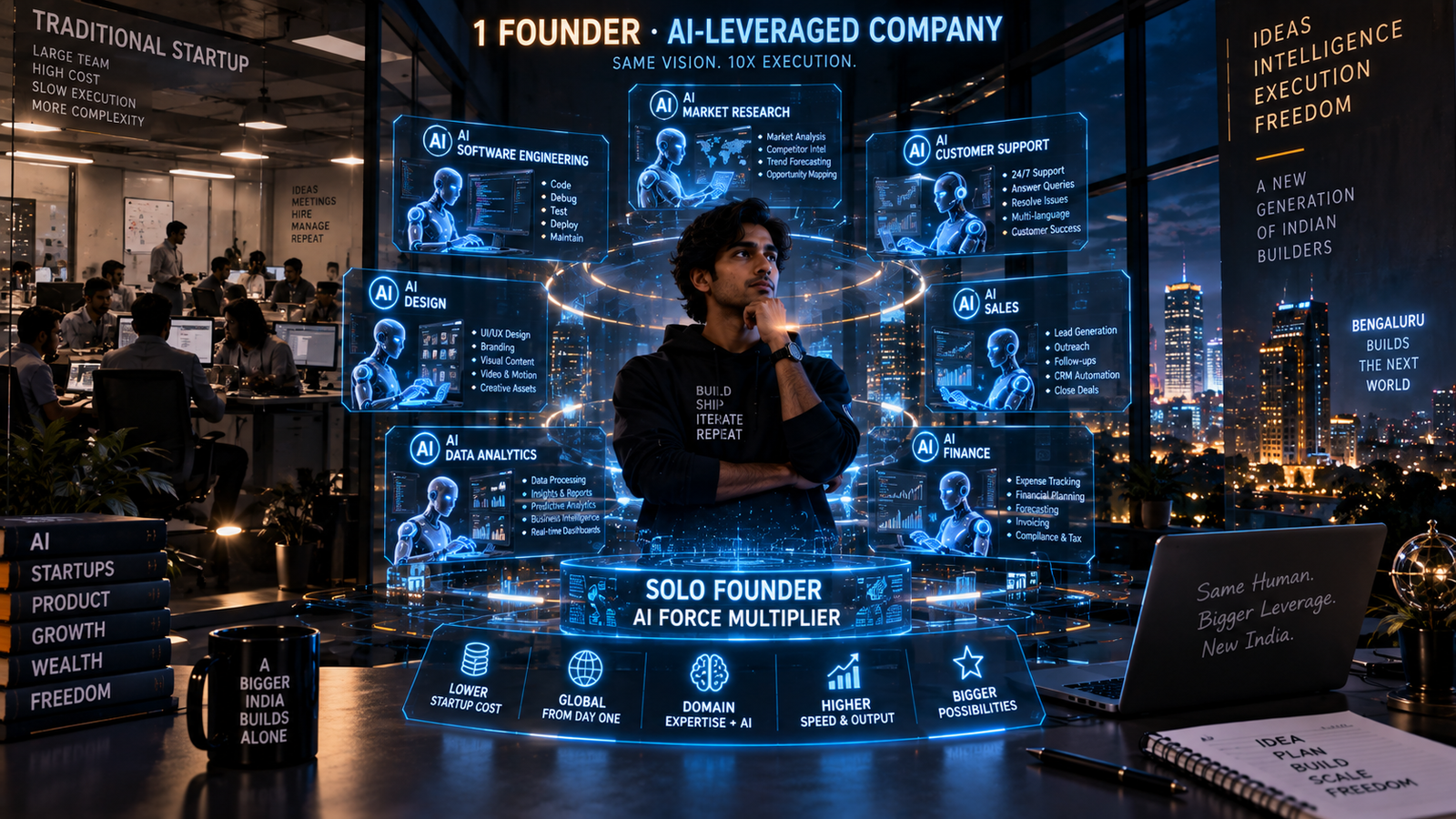
The startup team is getting smaller.
For decades, entrepreneurs usually needed several specialists to turn an idea into a working company.
One founder handled technology.
Another focused on product.
A third person might manage sales.
Then came engineers, designers, marketers and operations staff.
Artificial intelligence is now changing that equation.
Recent startup trends show a growing share of companies being created by solo founders. As a result, the traditional path from idea to company is becoming less dependent on headcount.
The trend also matters for solo founders and AI startups in 2026.
The Traditional Startup Formula
Building a technology company once required substantial resources.
Software development needed engineers.
Marketing required specialists.
Customer support required employees.
Research consumed founder time.
Consequently, even a simple startup could become expensive before finding its first customers.
AI changes several parts of that equation.
A founder can now use AI tools for coding, market research, writing, analysis, design and customer communication.
Therefore, a much smaller team can produce more output.
AI Is Becoming a Force Multiplier
AI does not automatically create a successful business.
Instead, it increases the amount of work a capable entrepreneur can accomplish.
For example, a founder can use AI to analyse competitors within hours rather than days.
Similarly, coding assistants can accelerate software development.
AI customer-support systems can handle routine questions.
Automated analytics can help founders understand customer behaviour.
As a result, entrepreneurs can spend more time on decisions that require judgment.
That includes product strategy, customer relationships and market positioning.
The Minimum Viable Company
The startup world already has a familiar concept called the minimum viable product.
Now another idea is becoming relevant:
the minimum viable company.
How many people are actually needed to test an idea?
Which tasks can software handle?
What should remain human?
How much capital is required before the first customer?
These questions can change startup economics.
A smaller initial team can reduce operating expenses.
Furthermore, lower costs can extend runway.
That gives founders more time to validate their products.
AI Does Not Create Product-Market Fit
There is, however, an important limitation.
AI can make development faster.
It cannot guarantee that customers need the product.
A founder still needs to identify a meaningful problem.
The market still determines whether customers will pay.
Distribution remains important.
Pricing also matters.
Therefore, AI efficiency should not be confused with business success.
The technology changes execution.
The customer still determines value.
Domain Expertise Is Becoming More Valuable
As AI makes software development easier, domain knowledge can become more important.
A healthcare professional may understand an overlooked clinical workflow.
An engineer may identify an industrial problem.
A finance professional may recognise a gap in financial operations.
Those insights can become startup opportunities.
Moreover, AI can help turn that knowledge into a product faster.
Consequently, the combination of domain expertise and AI could create a new generation of specialised startups.
Why India Matters
The trend is especially relevant to India.
The country has a large technology workforce and a growing startup ecosystem.
Indian entrepreneurs can also build products for international markets from the beginning.
A small team in Bengaluru can serve customers in Singapore, London or New York without immediately establishing large overseas operations.
As a result, AI can strengthen India’s existing advantage in technical talent and efficient software development.
Smaller Teams Also Create More Competition
There is another side to the equation.
If one founder can build a product quickly, competitors can potentially do the same.
Therefore, technology alone becomes a weaker competitive advantage.
Founders need stronger moats.
These may include:
- proprietary data
- customer relationships
- distribution
- domain expertise
- brand
- workflow integration
Furthermore, companies that build deep customer relationships can become harder to replace.
The Startup Team of the Future
Solo entrepreneurship does not mean large companies will disappear.
Instead, it changes the starting point.
A startup may begin with one person.
AI tools can support the founder across multiple functions.
The first prototype can arrive faster.
The first customer can appear before a traditional team exists.
Eventually, successful companies may still hire large organisations.
However, the journey toward that point can become much more efficient.
The startup of the future may begin with fewer people.
But it will demand better decisions from every one of them.
Tags: Solo Founder, AI Entrepreneurship, Startup Founder, AI Startups 2026, One Person Startup, Future of Work, Entrepreneurship India
Author CTA: Follow Flairius News — sharp takes on AI, business, and India’s startup economy — flairiusnews.com
 Nayra Roy