 By Aditya Agarwal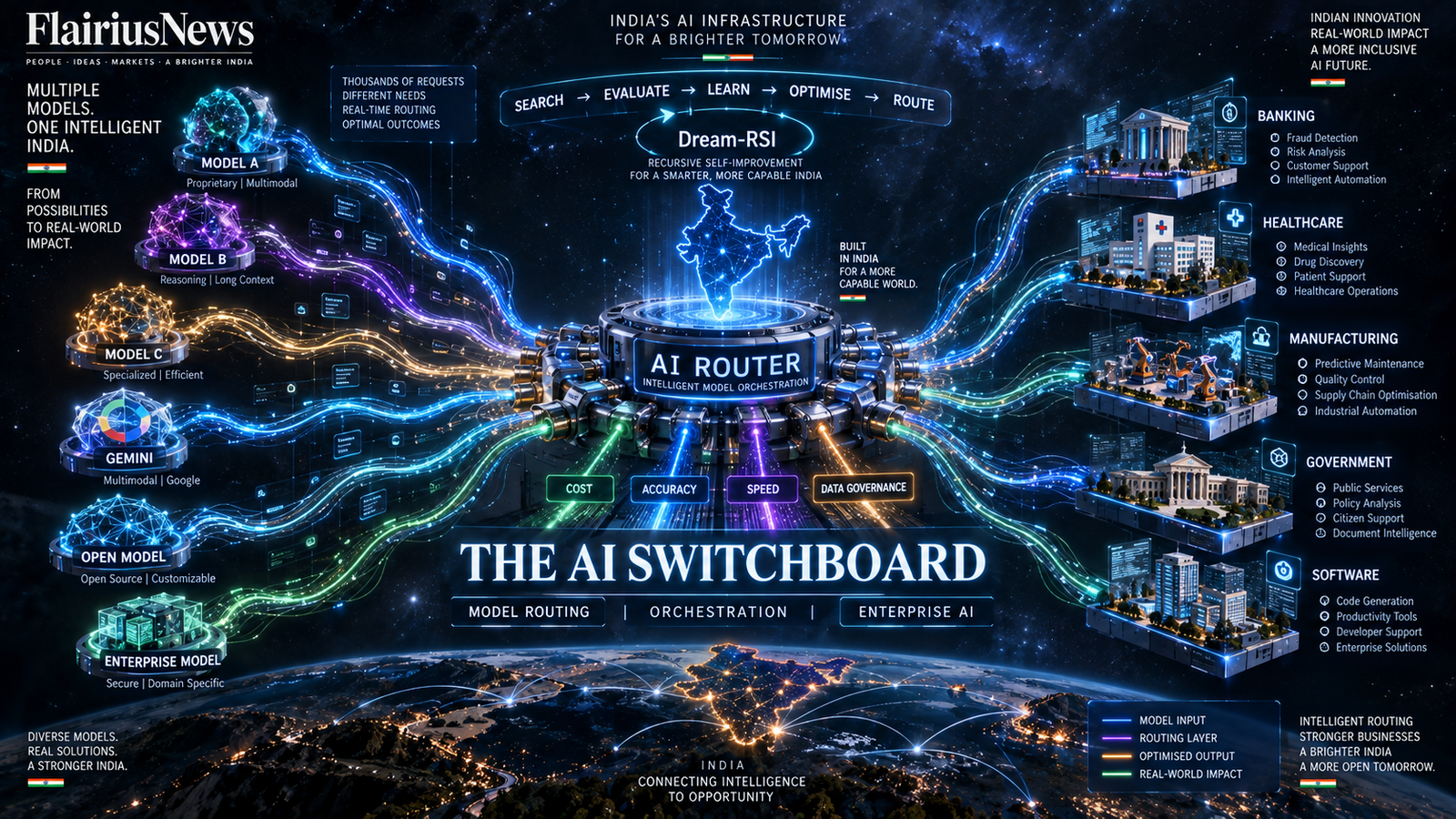
The AI industry has spent years competing over one question:
Who will build the most powerful model?
India’s emerging AI infrastructure startups are asking a different question.
What if companies do not need to choose just one model?
A new group of Indian startups is building AI model routers that automatically direct each query toward the model best suited to the task.
The selection can consider cost, accuracy, speed and data-governance requirements. (The Financial Express)
That could create a new infrastructure layer between enterprises and AI models.
The Problem With Using One Model
Businesses increasingly use multiple AI systems.
One model might be strong at reasoning.
Another may be cheaper for simple requests.
A third could work better with a particular language.
Some companies may also require models that keep sensitive data inside specific environments.
Consequently, choosing one model for everything can become inefficient.
What an AI Router Does
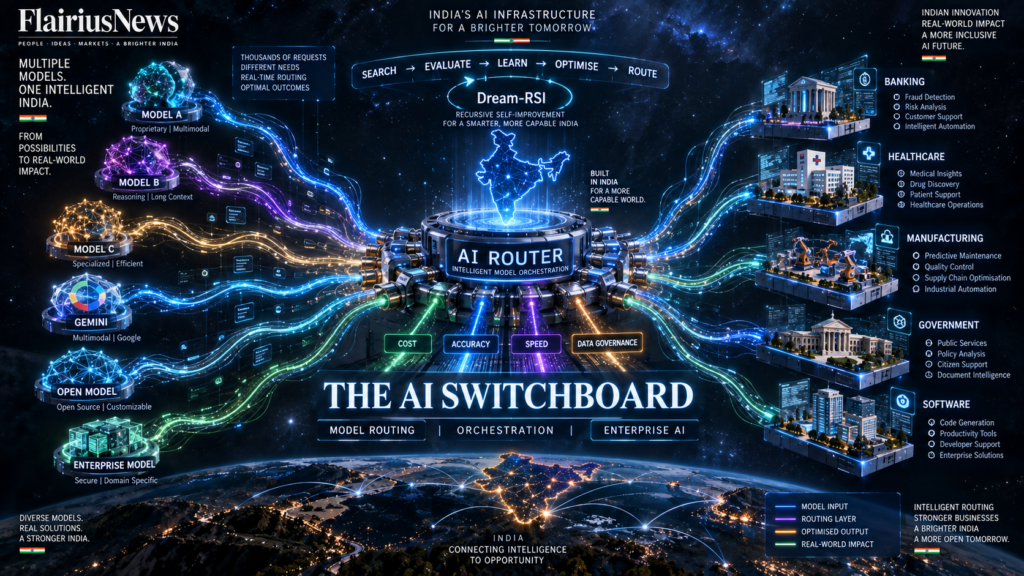
An AI router acts like a switchboard.
A user sends a request.
The router evaluates the task.
Then, it directs that request to an appropriate AI model.
The process can happen automatically.
Therefore, businesses can potentially use multiple models without managing every integration independently.
Indian Startups Are Targeting the Gap
Companies such as Indierouter AI, Staqu Technologies and NthEye are working in this emerging category.
Staqu reportedly serves more than 100 clients with routing capabilities.
Indierouter has attracted around 150 developers since launching its beta in August 2026.
NthEye is deploying routing technology in government applications. (The Financial Express)
The companies are approaching the opportunity from different directions.
However, they share a broader thesis.
AI infrastructure does not necessarily require building the model itself.
Why This Could Be Important for Enterprises
Large organisations may eventually use dozens of AI models.
Managing them individually creates complexity.
Each model requires an API.
Each may have different costs.
Security requirements can also vary.
Consequently, an orchestration layer can simplify the environment.
A router can potentially determine which model should handle a task.
Cost Could Become a Major Driver
Not every question needs the most powerful AI model.
A simple classification task may require little computing power.
A complex research problem may need significantly more.
Therefore, intelligent routing could reduce unnecessary spending.
For large enterprises, even small percentage savings can become meaningful when millions of AI requests are processed.
Data Governance Is Another Advantage
Companies also care about sensitive information.
Some tasks may involve customer records.
Others may involve financial information.
Healthcare data presents another challenge.
Therefore, an AI router could potentially consider data-governance rules before selecting a model.
That makes routing more than a cost optimisation tool.
It becomes part of enterprise AI governance.
The Dream-RSI Connection
This is where Google’s Dream-RSI research becomes particularly interesting.
Dream-RSI focuses on improving how AI agents explore problems.
Rather than simply changing the underlying model, the framework evolves the strategy used to search through possible solutions.
Reported experiments showed substantial reductions in agent calls on some tasks compared with specific baselines.
The broader lesson is important.
AI performance is increasingly about orchestration, not only model capability.
Model routing follows a similar philosophy.
Instead of asking which model is universally best, the system asks which model is best for this particular task.
India Could Build the AI Control Layer
India does not need to compete directly with the largest global companies on foundation-model scale.
That would require enormous computing infrastructure.
Instead, Indian startups can build the infrastructure around those models.
Routing is one example.
Monitoring is another.
Security and governance could become additional layers.
Consequently, India could develop a significant enterprise-AI infrastructure ecosystem without building every foundation model.
The Risk
Model routers also face challenges.
A router must make good decisions.
If it chooses the wrong model, performance can fall.
It also needs to manage constantly changing model capabilities.
Therefore, routing systems must become increasingly intelligent themselves.
The Next AI Infrastructure Battle
The AI market may eventually resemble the internet.
Users will not care which underlying infrastructure handles every request.
They will care about reliability, speed, cost and results.
That creates space for orchestration companies.
The next generation of AI infrastructure may therefore look less like a model and more like a switchboard.
India’s opportunity could be to build that switchboard.
Tags: AI Model Routers, AI Infrastructure India, Google Dream-RSI, AI Orchestration, Enterprise AI, Indian AI Startups, AI Agents
Author CTA: Follow Flairius News — sharp takes on AI, business, and India’s startup economy.