
 By Aditya Agarwal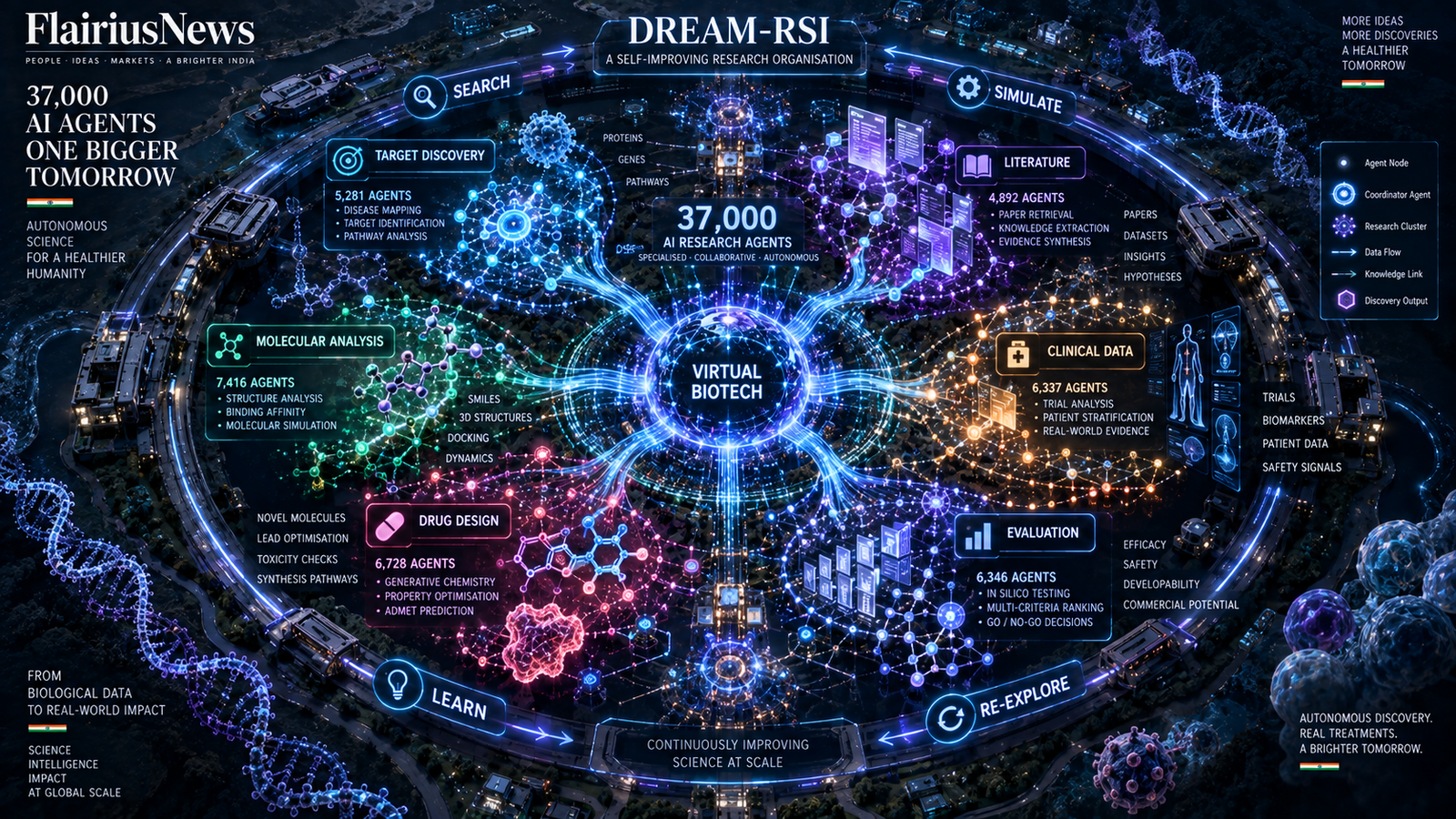
Artificial intelligence is moving deeper into scientific research.
Stanford researchers have created a virtual biotechnology operation involving 37,000 AI agents.
The system is designed to divide scientific work among specialised agents rather than relying on one AI system to perform every task. Reports describe agents working across areas such as target identification, literature analysis and drug-discovery workflows. (The Latest Stories)
The development points toward a new model of AI research.
Instead of one assistant helping a scientist, thousands of specialised agents can operate as a virtual organisation.
From AI Assistant to AI Research Organisation
Most AI tools today are designed around interaction.
A researcher asks a question.
The model responds.
An agent can go further.
It can search.
It can analyse information.
It can execute a sequence of tasks.
Now, researchers are exploring another step.
Multiple agents can be organised into a hierarchy.
One system can coordinate others.
Consequently, the AI begins to resemble an organisation rather than a single assistant.
Why 37,000 Agents Matter
The number is striking.
However, the important point is not simply the number of agents.
It is the architecture behind them.
A large scientific problem can be divided into smaller tasks.
One agent can examine literature.
Another can analyse experimental evidence.
Another can evaluate possible targets.
A coordinating layer can then combine those outputs.
Therefore, the system can explore a much wider research space.
AI and Drug Discovery
Drug discovery is particularly suitable for this approach.
The process involves enormous amounts of information.
Researchers need to examine biological pathways.
They need to understand existing studies.
They must analyse potential molecules.
Clinical information also needs to be considered.
As a result, scientific discovery can involve thousands of interconnected decisions.
AI agents can potentially divide those decisions into manageable tasks.
Google’s Dream-RSI Connection
This is where Google’s Dream-RSI research becomes relevant.
Dream-RSI is a framework for improving an AI agent’s exploration strategy through simulated experience and previous search histories.
Importantly, it is not simply a larger AI model.
Instead, the approach focuses on how an agent decides what to explore next.
That distinction matters.
A multi-agent research system can generate enormous numbers of possibilities.
However, inefficient exploration can waste computing resources.
Therefore, better search strategies could make autonomous research systems more efficient.
Bigger Models Are Not the Only Path
AI development is often described through model size.
More parameters.
More data.
More computing power.
Yet another path is emerging.
Researchers can improve the organisation around the model.
That includes tools.
Memory.
Planning.
Agent coordination.
Search strategies.
Evaluation.
Consequently, future AI systems may become more capable because their surrounding architecture becomes smarter.
The Virtual Company Model
A virtual biotech company is an interesting concept.
A traditional biotech organisation requires scientists, managers, analysts and support teams.
An AI-native organisation can divide those responsibilities among software agents.
The system can operate continuously.
It can also create specialised research roles.
Therefore, AI could eventually change the organisational structure of scientific companies.
Humans Still Matter
This does not mean human scientists become irrelevant.
Scientific research requires judgement.
Experiments need validation.
Safety matters.
Regulatory decisions also require accountability.
Therefore, autonomous AI research should be viewed as an augmentation and experimentation model rather than an automatic replacement for scientific institutions.
The Cost Question
Running thousands of agents requires computing resources.
That creates another challenge.
If every agent performs expensive reasoning independently, the system could become costly.
Consequently, efficiency becomes critical.
This is exactly why approaches such as Dream-RSI are interesting.
Improving search efficiency can reduce unnecessary exploration.
What Comes Next
The combination of large agent networks and better search strategies could reshape scientific computing.
Drug discovery is one possible application.
Materials science could be another.
Climate research could also benefit.
Mathematical discovery is another potential area.
However, these applications require rigorous validation.
The important shift is already visible.
AI is moving from answering questions to organising complex research processes.
And if systems can learn not only what to search but how to search efficiently, autonomous scientific research could become one of the most important AI frontiers of the next decade.
Tags: AI Agents, Stanford AI, 37000 AI Agents, AI Drug Discovery, Google Dream-RSI, Recursive Self Improvement, Autonomous Research
Author CTA: Follow Flairius News — sharp takes on AI, business, and India’s startup economy.