 By Aditya Agarwal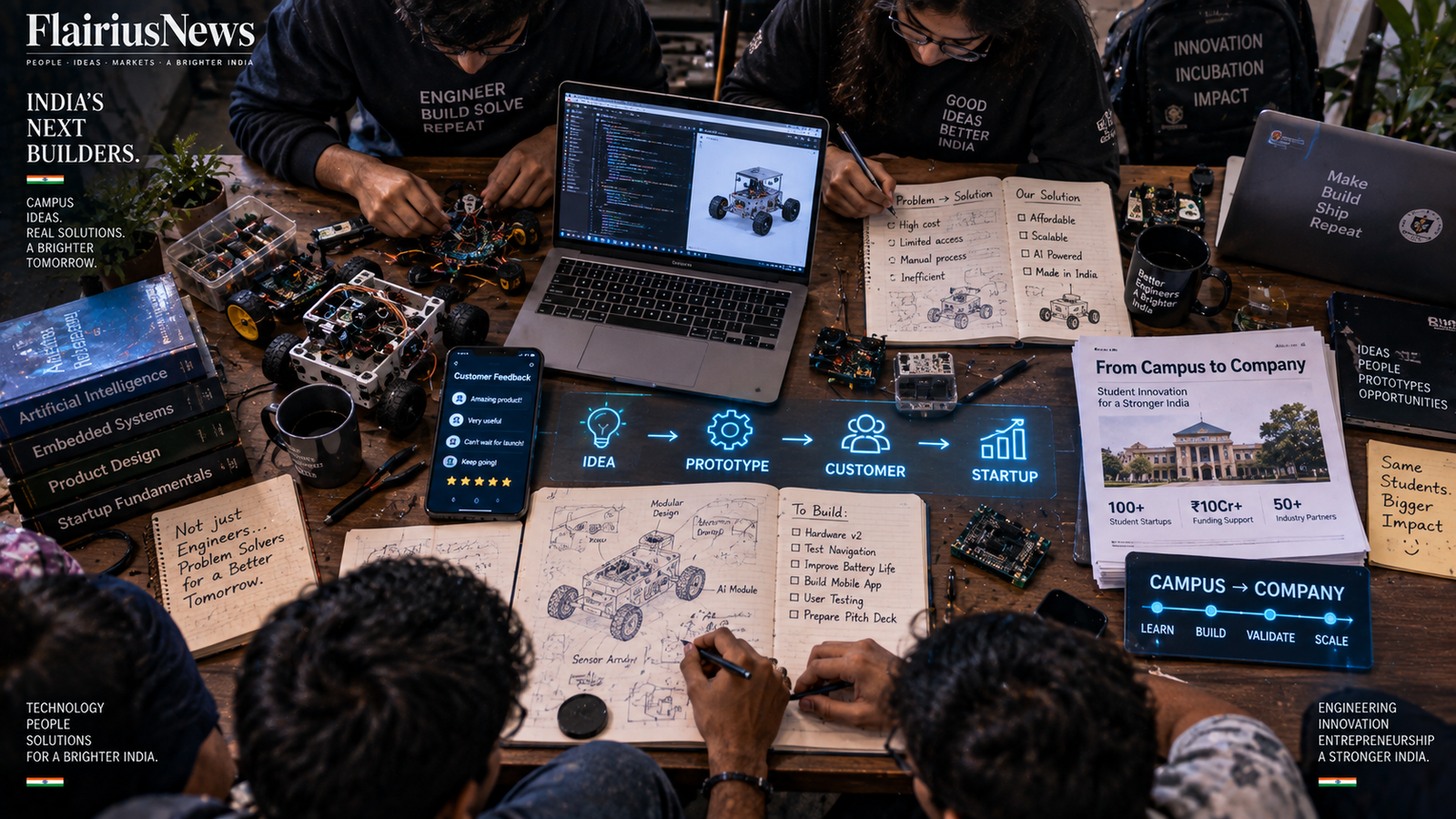
India’s engineering campuses are changing.
For decades, the traditional path was straightforward.
Graduate.
Join a technology company.
Build experience.
Then consider entrepreneurship later.
That sequence is beginning to change.
A growing number of engineering students are exploring startups before entering traditional employment. A report published today highlights rising interest in entrepreneurship across Indian campuses, supported by AI tools, incubators, mentorship and easier access to early-stage resources. (The Financial Express)
The change could influence India’s next founder generation.
AI Has Reduced the Cost of Starting
Building a software product once required a large technical team.
Today, AI can assist with coding, research, design, testing and documentation.
Consequently, a student with a laptop can build a working prototype much faster.
That does not guarantee a successful company.
However, it changes the starting point.
A student can test an idea before hiring a team.
Campus Incubators Are Becoming More Important
Universities are also changing their role.
Instead of simply preparing students for employment, some institutions are building stronger startup ecosystems.
IIT Bombay’s SINE and IIT Kanpur’s entrepreneurship infrastructure are examples of campus systems designed to support founders. (The Financial Express)
These environments can provide mentorship.
They can also provide access to investors, laboratories and other founders.
Therefore, students no longer have to build everything alone.
The New Student Founder
The student entrepreneur is also changing.
Earlier, many student startups focused on simple consumer applications.
Now, AI is pushing students toward more technical opportunities.
These include robotics.
Biotechnology.
Developer tools.
Enterprise software.
Semiconductors.
Consequently, university campuses could become early laboratories for India’s next technology companies.
Why AI Changes the Equation
AI gives students access to capabilities that previously required specialist teams.
A founder can use an AI coding assistant.
Another system can help analyse competitors.
A third can support customer research.
Meanwhile, generative tools can accelerate design and marketing.
As a result, the cost of experimentation has fallen.
That makes it easier to test multiple ideas before committing significant capital.
Entrepreneurship Still Requires Customers
Lower startup costs do not eliminate the hardest problem.
Customers still need to care.
A prototype can be built quickly.
Product-market fit cannot.
Therefore, student founders need to leave the campus environment and talk to real users.
They need to understand pricing.
They also need to learn distribution.
The Campus-to-Startup Pipeline
The emerging model looks different from the traditional employment pipeline.
Instead of:
College → Job → Experience → Startup
students can increasingly follow:
College → Problem → Prototype → Customer → Startup
That does not mean employment becomes irrelevant.
Many founders will still work before starting companies.
However, the option to experiment earlier has become much more accessible.
India Needs More Technical Founders
India’s technology economy has historically produced enormous software talent.
The next opportunity is to turn more of that talent into companies.
AI can help.
University incubators can help.
Investors can help.
Furthermore, experienced founders can mentor students through the difficult early stages.
The Risk of Moving Too Fast
There is also a downside.
AI makes building easier.
Therefore, more people can create products.
That can increase competition.
Students may also confuse technical achievement with business validation.
Consequently, entrepreneurship education needs to focus on customers, economics and execution alongside technology.
A New Career Option
For today’s engineering student, entrepreneurship is becoming another career path.
It does not need to be an all-or-nothing decision.
A student can build on weekends.
They can test a product with a small user group.
They can participate in an accelerator.
Eventually, they can decide whether to pursue the company full-time.
India’s next founder generation may therefore emerge earlier than before.
The campus is no longer only a place to prepare for the job market. It is increasingly becoming a place to test whether a student can create one.
Tags: Student Entrepreneurship India, Indian Founders, College Startups, AI Entrepreneurship, Engineering Students, Startup Ecosystem
Author CTA: Follow Flairius News — sharp takes on AI, business, and India’s startup economy.