
 By Aditya Agarwal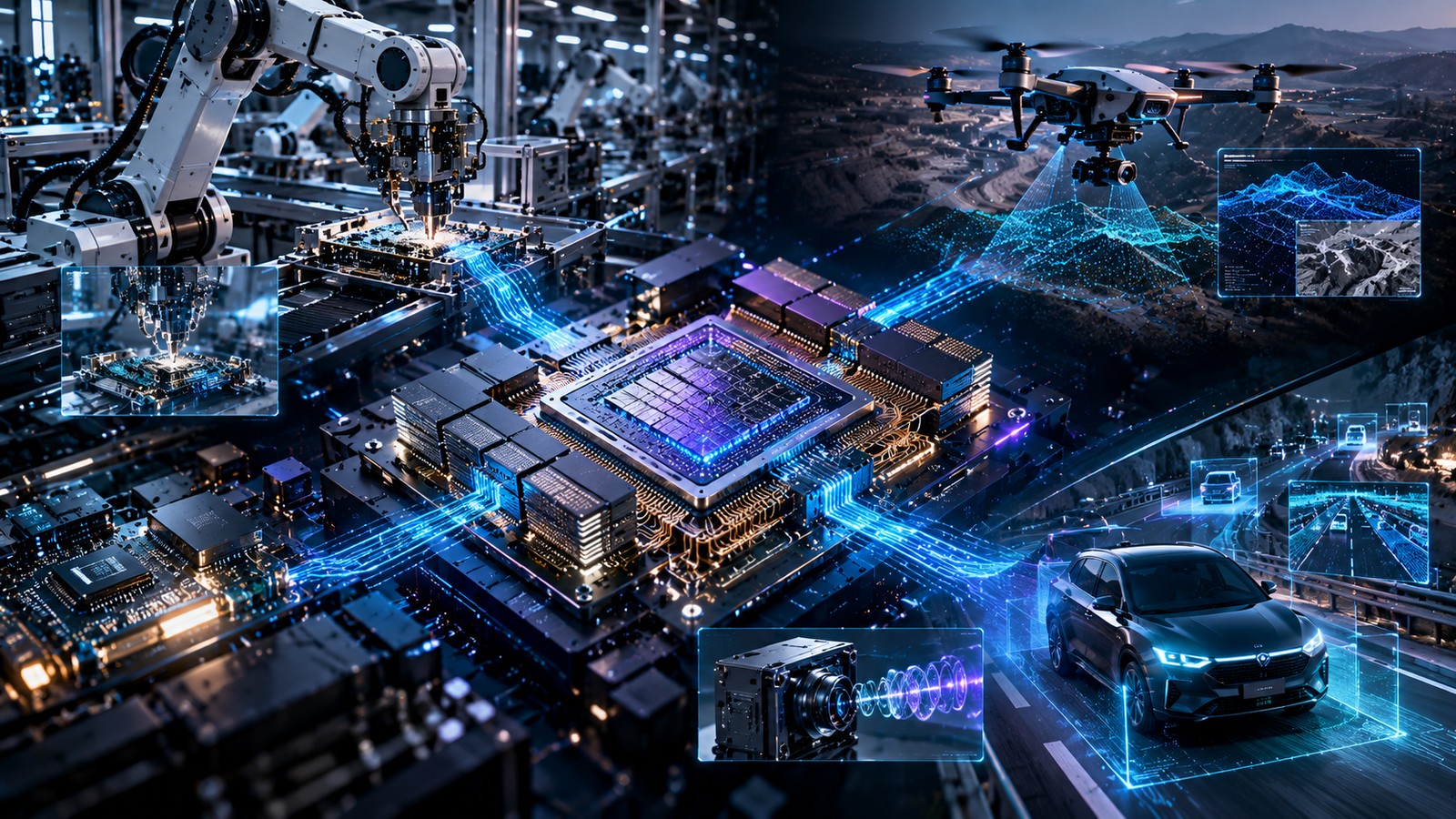
SiMa.ai raises $150 million
US-India AI platform company SiMa.ai has raised $150 million in Series C funding, bringing its valuation to approximately $1.4 billion.
The company said the latest round brings its total capital raised to approximately $500 million.
The entire Series C consists of primary capital.
SiMa.ai plans to use the funding to scale its next-generation AI silicon and software platform for physical AI applications.
Those applications include robotics, drones and automotive systems.
Physical AI needs different computing
Much of today’s AI infrastructure is designed around cloud computing.
Large data centres train and run models.
However, physical AI creates a different computing requirement.
A robot needs to process information close to its sensors.
A drone cannot constantly send every camera frame to a distant data centre.
An autonomous vehicle needs extremely fast responses.
Therefore, edge computing becomes important.
AI systems need to process information locally while operating within strict limits on power, latency and physical space.
That is the market SiMa.ai is targeting.
Software and silicon come together
SiMa.ai is not positioning itself solely as a chip company.
Its platform combines hardware and software.
That matters because AI acceleration depends on the entire computing stack.
A powerful processor is less useful if developers cannot easily deploy models on it.
Similarly, software optimisation cannot overcome insufficient hardware performance.
The company is therefore attempting to provide a complete edge-AI platform.
Its technology is designed to run AI workloads close to where data is generated.
That can reduce latency and potentially lower the amount of information sent to cloud infrastructure.
Robotics is becoming a major AI market
The growth of physical AI is closely connected to robotics.
Robots increasingly use computer vision, sensor fusion and machine-learning models.
Those systems need real-time processing.
Consider a warehouse robot.
It needs to identify objects.
It needs to understand its surroundings.
It must also make movement decisions quickly.
Sending every calculation to the cloud can create latency and connectivity problems.
Local AI processing offers another route.
The same logic applies to drones and industrial machines.
Automotive systems add another opportunity
Automotive AI is another important application.
Vehicles increasingly contain cameras, radar, sensors and computing systems.
Advanced driver-assistance systems need to process large volumes of information continuously.
That creates demand for efficient edge computing.
However, automotive hardware also faces strict requirements.
Reliability is critical.
Thermal performance matters.
Power consumption matters.
Software updates and long product lifecycles also influence purchasing decisions.
Therefore, becoming a supplier to automotive companies can take years.
The $1.4 billion valuation reflects investor interest
The latest funding round gives SiMa.ai a valuation of around $1.4 billion.
That makes it another example of investors placing large amounts of capital behind specialised AI hardware.
However, valuation should not be confused with commercial maturity.
AI-chip companies face substantial engineering and manufacturing challenges.
They also compete against large semiconductor companies with enormous resources.
SiMa.ai therefore needs to demonstrate that its specialised architecture can win customers in specific physical-AI workloads.
India connection strengthens
SiMa.ai has a US-India identity.
That gives the company access to India’s growing semiconductor and AI engineering talent.
India is increasingly becoming part of global chip-design and AI-hardware supply chains.
However, designing AI silicon is different from operating a semiconductor fabrication facility.
The company can build architecture and software while relying on external manufacturing partners.
That model allows specialised chip startups to operate without owning fabs.
Why physical AI matters now
The AI industry is moving from digital applications toward machines that interact with the physical world.
That changes the infrastructure requirement.
A chatbot can tolerate a small delay.
A robot navigating around a person cannot.
A drone avoiding an obstacle needs immediate processing.
An autonomous vehicle needs predictable latency.
As a result, physical AI can create a significant market for specialised edge hardware.
SiMa.ai is positioning itself around that transition.
The next test is deployment
The latest $150 million gives the company additional capital to scale.
But the important milestones will come from customers and deployed systems.
SiMa.ai needs its technology to move from demonstrations into production environments.
That requires reliability, developer adoption and competitive economics.
If those pieces align, specialised AI silicon could become a major part of the physical-AI ecosystem.
For now, the funding round shows that investors continue to put significant capital behind the hardware required to move AI beyond screens and into machines.
Tags: SiMa.ai, physical AI, AI chips, startup funding, edge AI, robotics, semiconductor, deeptech
Flairius CTA: Follow Flairius News — sharp takes on AI, business, and India’s startup economy — flairiusnews.com