
 By Aditya Agarwal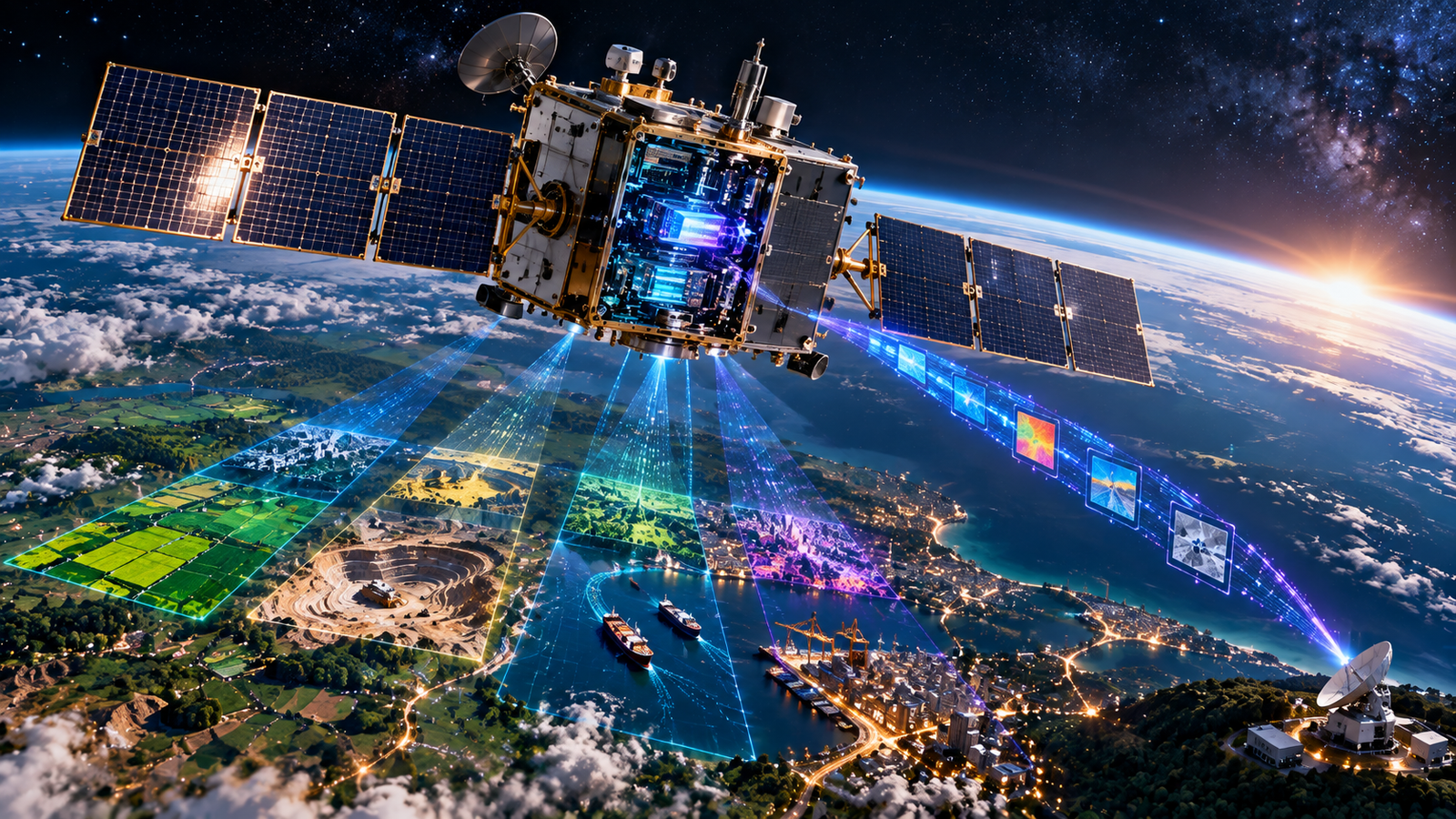
Computing moves from Earth toward orbit
Indian space startup TakeMe2Space is preparing to launch what it describes as India’s first orbital-computing satellite.
The company’s MOI-1A spacecraft is scheduled to launch on October 1 aboard SpaceX’s Transporter-18 rideshare mission.
The satellite weighs less than 50 kilograms.
More importantly, it carries Nvidia Orin NX edge-computing processors designed to process data in orbit. (The Economic Times)
The concept changes the traditional satellite-data model.
Normally, satellites collect large amounts of information and transmit that data to Earth.
Ground systems then process it.
TakeMe2Space wants to perform part of that computation before the data leaves orbit.
Why computing in orbit could matter
Satellite data can be extremely large.
High-resolution Earth imagery is a good example.
A satellite may collect enormous datasets while passing over a specific location.
Transmitting all of that information to Earth consumes bandwidth.
It can also take time.
Orbital computing offers another approach.
The satellite can process the data locally.
It can then send the useful result instead of transmitting the entire raw dataset.
That can reduce the amount of information that needs to travel between orbit and ground stations.
TakeMe2Space founder and CEO Ronak Samantray told Reuters that customers could upload containerised AI models to the satellite.
Those models would process data over a specified area.
The satellite would then transmit the analysis rather than the full underlying dataset. (The Economic Times)
The company already has customers lined up
TakeMe2Space said it has signed 23 customers for the mission.
The customer base includes geographic-information companies and educational institutions.
Commercial applications span agriculture, mining, supply-chain management and insurance.
US-based space-data analytics company Little Place Labs is among the customers. (The Economic Times)
That customer mix is important.
It shows that orbital computing is not being positioned only as a scientific experiment.
The company is attempting to build a commercial service.
However, the business model still needs to prove itself at operational scale.
The first mission will provide an important demonstration.
The economics depend on data movement
The business case rests partly on the cost of transmitting raw satellite data.
If a customer needs to download large quantities of information, communication costs can become significant.
Processing data in orbit could reduce those costs.
Customers would instead pay for computing capacity and receive the processed output.
That creates a different economics model.
The satellite becomes a small computing platform.
It is no longer only a camera or sensor.
TakeMe2Space says the spacecraft has approximately 150 watts of power, making it an edge-computing satellite rather than a conventional data centre. (The Economic Times)
That distinction matters.
The hardware remains constrained by space.
Power is limited.
Thermal management is difficult.
Radiation also creates engineering challenges.
Therefore, orbital computing cannot simply replicate a terrestrial cloud server.
Nvidia hardware is part of the architecture
The MOI-1A carries Nvidia Orin NX processors.
These are designed for edge computing rather than massive terrestrial AI data centres.
That makes them appropriate for a constrained satellite environment.
The system must perform useful computation while operating with limited power.
This creates an interesting intersection between AI and space technology.
AI models are becoming smaller and more efficient.
At the same time, satellites are becoming more capable.
Together, those trends make on-orbit processing increasingly practical.
The longer-term ambition is larger networks
The October mission is only the beginning of TakeMe2Space’s longer-term plan.
The company wants to develop larger, networked satellites capable of serving multiple customers.
That would move the business from a single demonstration satellite toward an orbital computing network.
Such a network could potentially process information across multiple locations.
It could also create redundancy and increase available computing capacity.
However, scaling from one spacecraft to a network is a major engineering challenge.
Launch schedules, satellite reliability, communication links and customer demand all need to align.
India’s space startup ecosystem is expanding
TakeMe2Space’s approach reflects the increasing diversity of India’s private space sector.
Indian startups are no longer focused only on rockets.
They are developing satellites, sensors, Earth-observation systems, propulsion technologies and space-data services.
Orbital computing adds another category.
It treats space infrastructure as a computing environment.
That could eventually connect satellite technology with AI, defence, agriculture, insurance and logistics.
The October 1 test
The immediate milestone is simple.
MOI-1A has to reach orbit and operate as planned.
The company then needs to demonstrate that customers can successfully run models and receive useful results.
If the system works, the commercial proposition becomes clearer.
Satellite operators could process information closer to where it is collected.
That could reduce data-transfer requirements and accelerate certain applications.
The launch therefore represents more than another Indian satellite mission.
It is a test of whether computing itself can become part of the commercial space-services layer.
Tags: TakeMe2Space, orbital computing, Indian space startup, AI satellite, Nvidia, SpaceX, deeptech, edge computing
Flairius CTA: Follow Flairius News — sharp takes on AI, business, and India’s startup economy — flairiusnews.com