
 By Aditya Agarwal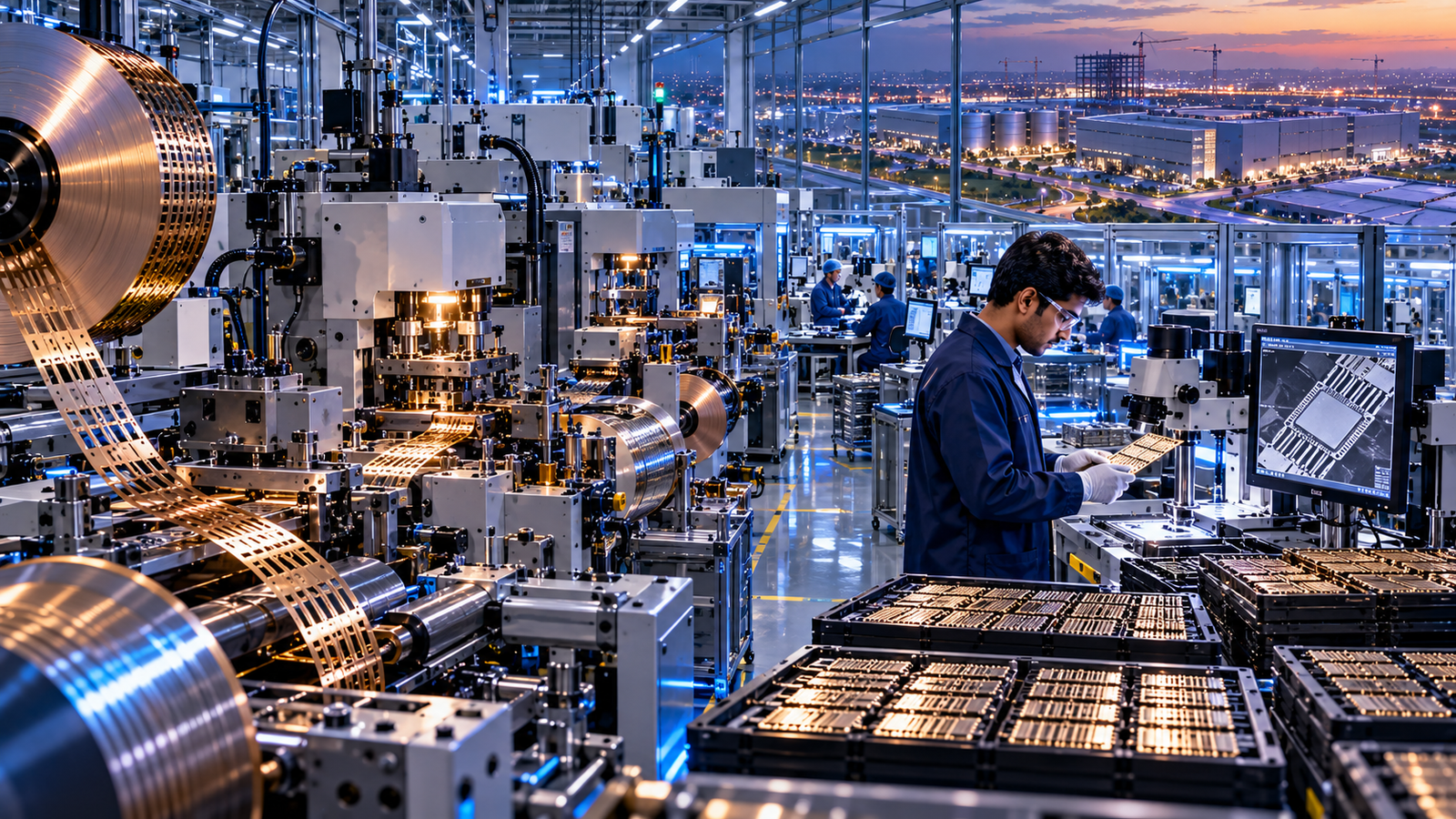
A young founder chooses hardware over apps
At a time when many young entrepreneurs are entering software and artificial intelligence, Ahmedabad-based Rehan Mansuri is taking a different route.
At 18, Mansuri has launched Micronex, a startup planning to manufacture semiconductor lead frames in Sanand, Gujarat.
The project involves an investment of approximately ₹80 crore.
Micronex plans to begin production by May 2027.
Its first phase is expected to have annual capacity of approximately 50 crore lead-frame units, according to an official statement reported by The Times of India. (The Times of India)
The business is significant because lead frames are a basic but essential part of semiconductor packaging.
They provide the structural and electrical connection between a semiconductor chip and its package.
Therefore, they sit inside the physical supply chain that allows chips to become usable electronic components.
Why lead frames matter
Semiconductor discussions often focus on wafer fabrication.
However, chip manufacturing does not end when a transistor is created on a wafer.
The chips must be cut, packaged, connected and tested.
Lead frames are part of that packaging process.
They provide a platform on which semiconductor dies can be mounted.
They also help connect the chip electrically to external circuitry.
That makes them a relatively specialised component.
For India, developing domestic capabilities in such components can strengthen the semiconductor ecosystem beyond fabrication.
The opportunity is therefore broader than building semiconductor fabs.
Packaging materials, testing equipment, precision machinery and component suppliers all form part of the ecosystem.
Sanand is becoming a manufacturing node
Micronex is planning its facility in Sanand, one of Gujarat’s emerging semiconductor and electronics manufacturing locations.
The choice is strategically relevant.
Sanand has attracted semiconductor-related projects and electronics manufacturing investments.
That creates the possibility of clustering.
When suppliers locate close to major manufacturers, logistics can become easier.
Specialised workers can also move between companies.
Furthermore, engineering capabilities can develop around a concentrated industrial base.
However, clusters take time.
A factory does not automatically create a supply chain.
Companies need customers, quality certifications, reliable utilities and production consistency.
An unusual entrepreneurial choice
Mansuri’s decision is notable because hardware manufacturing is capital intensive.
A software company can often launch with a relatively small team.
A manufacturing company needs machinery, land, utilities, quality systems and working capital.
The development cycle is also longer.
Micronex is targeting production in 2027.
That means the business will spend significant time building capacity before commercial operations begin.
This is fundamentally different from the rapid iteration cycle associated with consumer internet startups.
Nevertheless, semiconductor components can offer a different kind of opportunity.
Once customers qualify a supplier, relationships can become more durable.
The manufacturing process also creates technical barriers that are harder to replicate than a simple software feature.
The Kaynes Semicon connection
Micronex has already signed a memorandum of understanding with Kaynes Semicon, according to the company information reported by The Times of India.
The MoU was signed during Semicon India 2026 in New Delhi.
The potential relationship gives the young company an important connection to India’s semiconductor manufacturing ecosystem. (The Times of India)
However, an MoU is not the same as a long-term commercial supply contract.
The project will ultimately need to demonstrate manufacturing quality and reliability.
That distinction is important.
The company’s planned production capacity is an ambition.
Its eventual commercial output will depend on execution, equipment installation, qualification and customer demand.
Why young founders entering hardware matters
India’s startup ecosystem has traditionally produced large numbers of software and consumer businesses.
Hardware entrepreneurship has developed more slowly.
The capital requirements are higher.
The regulatory environment can also be more complicated.
Moreover, specialised manufacturing requires technical talent.
Therefore, young founders entering industrial businesses can broaden the definition of Indian entrepreneurship.
The opportunity is especially relevant in sectors where India is attempting to build domestic supply chains.
Semiconductors are one example.
Advanced batteries, industrial electronics, aerospace components and precision manufacturing are others.
The bigger opportunity is the supply chain
India does not need only semiconductor fabs.
It needs the companies around them.
Those companies can supply materials, equipment, packaging components, testing services and specialised manufacturing.
That creates opportunities for smaller entrepreneurs.
A founder does not necessarily need to build a ₹50,000-crore fabrication plant.
A specialised component business can become strategically valuable by solving a smaller problem inside the same ecosystem.
Micronex represents that approach.
Its initial ambition is focused.
It is not trying to manufacture an entire semiconductor.
Instead, it is targeting one component within the packaging chain.
The test ahead
The next milestone will be production.
Micronex plans to begin manufacturing in May 2027.
Until then, the company must build its facility, install equipment and establish the required manufacturing processes.
It will also need to demonstrate quality at commercial scale.
If successful, the business could become an example of a new type of Indian entrepreneurship.
One that combines youth with industrial manufacturing.
One that targets global supply chains rather than only domestic digital consumers.
And one that builds around a small but important component of a much larger technology industry.
Tags: Rehan Mansuri, Micronex, semiconductor, entrepreneurship, Gujarat, Sanand, manufacturing, Indian founders
Flairius CTA: Follow Flairius News — sharp takes on AI, business, and India’s startup economy — flairiusnews.com
[…] Flairius News has previously covered India’s emerging semiconductor entrepreneurship through Micronex and India’s semiconductor supply chain. […]