
 By Aditya Agarwal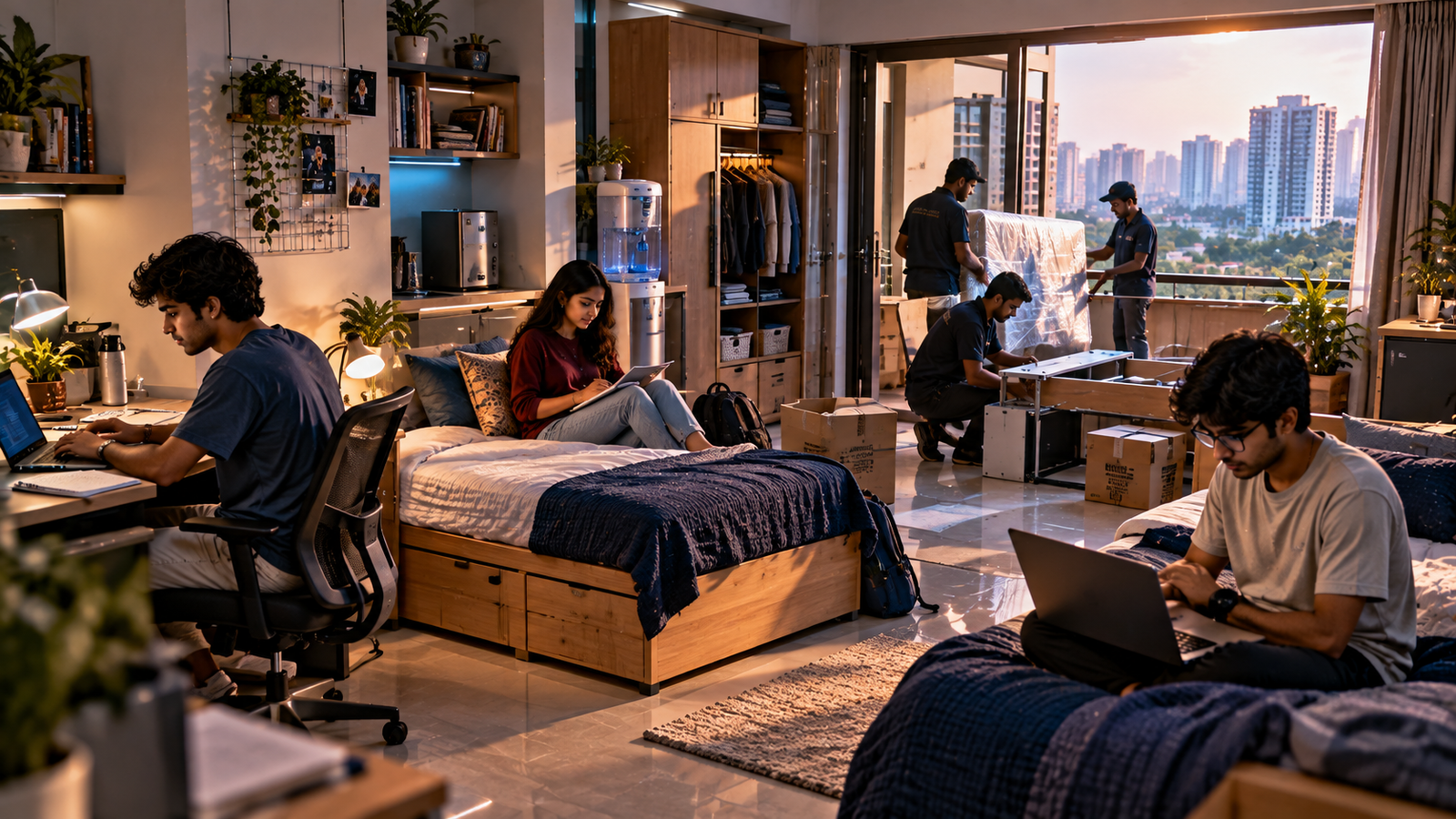
Moving to a new city for college creates a practical problem that is often overlooked by India’s education ecosystem.
Students need beds, mattresses, wardrobes, study tables, appliances and basic household equipment.
Buying everything at once can be expensive.
Selling or transporting it again after graduation can be equally inconvenient.
Indian startup Gharbar is building a business around that gap.
Founded by brothers Rahul Chandra and Shashi Chandra, the company provides basic household amenities to students through a rental model.
From Personal Problem to Business
The founders grew up in Bihar and moved away from home themselves.
Their experience eventually led them to a broader observation.
Students moving to cities often have two choices.
They can purchase household products they may only need for a limited period.
Alternatively, they can accept lower-quality or incomplete living arrangements.
Gharbar attempts to create a middle option.
Its model is called Basic Amenities on Rent, or B.A.R.
The company initially offered four products: beds, mattresses, almirahs and water purifiers.
Its catalogue has since expanded to around 15 essential furniture and household SKUs.
Rental Instead of Ownership
The model changes the economics of student living.
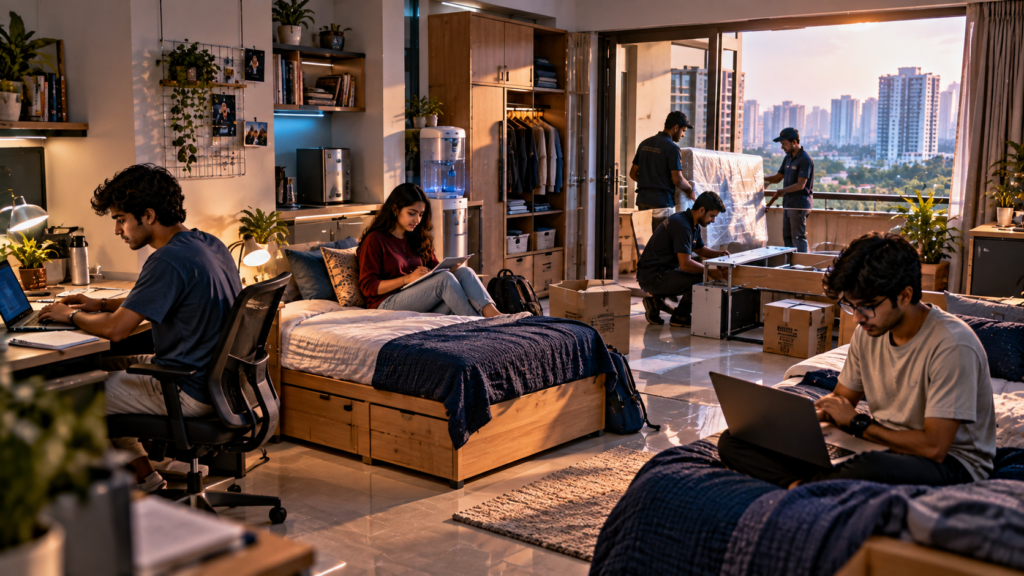
A student does not need to purchase a refrigerator, mattress or wardrobe for permanent ownership.
Instead, the company can deliver the item, install it and maintain it throughout the rental period.
When the student moves, the product can be collected and reused.
That creates the potential for a circular rental model.
However, the economics depend heavily on product durability and utilisation.
Furniture needs to survive multiple rental cycles.
Delivery and collection also need to remain efficient.
Consequently, Gharbar’s operating model is as important as its customer proposition.
Manufacturing Could Become a Competitive Advantage
The company is developing its own furniture manufacturing capabilities.
That allows Gharbar to design products specifically for repeated rental use.
Standardised and modular furniture can potentially reduce repair costs.
It can also simplify transportation and maintenance.
This is different from simply purchasing conventional consumer furniture and renting it out.
The company is attempting to build products around the rental lifecycle itself.
Early Traction in Delhi-NCR
Gharbar says it has served more than 1,500 students across North Delhi.
The startup is now preparing to expand further across Delhi-NCR.
The region provides a large potential customer base because of its concentration of universities, coaching centres and private colleges.
However, the market is fragmented.
Students live across hostels, rented apartments, paying-guest accommodation and shared housing.
That fragmentation makes distribution important.
The company will need to develop efficient delivery routes while maintaining affordable rental prices.
Building Around an Underserved Customer
Gharbar has received support through the Startup India Seed Fund Scheme.
It has also received backing from AlloyX Ventures and early-stage angel investors, while SBI is a debt partner.
The startup was incubated through DTU-IIF and Udhmodya Foundation.
Its early development highlights a broader opportunity in India’s startup ecosystem.
Not every consumer problem requires a high-frequency app.
Some businesses can be built around physical infrastructure and recurring service requirements.
Student living is one such market.
A Larger Student-Living Ecosystem
Gharbar’s longer-term ambition extends beyond furniture rental.
Once a company understands where students live and what they need, it can potentially build additional services around the same customer base.
That could include appliances, household maintenance and other recurring needs.
However, expansion must remain disciplined.
Asset-heavy rental businesses require capital because inventory must be purchased before revenue is generated.
Therefore, utilisation rates, maintenance costs and customer retention will determine whether the model can scale efficiently.
Gharbar is still an early-stage company.
Its significance lies less in its current size and more in the problem it is attempting to solve.
India’s student population is increasingly mobile.
As students move between cities for education, the infrastructure required to support that mobility is becoming a business opportunity of its own.
Tags: Gharbar, Student Living, Startup India, Furniture Rental, Delhi NCR, Consumer Startup, Indian Startups
Flairius CTA:
Follow Flairius News — sharp takes on AI, business, and India’s startup economy — flairiusnews.com