
 By Ahana Verma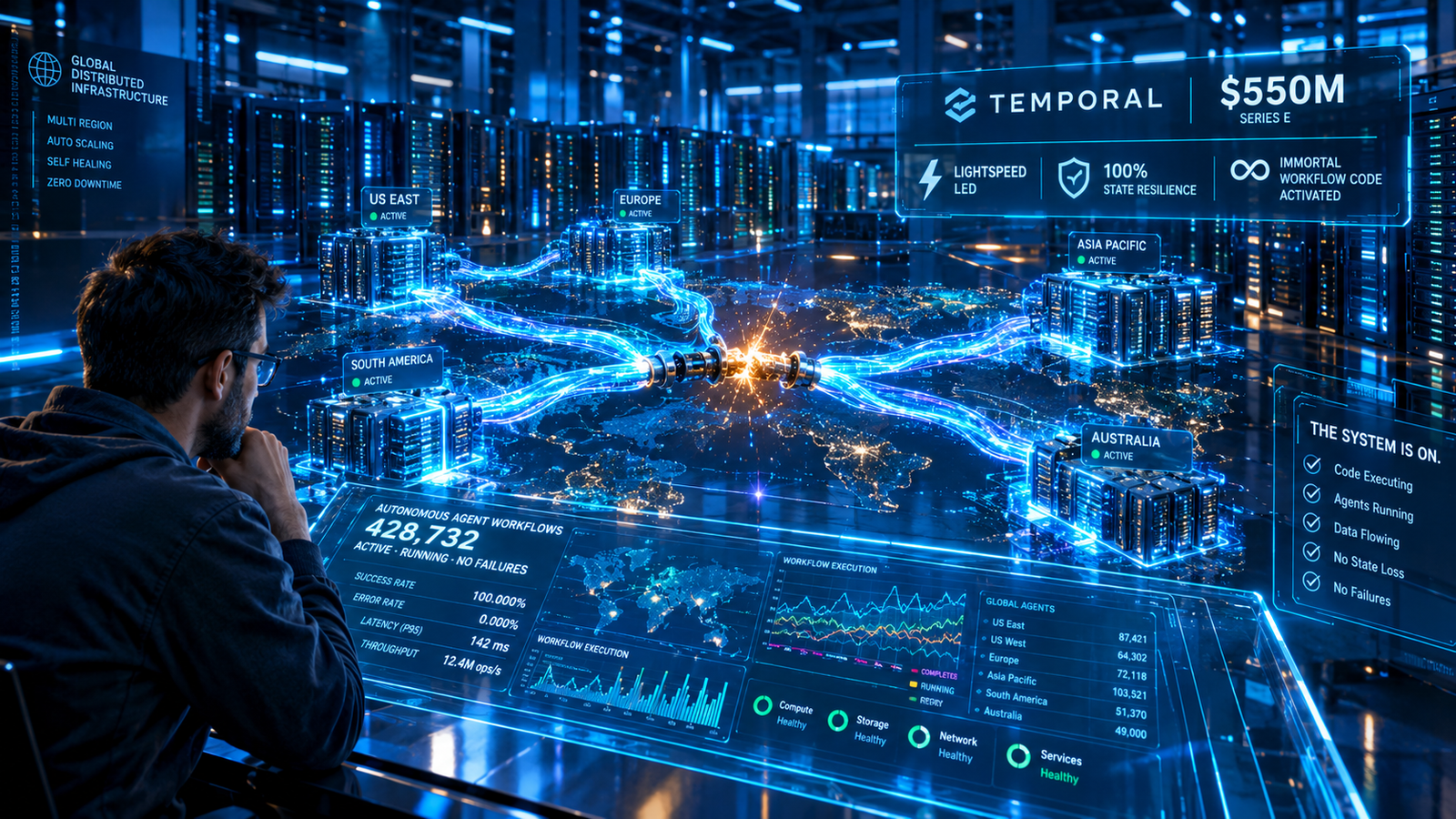
Building autonomous software agents is straightforward in simple pilot environments. However, keeping multi-step algorithmic workflows alive across fragile distributed cloud networks is an immense engineering nightmare.
When an automated agent orchestrates financial transactions, provisions servers, and queries legacy databases, a momentary network timeout or API error crashes the entire process. In high-consequence enterprise applications, lost transactional states can trigger multi-million-dollar bookkeeping discrepancies.
To solve this vulnerability, enterprise infrastructure leader Temporal raised $550 million in a Series E funding round led by Lightspeed. The capital injection confirms that durable execution has become the mandatory foundation for the entire agentic enterprise economy in late 2026.
Why Autonomous Workflows Break in Production
Traditional software architecture relies on stateless microservices. When an enterprise program completes a task, it saves the output to a database, dispatches an external API call, and hopes the downstream system responds predictably.
Yet in complex, multi-agent workflows, tasks span hours, days, or even weeks. An autonomous compliance agent must pull records, await human authorization, verify payment transfers, and issue receipts across divergent systems.
If a server restarts or a third-party API fails halfway through that sequence, classical systems lose track of the operational state. Engineering teams traditionally spent up to 60% of their development time writing brittle custom retry loops, failure handlers, and database locks to prevent state corruption.
The Power of Durable Execution
Temporal eliminates this technical drag through a framework known as durable execution. The technology treats distributed code as immortal, guaranteeing that program state persists seamlessly through hardware crashes, network splits, and code upgrades.
Specifically, if a cloud server running an automated AI workflow suddenly loses power, Temporal restores the exact execution state on another server in milliseconds. The program resumes precisely where it stalled, without re-executing completed operations or duplicating financial charges.
Furthermore, developers write standard, sequential code in familiar languages like Python, TypeScript, and Go. The platform abstracts away all distributed systems complexity, allowing engineering teams to deploy complex multi-agent workflows with zero custom recovery infrastructure.
Becoming the Operating System for Agentic Tech
Enterprise investment in durable execution proves that the artificial intelligence market is transitioning from experimental prompt tools into mission-critical corporate operations. Global banks, logistics operators, and SaaS unicorns now run their core operational pipelines on durable runtimes.
When financial institutions process automated cross-border settlements, durable execution ensures transactions settle correctly despite unexpected network partitions. Similarly, autonomous customer support agents reference immutable execution logs, preventing duplicate client refund disbursements.
Additionally, durable execution bridges human-in-the-loop workflows. If an autonomous agent requires human managerial approval before issuing a $100,000 purchase order, the program pauses its state safely for days, resuming instantly once the manager clicks approve.
Autonomous intelligence cannot function without unbreakable infrastructure. By raising $550 million to harden workflow durability, Temporal is constructing the central nervous system for tomorrow’s autonomous digital corporations.
Tags: Temporal AI, Durable Execution, Microservices Resilience, Enterprise AI 2026, Series E Funding, Distributed Systems, Software Reliability, Lightspeed Venture Partners Author CTA: Follow Flairius News — sharp takes on AI, business, and India’s startup economy — flairiusnews.com
 Raghav Sharma
  Aditya Agarwal