
 By Raghav Sharma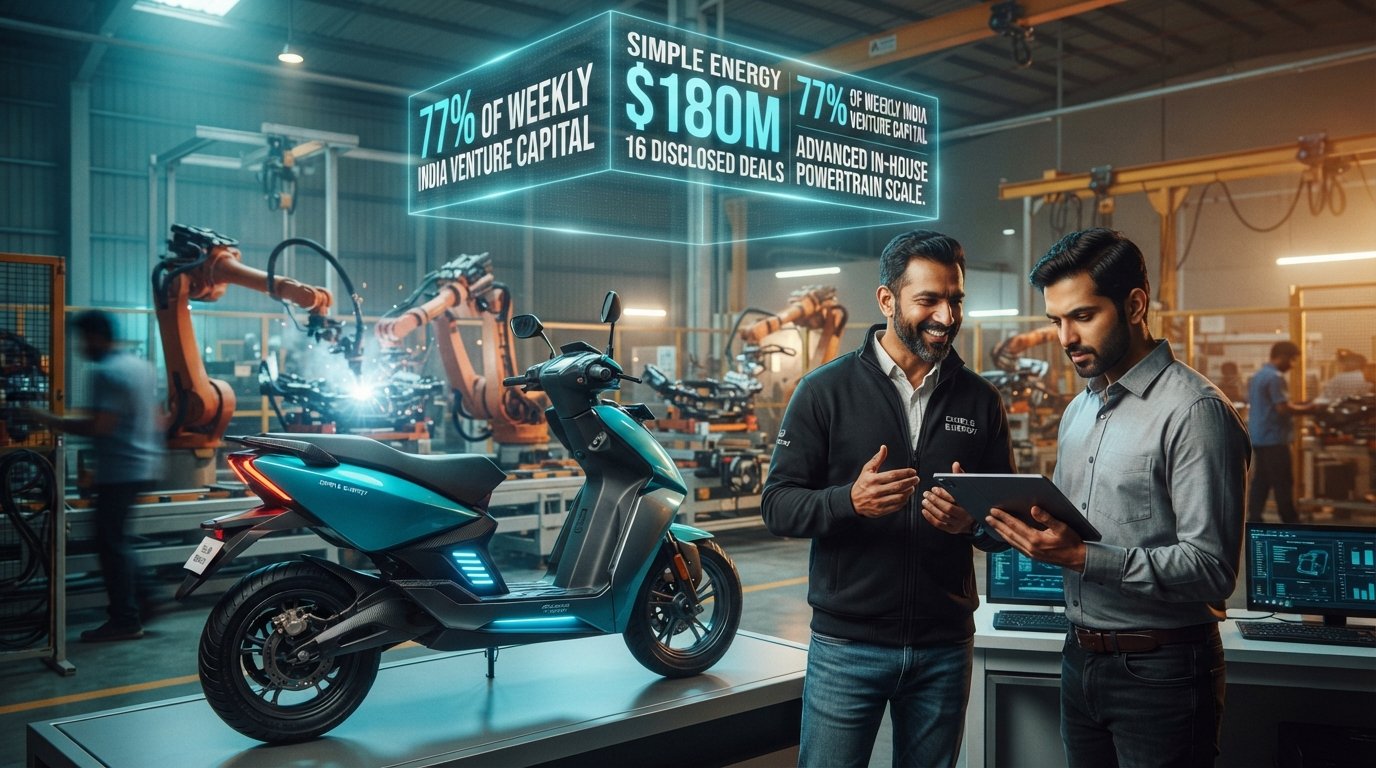
India’s venture capital funding landscape experienced a dramatic capital concentration this autumn. During the final week of September 2026, Indian technology startups raised an impressive $233.6 million across 16 disclosed funding transactions.
However, the headline story belongs to a single clean-technology champion. Bengaluru-based electric two-wheeler maker Simple Energy announced a massive $180 million Series C round, accounting for roughly 77% of the entire week’s venture total.
Consequently, clean technology emerged as the undisputed heavyweight category of the funding cycle. The landmark capital deployment proves that growth-stage investors are aggressively backing high-conviction hardware manufacturers with proven intellectual property and scalable assembly capacity.
How Simple Energy Captured Capital Dominance
While software and edtech startups raised smaller, modest rounds, Simple Energy commanded the lion’s share of investor checks. The electric vehicle manufacturer established its competitive positioning through relentless in-house powertrain engineering.
Instead of importing off-the-shelf Chinese battery packs and motor components, the startup designed its battery thermal management and electric motors natively. This internal intellectual property allows its flagship scooters to achieve superior range per charge while resisting intense tropical heat profiles.
Furthermore, the $180 million capital infusion will directly finance manufacturing plant expansions, retail dealership networks, and next-generation product platforms. By scaling domestic assembly lines, the company drives down manufacturing unit costs, improving operating margins across Tier-2 and Tier-3 urban markets.
The Divergence Between Deal Count and Total Capital
The weekly venture data provides a crucial lesson in modern startup financing dynamics. While 16 separate companies closed investment rounds, early-stage financings remained modest in dollar volume.
A wave of early-stage rounds—spanning healthcare diagnostics, consumer brands, and artificial intelligence startups—each raised between $400,000 and $2 million. In contrast, one massive growth-stage transaction pushed the aggregate venture numbers into positive territory.
Therefore, founders must recognize that capital markets have divided into two distinct gears. Early-stage rounds face strict diligence and smaller valuations, while proven growth-stage category leaders access vast multi-million-dollar checks from sovereign funds, family offices, and private equity syndicates.

What the Clean-Tech Consolidation Means for Founders
The success of Simple Energy highlights the immense institutional appetite for tangible, physical climate technology. Investors realize that India’s mobility transition is accelerating beyond urban metros into suburban commuting corridors.
Government subsidies like the Electric Mobility Promotion Scheme provide stable regulatory backing. Furthermore, the relentless expansion of domestic charging infrastructure eliminates consumer range anxiety, turning electric two-wheelers into the default choice for middle-class Indian households.
Consequently, startups operating in battery recycling, commercial fleet telematics, and charging infrastructure are benefiting from this momentum. Hardware manufacturing, once avoided by venture capitalists, has evolved into the defining investment vertical of the decade.
Clean mobility has proven its commercial durability. Simple Energy’s $180 million milestone demonstrates that Indian deeptech hardware ventures can command global venture scale when backed by proprietary engineering.
Tags: Simple Energy, EV Startups India, Series C Funding, Clean Tech 2026, Indian Startup Funding $233M, Electric Two-Wheelers, Hardware Venture Capital Author CTA: Follow Flairius News — sharp takes on AI, business, and India’s startup economy — flairiusnews.com
 Aditya Agarwal