
 By Nayra Roy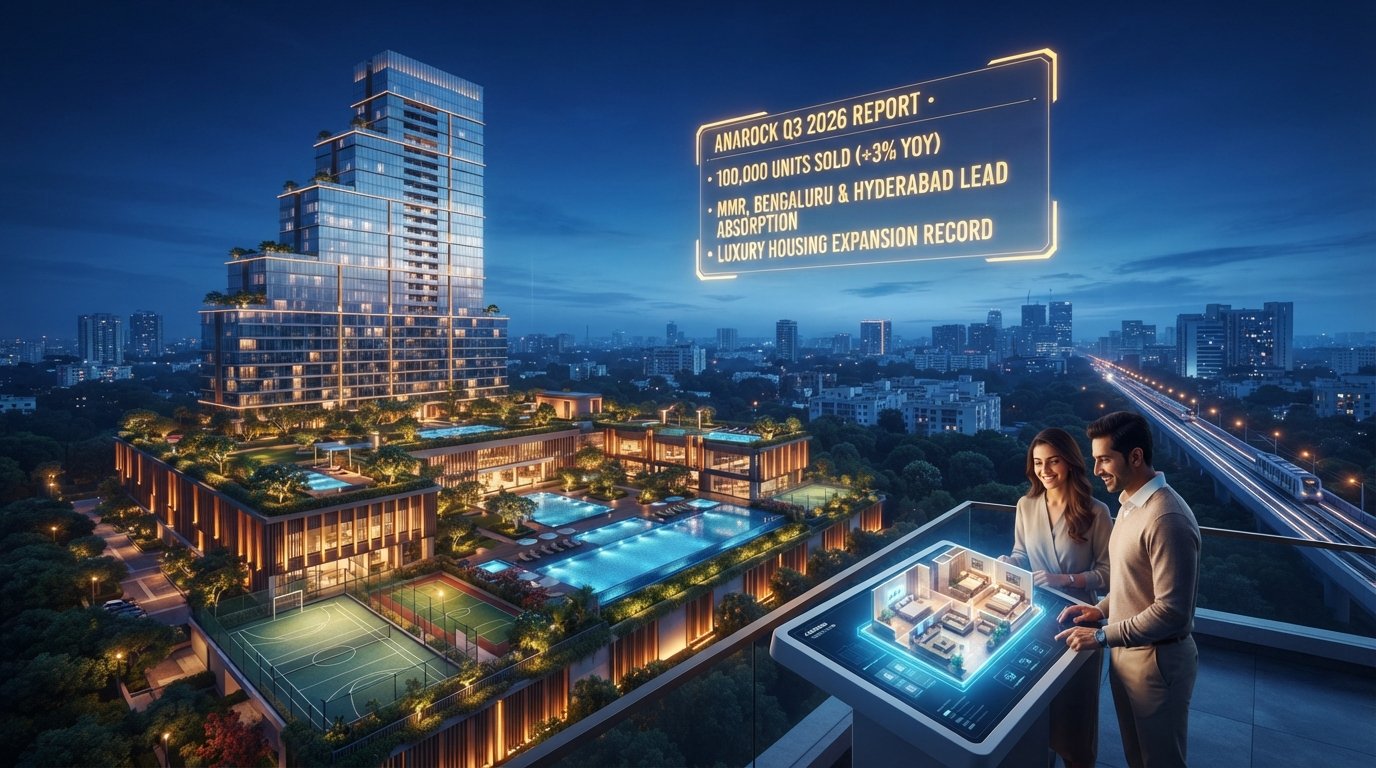
India’s residential property market displayed remarkable resilience this quarter despite seasonal monsoon lulls and macroeconomic rate adjustments.
According to the latest quarterly property benchmark released by real estate consultancy Anarock, housing sales across India’s top seven metropolitan cities rose 3% year-on-year to approximately 100,000 units during July-September 2026.
However, the defining story beneath the headline unit volume is the dramatic surge in total sales value. Driven by an accelerating consumer preference for spacious luxury apartments and branded gated communities, the Indian residential sector has completed a structural pivot toward high-value premiumization.
MMR, Bengaluru, and Hyderabad Lead Regional Absorption
Residential demand concentrated heavily within India’s primary wealth and technology corridors. The Mumbai Metropolitan Region, Bengaluru, and Hyderabad collectively accounted for the vast majority of quarterly transactions, outperforming broader national averages.
In Bengaluru and Hyderabad, hiring expansion in Global Capability Centres and consistent tech compensation packages fueled demand for three- and four-bedroom apartments. Buyers actively upgraded from cramped standalone apartments to integrated gated townships offering private sports academies, dedicated co-working lounges, and extensive green open spaces.
Similarly, in MMR, infrastructure acceleration unlocked new high-value residential micro-markets. The operational expansion of the Mumbai Coastal Road and the Mumbai Trans Harbour Link shortened commuting times, triggering aggressive residential absorption across previously congested suburban nodes.

The Decisive Structural Shift Toward Luxury Housing
The most significant trend recorded in the Q3 2026 data is the complete transformation of buyer demand categories. While the budget housing segment priced under ₹50 lakh continued to experience contracting market share, the premium and luxury categories recorded explosive growth.
Residential homes priced above ₹1.5 crore now represent the fastest-selling inventory category across tier-one cities. Rising household incomes, dual-income corporate couples, and substantial NRI real estate remittances have expanded purchasing power to historic highs.
Consequently, average weighted residential property prices registered a steady 8% to 14% annual appreciation across prime urban sectors. Buyers prioritize physical construction quality, project execution speed, and established developer reputations above raw price discounts.
Institutional Consolidation Among Listed Developers
The ongoing housing expansion continues to consolidate market share around large, capitalized developers. Strict regulatory compliance under RERA and stringent institutional financing rules have made it difficult for unorganized regional builders to compete.
Institutional developers backed by listed public balance sheets now control the primary launch pipeline. Because these established conglomerates secure cheaper construction finance and deliver projects on schedule, buyers willingly pay a 15% to 20% brand premium.
Moreover, developers are designing projects with integrated physical sustainability. Modern residential towers feature on-site solar micro-grids, centralized air filtration, and advanced rainwater replenishment infrastructure as standard amenities.
India’s housing sector has entered a mature expansion phase. Backed by genuine end-user absorption and unprecedented demand for premium living spaces, the 100,000-unit quarterly milestone demonstrates the deep structural strength of Indian urban real estate.
Tags: Anarock Report 2026, India Housing Sales Q3, Real Estate India, Luxury Residential Property, MMR Real Estate, Bengaluru Housing Market, Hyderabad Property Prices Author CTA: Follow Flairius News — sharp takes on real estate, AI, and India’s startup economy — flairiusnews.com
 Aditya Agarwal