
 By Raghav Sharma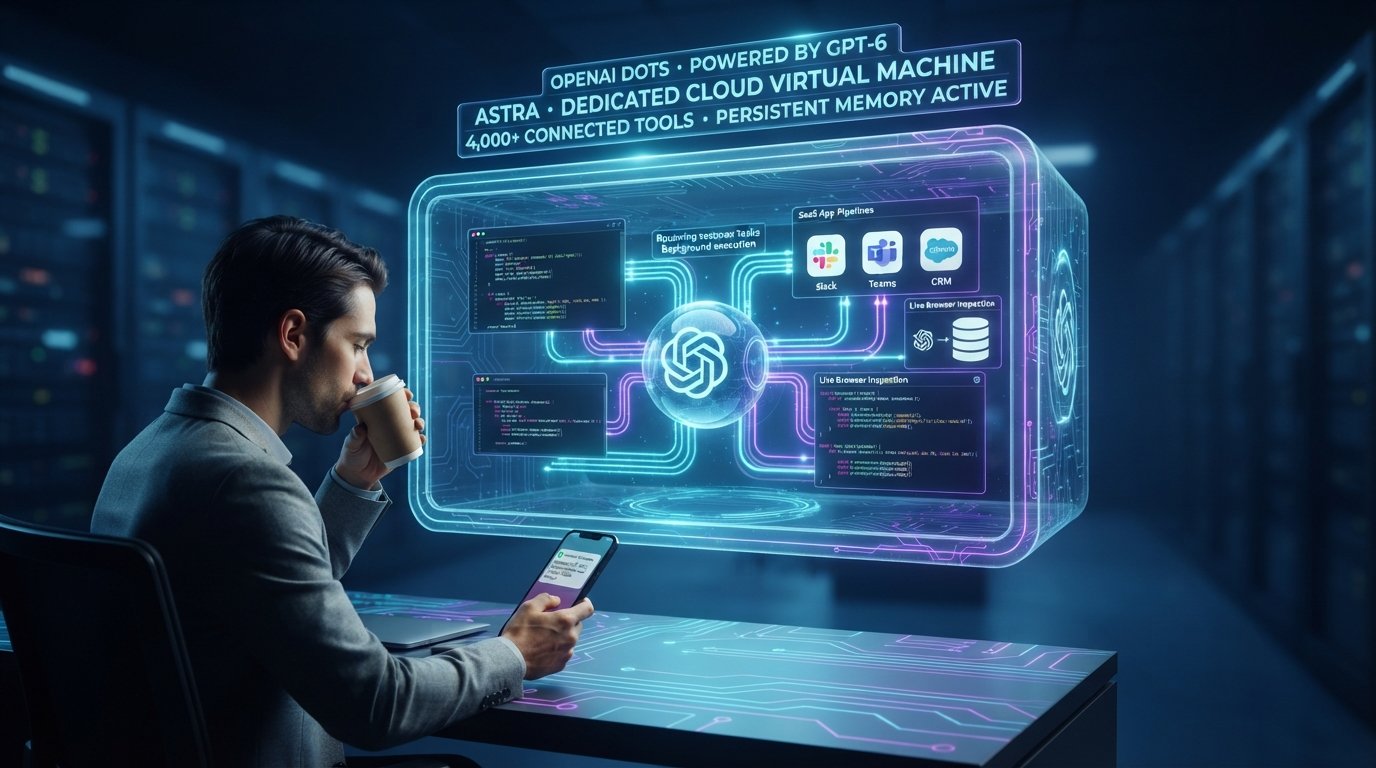
Conversational artificial intelligence has maintained the same foundational design for nearly four years. A human user enters a prompt, the algorithm generates an answer, and the program halts until the next manual request arrives.
However, that reactive prompt-and-response era has ended. At its annual developer conference in San Francisco, OpenAI officially introduced Dots persistent, always-on AI agents designed to handle ongoing multi-day tasks autonomously.
Consequently, the flagship product of the generative AI boom has transitioned from an interactive chat interface into an autonomous digital coworker. Powered by the new GPT-6 Astra reasoning model, each Dot runs on its own virtual cloud computer and browser environment. Therefore, the agent works continuously across enterprise software stacks even when the user closes their laptop.
How OpenAI Dots Break the Classical Chatbot Paradigm
Standard language models operate within isolated conversational threads. When a user asks an AI assistant to analyze a quarterly budget or draft a contract, the model stops executing the moment it completes its text generation.
In sharp contrast, an OpenAI Dot retains continuous accountability for an ongoing business goal. The agent monitors incoming updates, interacts with third-party software, and makes incremental progress toward its objective over days or weeks.
Furthermore, Dots bridge user communication across workplace platforms like Microsoft Teams and Slack. Instead of forcing operators to open a browser window, the agent reaches out proactively when it requires human authorization, encounters a strategic decision, or completes a critical milestone.
The Cloud Computer Architecture Behind the Agent
The defining technical breakthrough of Dots is their execution architecture. Previous computer-use agents suffered from friction because they attempted to hijack the user’s physical laptop screen and mouse.
OpenAI solved this operational barrier by provisioning each Dot with an isolated, secure cloud computer and browser. Consequently, the agent browses research sites, runs development code in sandbox terminals, and manipulates enterprise web tools without freezing the user’s local hardware.
Specifically, the agent connects into more than 4,000 enterprise applications through OpenAI’s integrated plugin network. When assigned to draft an enterprise proposal, the Dot pulls real-time CRM updates, reviews past documentation, and generates working project prototypes inside ChatGPT Work.
Moreover, the company introduced proactive research capabilities. When the user is inactive, the agent audits connected data sources in a restricted, read-only mode, identifying operational bottlenecks and preparing workflow briefings for the morning.
Enterprise Security and the Guardrail Perimeter
Granting an autonomous software agent access to commercial files naturally introduces governance and security concerns. OpenAI addressed this friction by enforcing strict permission boundaries.
Users and enterprise IT administrators establish custom security parameters defining what a Dot can execute independently versus what requires explicit approval. Critical administrative actions including altering passwords, executing payments, or permanently deleting data pause the agent until the operator authorizes the task.
Additionally, OpenAI unveiled “Specialist Dots” designed specifically for enterprise organizations. These specialist agents possess dedicated corporate identities, IT-provisioned credentials, and strict access controls tailored to compliance, legal auditing, and technical operations.
What the Agentic Shift Means for Enterprise Software
The launch of Dots signals an existential reckoning for conventional SaaS interfaces. If autonomous agents handle complex multi-step tasks across cloud applications in the background, traditional web dashboards lose their primary purpose.
Instead of humans spending forty hours a week clicking through ticketing systems, scheduling calendars, and exporting spreadsheets, human professionals will act as directors managing a fleet of persistent AI operators.
OpenAI has officially altered the expectations for generative software. The race is no longer about who builds the smartest conversational bot, but who provides the most reliable autonomous workforce.
Tags: OpenAI Dots 2026, GPT-6 Astra, Autonomous Agents, ChatGPT Work, Enterprise AI Workflows, Always-On AI, OpenAI DevDay Author CTA: Follow Flairius News — sharp takes on AI, business, and India’s startup economy — flairiusnews.com
 Ahana Verma
  Aditya Agarwal