
 By Nayra Roy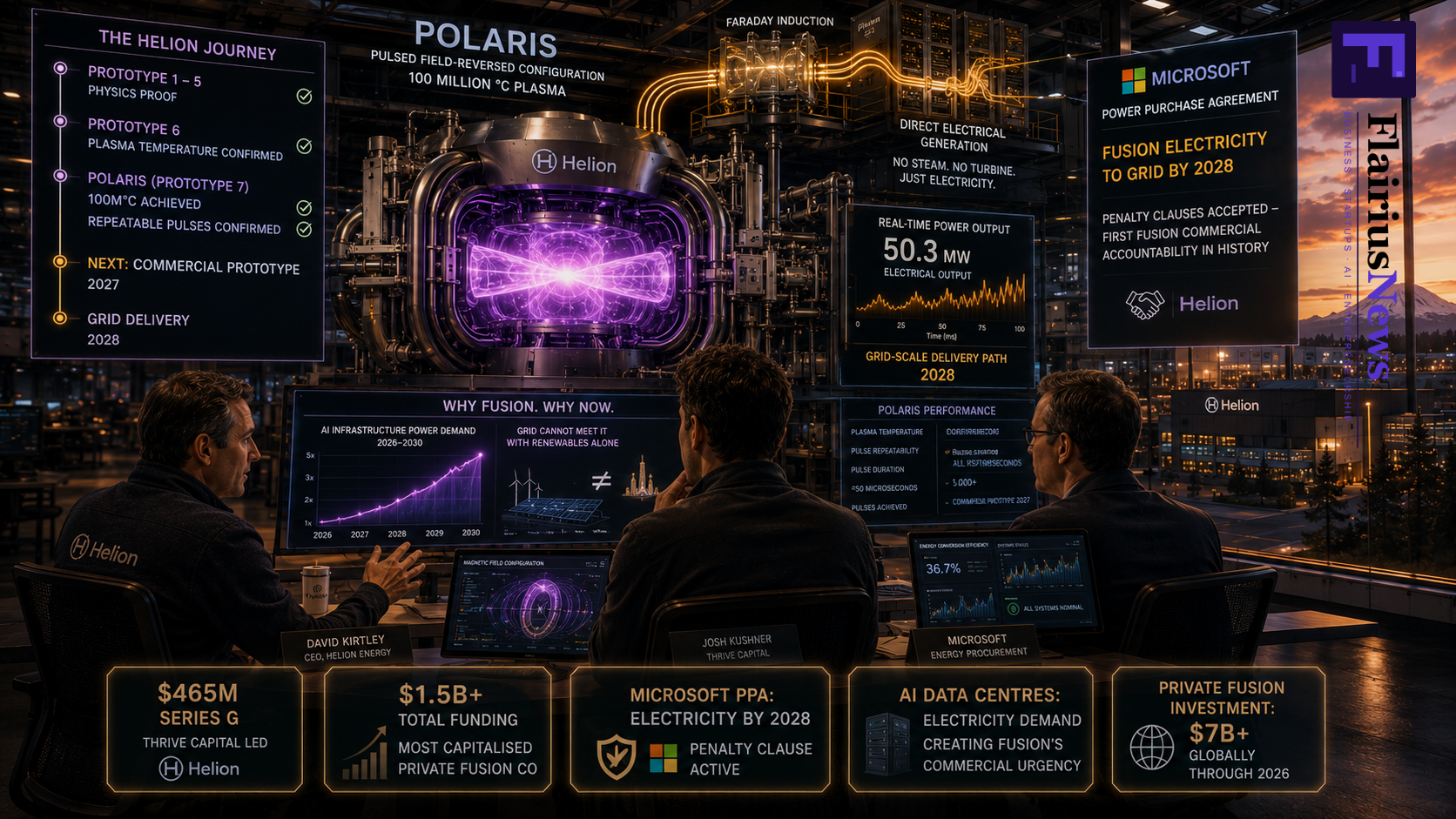
For most of the last 70 years, fusion energy has been the ultimate unfulfilled promise of science. Furthermore, the joke in physics circles has persisted for decades: commercial fusion is always 30 years away. In 2026, that joke is getting significantly less funny.
Helion, the Everett, Washington-based fusion startup, raised $465 million in a Series G round led by Thrive Capital at a $15.5 billion post-money valuation. Moreover, the round brings Helion’s total reported funding to at least $1.5 billion making it the most heavily funded private fusion energy company in the world. Specifically, the capital comes from one of venture capital’s most sophisticated growth investors Thrive Capital, which manages $25 billion and has backed Stripe, OpenAI, GitHub, and Instagram. Therefore, Helion’s $15.5 billion valuation is not a speculative science bet. It is a conviction investment from an investor with a track record of identifying category-defining companies before their commercial moment.
Furthermore, Helion has a commercial anchor that no other fusion startup has yet achieved. Specifically, the company has a signed agreement with Microsoft to deliver fusion-generated electricity to the grid by 2028. Moreover, that agreement includes a financial penalty clause meaning Helion has accepted commercial accountability for hitting a delivery date, not just a research milestone.
What Helion’s Fusion Approach Is and Why It Is Different
Helion is not building a traditional tokamak fusion reactor the large, expensive, magnetic confinement approach that ITER represents. Specifically, Helion uses a field-reversed configuration a more compact, pulsed fusion approach where plasma is compressed and accelerated into collision, generating fusion energy that directly drives electricity through Faraday induction without a conventional steam turbine. Moreover, the company claims this approach generates electricity more directly and efficiently than conventional fusion designs.
Furthermore, Helion’s fuel cycle uses helium-3 a fusion reaction product that can itself be used as a fuel in subsequent reactions. Specifically, this creates a partially closed fuel cycle that reduces the tritium breeding requirements that make conventional deuterium-tritium fusion designs more complex and costly. Therefore, Helion’s approach is differentiated both in physical design and in fuel economics relative to the mainstream fusion research pathway.
Additionally, the engineering progress has been real. Specifically, Helion’s seventh prototype Polaris has achieved plasma temperatures above 100 million degrees Celsius, the threshold required for fusion reactions to occur. Moreover, Polaris has demonstrated controlled, repeatable plasma pulses at the parameters needed to confirm the fusion approach is physically viable. Consequently, the company is not at the theoretical stage. It is at the engineering scale-up stage the step between proof of concept and commercial prototype.
Why Microsoft’s Power Purchase Agreement Matters More Than the Science
The Microsoft agreement is the most commercially significant aspect of Helion’s story. Specifically, power purchase agreements where a buyer commits to purchasing electricity from a specific generator at a specific price for a specific period are the financial instruments that make energy infrastructure bankable. Moreover, a Microsoft PPA signals that the world’s largest AI infrastructure investor believes Helion will deliver commercial fusion electricity within its planning horizon.
Furthermore, the timing is not coincidental. Specifically, Microsoft has committed to running its data centres on carbon-free energy. Moreover, the scale of Microsoft’s AI infrastructure build-out with $190 billion in 2026 capital expenditure including massive data centre expansion creates an insatiable demand for low-carbon, always-on electricity that intermittent renewable sources cannot reliably provide. Therefore, fusion energy which generates continuous, carbon-free electricity without the intermittency of solar and wind is a perfect match for AI data centre power requirements.
Additionally, the penalty clause in Helion’s Microsoft agreement deserves attention. Specifically, fusion energy companies have historically been exempt from commercial accountability research milestones replace delivery commitments. However, Helion has accepted financial penalties for missing the 2028 delivery date. Therefore, the company’s leadership has voluntarily subjected itself to commercial pressure that will force engineering progress in ways that research-funding timelines do not.
What the Fusion Energy Boom Means for Founders and Investors
Helion is not alone. Specifically, Commonwealth Fusion Systems raised $1.8 billion in 2021, TAE Technologies has raised over $1.2 billion, and Zap Energy, Realta Fusion, and Xcimer Energy have each attracted significant venture capital. Moreover, the total private investment in fusion energy startups exceeded $7 billion globally through 2026 the largest concentration of private capital in a single energy technology category in history.
Furthermore, the energy demand signal driving this investment is clear. Specifically, the AI data centre build-out is creating electricity demand growth that no current energy infrastructure can meet sustainably. Moreover, grid operators across the US, Europe, and Asia are already signalling concerns about the power requirements of the AI compute expansion planned for 2026 to 2030. Consequently, fusion energy if it can deliver at commercial scale solves the most fundamental constraint on AI infrastructure growth.
Therefore, Helion’s $465 million and $15.5 billion valuation is not primarily a bet on fusion physics. It is a bet that AI’s energy demand creates the commercial urgency needed to accelerate fusion from science project to deployed infrastructure and that Helion is the team most likely to close that gap first.
Tags: Helion Energy, $465M Series G, Thrive Capital Fusion, Helion $15.5B Valuation, Fusion Energy Startup 2026, Microsoft Helion PPA, Clean Energy AI Data Centre, Fusion Power Commercial 2026, Helion Polaris Prototype, Fusion Energy Boom 2026 Author CTA: Follow Flairius News — sharp takes on AI, business, and India’s startup economy — flairiusnews.com
 Aditya Agarwal