
 By Raghav Sharma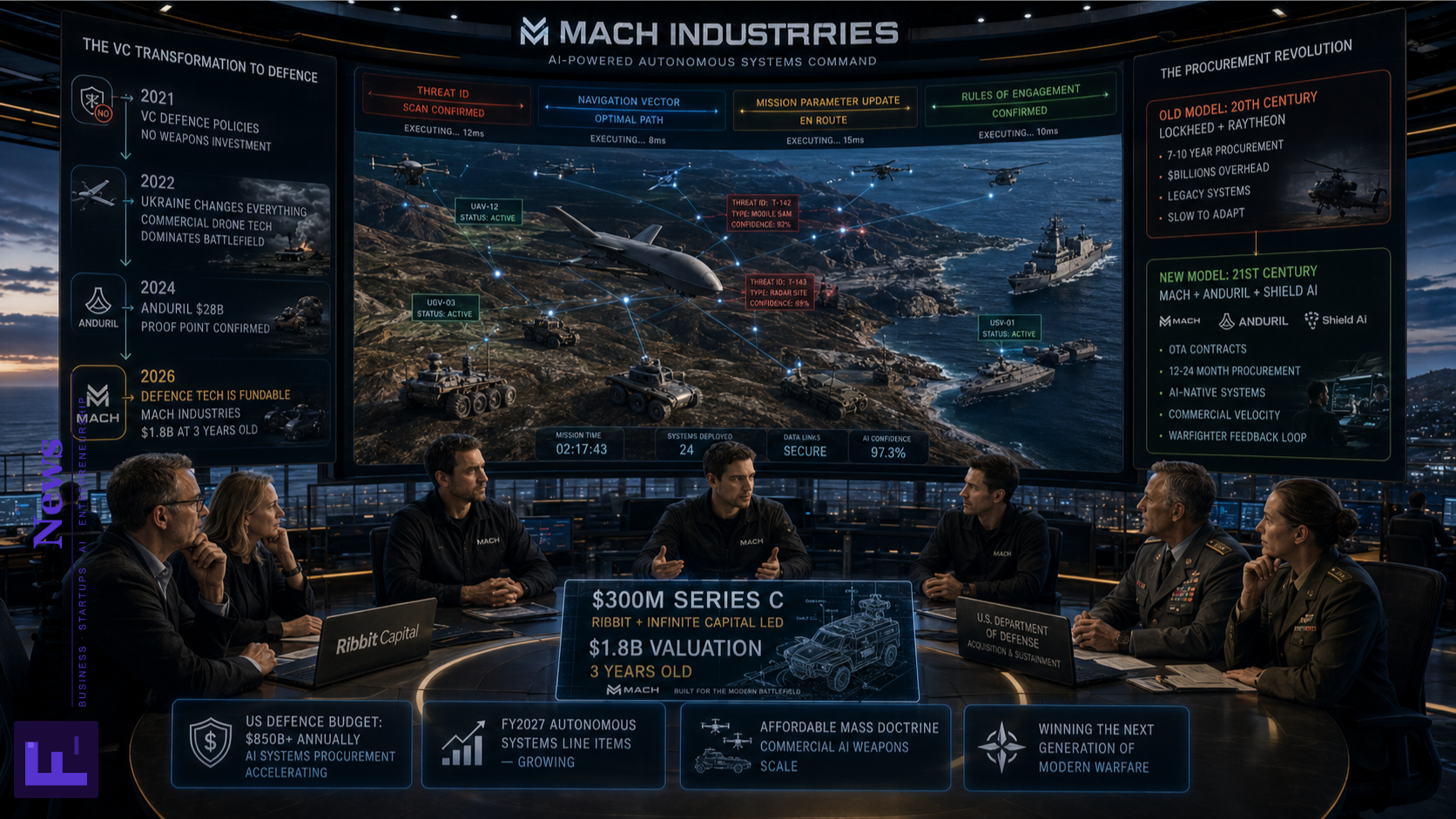
Five years ago, most venture capital firms had explicit policies against investing in defence technology. Furthermore, many published those policies publicly citing ethical concerns about weapons development, dual-use technology risks, and the reputational complications of military contracts. Today, those same firms are competing to lead defence tech rounds.
Mach Industries raised $300 million in a Series C round at a $1.8 billion valuation, led by Ribbit Capital and Infinite Capital. Specifically, the Huntington Beach, California-based company builds AI-powered weapons systems and autonomous defence platforms a description that would have been unmarketable in Silicon Valley’s investor community as recently as 2022. Moreover, it was founded just three years ago, making its $1.8 billion valuation one of the fastest institutional value creations in the defence tech category.
The speed of Mach Industries’ growth reflects a broader shift in the venture capital industry’s relationship with national security. Specifically, Russia’s invasion of Ukraine in 2022 and the subsequent transformation of modern warfare by drone and autonomous systems technology created a visible, urgent, and politically legible case for technology investment in defence. Furthermore, the US Department of Defense’s explicit embrace of commercial technology partnerships through programmes like DARPA, the Defence Innovation Unit, and AFWERX reduced the procurement uncertainty that had historically made defence tech unviable for venture-backed startups.
What Mach Industries Is Building
Mach Industries focuses on autonomous systems and AI-powered precision weapons platforms. Specifically, the company’s product line addresses what the US defence establishment calls the “affordable mass” problem the need to field large numbers of high-precision, autonomous weapons platforms at a cost that makes adversary countermeasures economically unsustainable.
Moreover, the technical foundation is AI. Specifically, Mach’s autonomous systems use AI for targeting, navigation, mission planning, and threat identification enabling smaller operational teams to deploy larger numbers of precision assets than traditional manned systems allow. Furthermore, the AI layer enables rapid updates to mission parameters and rules of engagement through software, rather than requiring hardware modifications. Consequently, Mach’s platforms can be updated faster than traditional defence procurement cycles allow.
Additionally, Mach Industries has positioned itself within the US defence industrial base’s emerging commercial supplier ecosystem. Specifically, it works alongside companies like Anduril, Shield AI, and Joby Aviation all of which represent a generation of venture-backed defence tech companies that are disrupting the Lockheed Martin, Raytheon, and Boeing model of large, slow, expensive defence procurement.
Why Venture Capital Changed Its Mind About Defence
The venture capital shift toward defence investment reflects three structural changes. First, the geopolitical environment made the ethical case for investment clearer. Specifically, democratic governments defending against authoritarian aggression created a moral framework that many investors were more comfortable with than abstract deterrence theory. Furthermore, Ukraine’s effective use of commercial drone technology including units originally designed for agricultural applications demonstrated that commercial technology investment could have direct defensive security implications.
Second, the procurement reform created a viable business model. Specifically, the US DoD’s Other Transaction Authority (OTA) contracts allow rapid procurement from commercial companies without the decade-long traditional acquisition process. Moreover, the Defence Innovation Unit’s commercial solutions openings have created a pathway for startups to reach initial contracts in 12 to 24 months rather than the 7 to 10 year procurement timelines that made defence tech unviable for venture-backed companies previously.
Third, the talent and capital environment shifted. Specifically, the same Silicon Valley engineers who previously avoided defence work are increasingly open to it citing the explicit connection between their work and national security outcomes. Furthermore, the public success of Anduril which reached a $28 billion valuation created a proof point that defence tech could generate the kind of returns that venture capital requires.
What $300 Million at $1.8 Billion Valuation Signals
Mach Industries’ $1.8 billion valuation at three years old is a statement about category potential, not current revenue scale. Specifically, Ribbit Capital and Infinite Capital are betting that the US defence tech market which allocates more than $850 billion annually is in the early stages of a procurement shift toward commercial, AI-first suppliers. Moreover, if that shift reaches even 10 to 15% of total procurement, the available market for companies like Mach exceeds any consumer or enterprise software category.
Furthermore, the series C timing is strategic. Specifically, the FY2027 US defence budget is currently in debate with significant line items for autonomous systems, AI-assisted targeting, and software-defined weapons platforms. Therefore, Mach Industries is raising its growth capital precisely as its target procurement category is being funded at the federal level.
The year of the defence startup is not coming. Furthermore, for companies like Mach Industries, it is already here.
Tags: Mach Industries, $300M Series C, Ribbit Capital Defence Tech, AI Defence Startup, Defence Tech VC 2026, Autonomous Weapons AI, US Defence Innovation, Anduril Mach Industries, AI Military Systems, Venture Capital Defence 2026 Author CTA: Follow Flairius News — sharp takes on AI, business, and India’s startup economy — flairiusnews.com
 Nayra Roy
  Ahana Verma