
 By Ahana Verma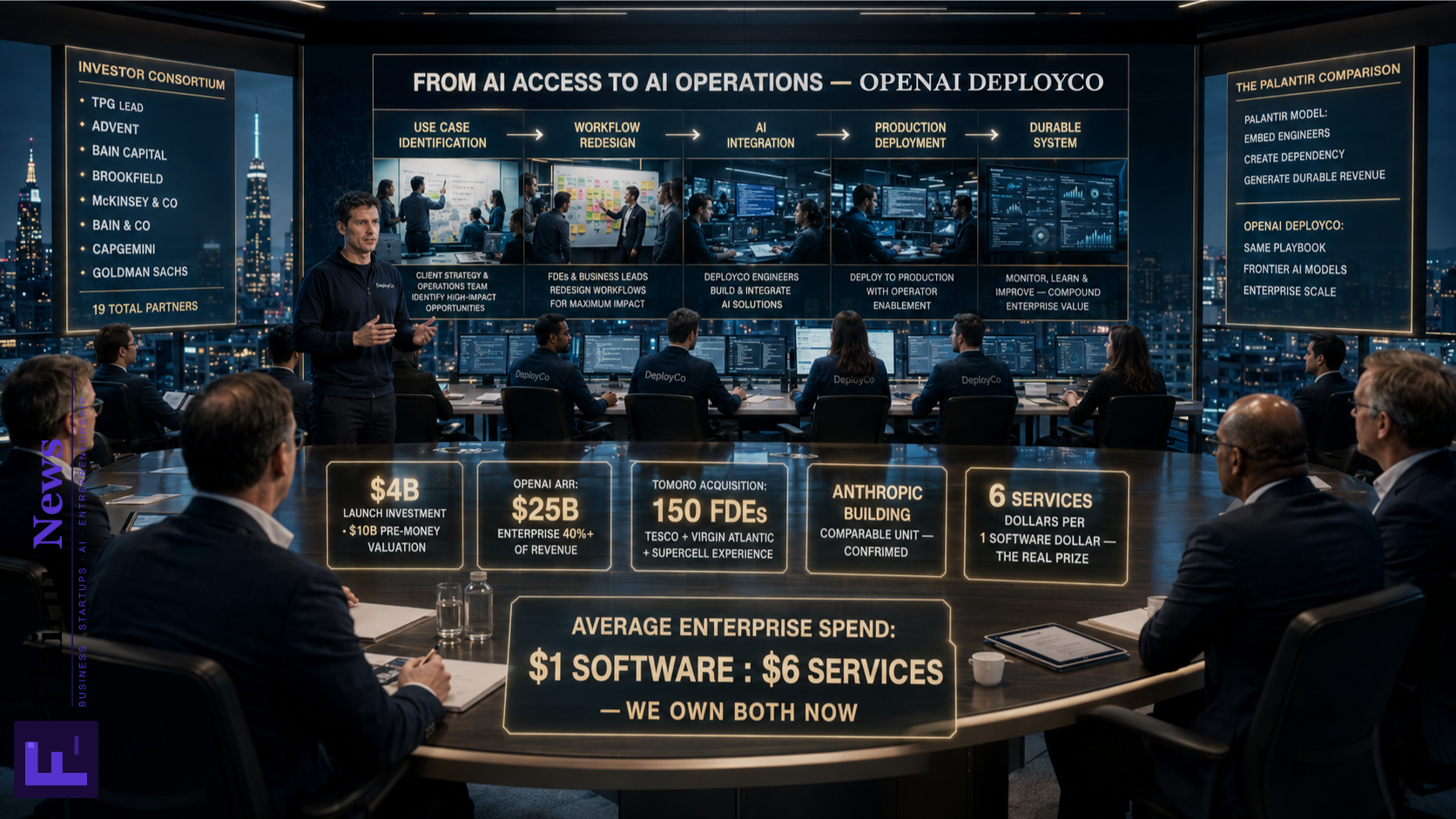
Selling AI is no longer enough. Furthermore, OpenAI has decided that implementing it inside every organisation, on every workflow, at production scale is the real business opportunity of 2026.
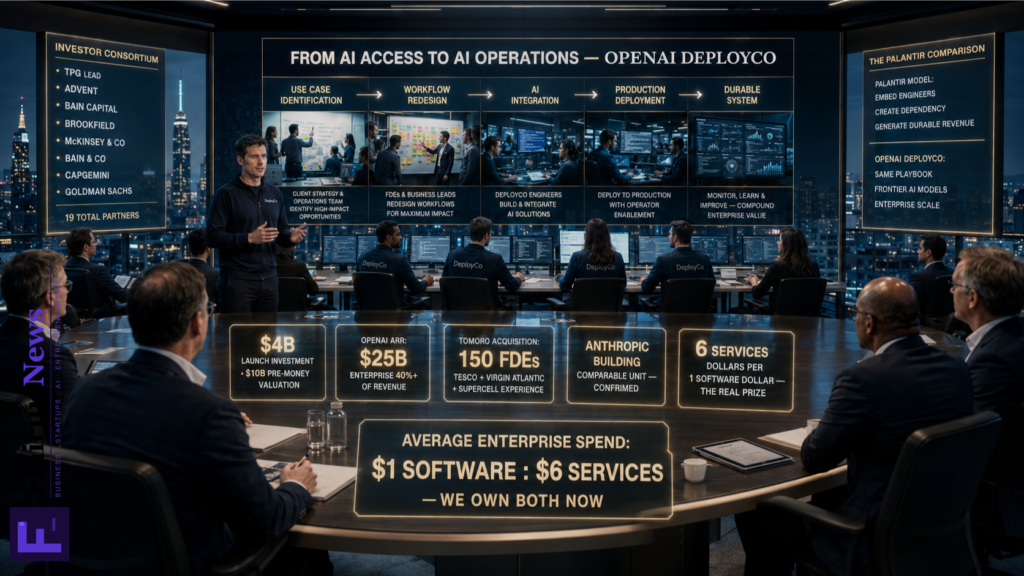
On May 11, 2026, OpenAI launched the OpenAI Deployment Company known as DeployCo with more than $4 billion in initial investment and a mandate to embed AI directly into enterprise operations. Specifically, the round was led by TPG, with Advent, Bain Capital, and Brookfield as co-lead founding partners. Moreover, McKinsey, Bain & Co., and Capgemini three of the world’s most influential management consultancies are among DeployCo’s 19 global investors. Consequently, OpenAI has not simply launched a consulting unit. It has built a consulting unit with the world’s top consulting firms sitting on its cap table.
The strategic logic is sharp. Specifically, for every dollar enterprises spend on software, they spend roughly six dollars on implementation services. Moreover, enterprise already accounts for more than 40% of OpenAI’s total revenue with the company reporting $25 billion in annualised revenue as of February 2026 and enterprise on pace to reach parity with consumer revenue by end of year. Therefore, owning the implementation layer is not a defensive move. It is an offensive one.
What DeployCo Actually Does
DeployCo operates through a model built around Forward Deployed Engineers specialists who work directly inside client organisations. Specifically, these engineers do not hand over a product and leave. Instead, they sit within the client’s operations, identify where AI delivers the most value, redesign workflows around AI, and build systems that turn initial productivity gains into durable structural advantages.
Moreover, the model is explicitly Palantir-inspired. Specifically, Palantir built one of the most profitable enterprise software businesses in history by embedding engineers directly inside government and corporate clients creating deep dependency and high switching costs simultaneously. Furthermore, OpenAI’s Chief Revenue Officer Denise Dresser described DeployCo’s mission clearly: “The challenge now is helping companies integrate these systems into the infrastructure and workflows that power their businesses.”
Additionally, as part of the launch, OpenAI announced plans to acquire Tomoro an applied AI consulting firm with approximately 150 experienced engineers who have previously built mission-critical AI systems for companies including Tesco, Virgin Atlantic, and Supercell. Therefore, DeployCo launched not as an aspiration but as an immediately operational business with proven engineering talent and enterprise deployment credentials.
Why Bain, McKinsey, and Capgemini Invested in Their Own Competitor
The presence of major consultancies as investors is the most strategically interesting dimension of DeployCo’s launch. Specifically, Bain & Co., McKinsey, and Capgemini are not passive investors. They are OpenAI’s biggest potential competitors in the enterprise AI implementation space and yet they chose to invest rather than build independently.
The calculation is clear. Specifically, the consultancies understand that AI will transform their own businesses faster than their traditional models can adapt. Moreover, investing in DeployCo gives them early access to OpenAI’s product roadmap, model capabilities, and enterprise deployment playbooks knowledge they can use to evolve their own services. Furthermore, Goldman Sachs is the only investor backing both DeployCo and a comparable initiative from Anthropic signalling that the largest financial institutions are positioning themselves across the entire enterprise AI implementation ecosystem simultaneously.
Consequently, the McKinsey and Bain investments are not contradictions. They are strategic options giving the consultancies visibility into OpenAI’s direction while they build their own AI service capabilities in parallel.
What This Means for Every Enterprise AI Decision in 2026
DeployCo’s launch reshapes the enterprise AI decision-making landscape in three specific ways. First, it raises the implementation standard. Specifically, companies that previously deployed AI through system integrators or internal teams now have an option to deploy directly with the model creator’s engineers. Moreover, this creates pressure on incumbent IT services firms Accenture, Infosys, TCS, Wipro to demonstrate that their OpenAI expertise matches DeployCo’s depth. Therefore, the enterprise AI services market is entering a period of competitive intensity that the previous model-plus-API approach never created.
Second, it accelerates enterprise adoption timelines. Specifically, the primary barrier to enterprise AI deployment has always been implementation complexity connecting models to legacy systems, handling data governance, managing change management, and ensuring measurable output. Furthermore, DeployCo’s Forward Deployed Engineers are specifically designed to remove these barriers. Consequently, enterprises that previously took 12 to 18 months to move from AI pilot to production deployment may now achieve that transition in 3 to 6 months.
Third, it creates a new competitive dynamic for Anthropic. Specifically, Axios reported that Anthropic is working on a comparable deployment initiative confirming that the enterprise AI implementation layer is now a contested frontier, not an open field. Moreover, Goldman Sachs backing both signals that the financial market sees this as a durable, high-value category. Therefore, the DeployCo launch is not the end of a story. It is the opening of a much larger one.
Tags: OpenAI DeployCo, $4B Enterprise AI, OpenAI Deployment Company, Forward Deployed Engineers, OpenAI Tomoro Acquisition, Enterprise AI Consulting, McKinsey AI Investment, Bain Capital AI, TPG OpenAI, Enterprise AI Implementation 2026 Author CTA: Follow Flairius News — sharp takes on AI, business, and India’s startup economy — flairiusnews.com
 Aditya Agarwal
  Raghav Sharma