
 By Raghav Sharma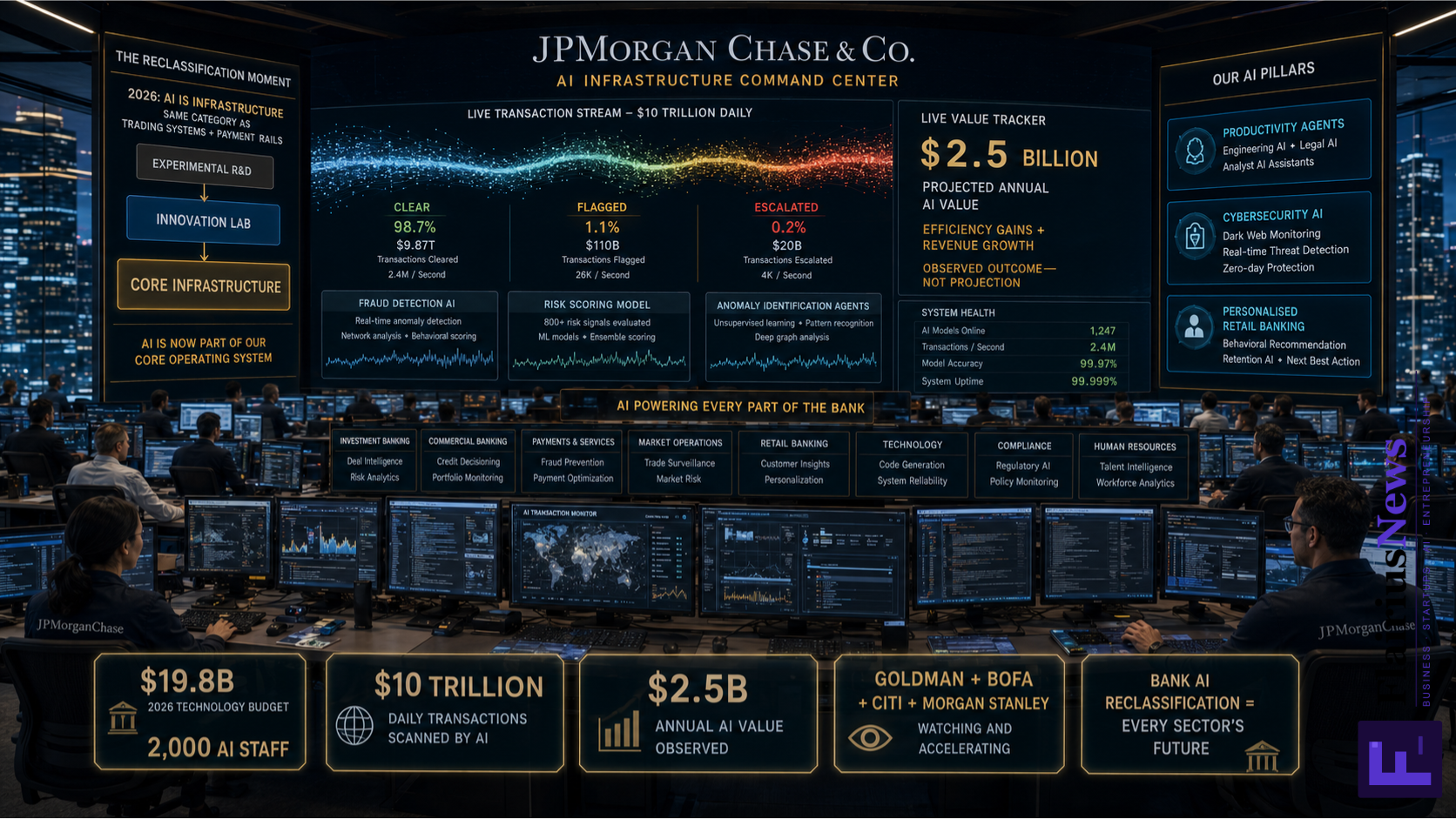
When the world’s largest bank reclassifies artificial intelligence from experimental R&D to core infrastructure, it is not making a strategic announcement. Furthermore, it is making a permanent commitment one with capital budget implications that flow through every part of its business for years.
JPMorgan Chase formally made that reclassification in 2026. Specifically, the bank has allocated approximately $19.8 billion to technology investment this year, with 2,000 staff now dedicated to AI development. Moreover, the bank is no longer treating AI as a department or a project. Instead, it is treating AI as infrastructure in the same category as trading systems, payment rails, and risk management platforms that the bank cannot operate without.
Furthermore, the financial metrics validate the reclassification. Specifically, JPMorgan’s AI systems currently scan more than $10 trillion in daily transactions making it one of the largest real-time AI deployments in financial services globally. Additionally, AI is projected to generate $2.5 billion in annual value for the bank through efficiency gains and revenue growth. Therefore, the ROI case for JPMorgan’s AI investment is not a projection. It is an observed outcome that is scaling.
What JPMorgan Is Actually Deploying
JPMorgan’s AI strategy focuses on three specific pillars. First, internal productivity through AI agents. Specifically, the bank has deployed AI agents that assist software engineers, legal teams, and financial analysts accelerating output in roles where the value of additional throughput is immediately measurable. Moreover, the bank’s engineering teams use AI coding assistants that have demonstrably reduced development time for internal platform updates and regulatory compliance tooling.
Second, cybersecurity hardening. Specifically, JPMorgan’s AI systems process transaction data in real time to detect fraud, identify anomalous access patterns, and flag potential security events before they escalate. Furthermore, the bank’s threat intelligence AI analyses external data sources dark web activity, known attacker signatures, geopolitical risk signals and integrates that intelligence into its defensive posture automatically. Consequently, JPMorgan’s AI is not just an efficiency tool. It is a security system processing more data per second than any human team could evaluate.
Third, personalised retail banking. Specifically, JPMorgan uses AI to tailor financial product recommendations, spending insights, and savings guidance for its consumer banking customers. Moreover, the personalisation extends to timing delivering relevant recommendations when a customer is most likely to act on them, based on behavioural signals rather than demographic segments. Therefore, the retail banking AI layer creates both revenue opportunity and customer retention value simultaneously.
Why Banks Leading on AI Matters for Every Other Sector
JPMorgan’s AI reclassification carries a signal that extends far beyond financial services. Specifically, banks are among the most conservative technology adopters in the economy constrained by regulation, risk management requirements, and the catastrophic consequences of system failure. Moreover, they have the most stringent data governance requirements, the most complex legacy infrastructure, and the most demanding audit environments.
Therefore, when JPMorgan reclassifies AI as core infrastructure, it is implicitly validating three things. First, that AI has matured to the point where enterprise-grade reliability is achievable at scale. Second, that the compliance and governance frameworks for AI in regulated environments are now sufficiently developed for production deployment. Third, that the ROI case is strong enough to justify permanent capital allocation not just pilot programme budgets.
Furthermore, the $19.8 billion JPMorgan is spending on technology in 2026 is not unique to banking. Specifically, the bank’s investment pattern previews what every large enterprise will do with AI over the next three to five years as the technology matures from experimental to infrastructure in sector after sector. Consequently, every industry watching JPMorgan’s 2026 AI budget is seeing its own future AI budget reflected back at it.
What the 2,000-Person AI Team Signals
JPMorgan’s 2,000 dedicated AI staff is another indicator that deserves attention. Specifically, this is not a centre of excellence or an innovation lab. It is a standing engineering and data science organisation with a headcount comparable to a mid-sized technology company. Moreover, the team is embedded across the bank’s operations not siloed in a separate innovation unit.
Additionally, competing financial institutions are watching closely. Specifically, Goldman Sachs, Bank of America, Citigroup, and Morgan Stanley are all accelerating their own AI investment programmes aware that JPMorgan’s head start in AI infrastructure creates compounding advantages in risk modelling, trading efficiency, customer acquisition cost, and regulatory compliance automation that will be difficult to replicate quickly. Consequently, the bank AI race of 2026 is not about who has the best pilot programme. It is about who has the best production infrastructure.
Tags: JPMorgan Chase AI, $19.8B Tech Budget, Bank AI Infrastructure, JPMorgan 2000 AI Staff, Enterprise AI Financial Services, AI Core Infrastructure 2026, JPMorgan AI Agents, $10 Trillion AI Transaction Scanning, Financial Services AI Reclassification, Bank AI Race 2026 Author CTA: Follow Flairius News — sharp takes on AI, business, and India’s startup economy — flairiusnews.com
 Aditya Agarwal