 By Raghav Sharma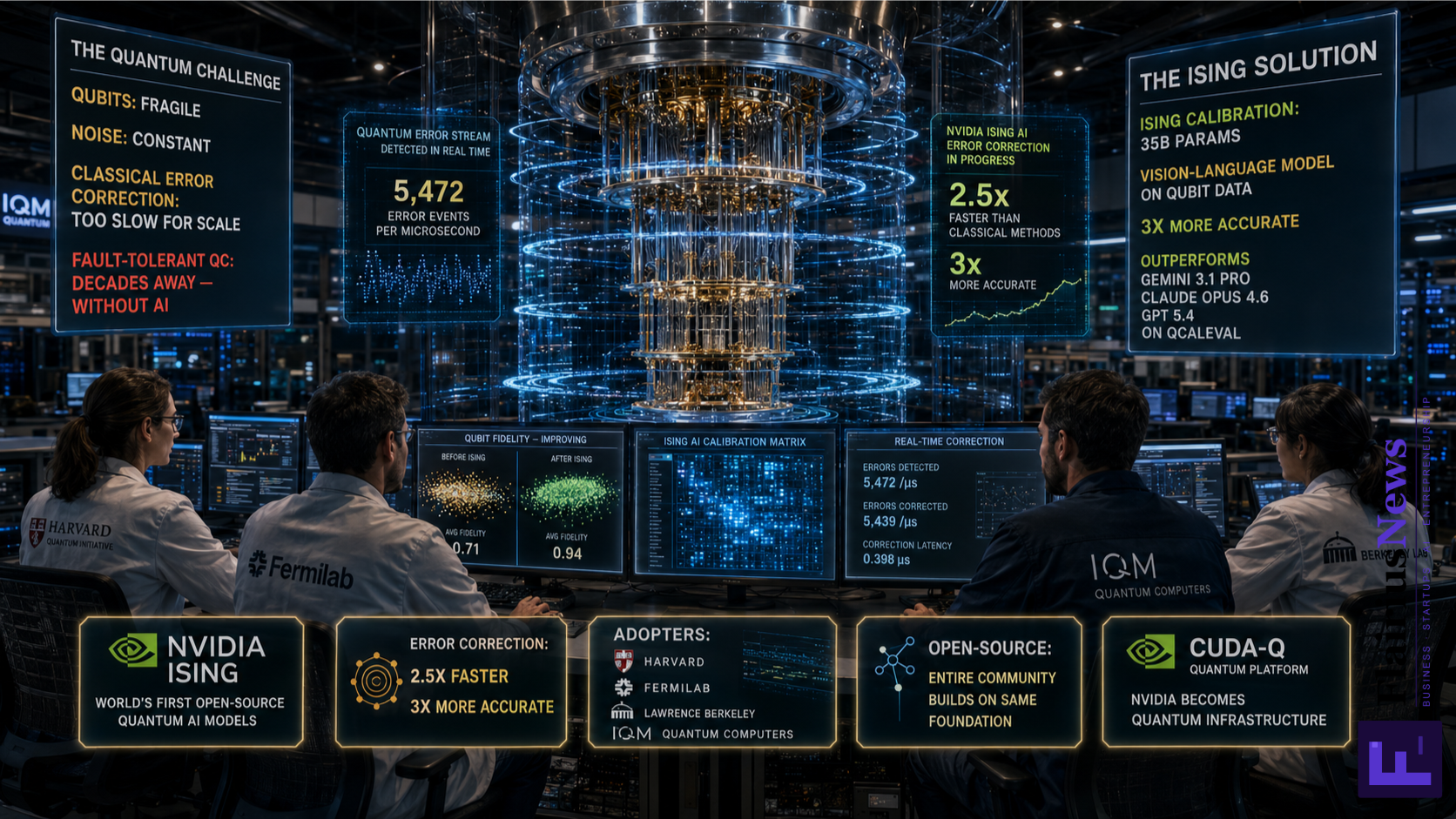
Quantum computing has always had a timing problem. Specifically, the technology works beautifully in theory but fails constantly in practice because quantum bits, or qubits, are extraordinarily fragile. Moreover, the noise and instability in modern quantum processors create errors at a rate that makes large-scale, reliable computation almost impossible without constant correction.
NVIDIA just open-sourced the AI models designed to solve exactly this problem. Furthermore, the launch may be one of the most technically consequential moves in computing in 2026.
On April 14, 2026, NVIDIA announced NVIDIA Ising the world’s first family of open-source AI models specifically designed to accelerate quantum processor calibration and real-time error correction. Specifically, Ising delivers error-correction decoding that is up to 2.5 times faster and 3 times more accurate than traditional approaches. Moreover, the models are available open-source meaning the entire quantum computing research and enterprise ecosystem can adopt, fine-tune, and build on them immediately, without licensing fees or proprietary lock-in.
What Ising Does and Why Quantum Needed AI to Solve Its Problems
To understand why Ising matters, you first need to understand why quantum computing has struggled to become commercially useful. Specifically, qubits are not like transistors. They do not hold a value reliably. Instead, they are subject to thermal noise, electromagnetic interference, and quantum decoherence meaning errors accumulate rapidly as computation runs. Therefore, for any meaningful quantum application, quantum error correction is not optional. It is the entire engineering challenge.
Traditional error correction approaches are mathematically rigorous but computationally expensive. Specifically, existing classical algorithms for quantum error decoding are too slow to keep pace with the error rates of modern quantum processors operating at scale. Moreover, as quantum processors scale from tens of qubits to hundreds and thousands, the error correction problem grows exponentially in complexity. Consequently, the error correction bottleneck has been the single most significant barrier to commercially useful quantum computing not the quantum hardware itself.
NVIDIA Ising addresses this directly. Specifically, the Ising Calibration model is a 35-billion-parameter vision-language model trained on multi-modality qubit data supporting automated calibration of quantum processors at a level of accuracy that previously required manual expert intervention. Furthermore, on the newly introduced QCalEval benchmark for quantum calibration tasks, Ising Calibration outperforms Gemini 3.1 Pro, Claude Opus 4.6, and GPT 5.4. Therefore, NVIDIA has built the best AI model for quantum calibration currently available and released it open-source to the entire research community.
Who Is Already Adopting Ising
The adoption signal from the research community is immediate and credible. Specifically, the institutions adopting Ising include Harvard University, Fermi National Accelerator Laboratory, Lawrence Berkeley National Laboratory’s Advanced Quantum Testbed, IQM Quantum Computers, Academia Sinica, and the UK National Physical Laboratory.
Furthermore, this is not a list of early adopters waiting for the technology to mature. These are the world’s most serious quantum computing research institutions organisations that would not publicly associate with a technology that did not demonstrate genuine capability. Moreover, IQM Quantum Computers represents the enterprise commercialisation pathway demonstrating that Ising is not just an academic tool but a commercial-grade platform for building and operating quantum processors.
Consequently, the combination of open-source availability and immediate adoption by top-tier research institutions creates a flywheel. Specifically, as more research teams use Ising, they contribute improvements, fine-tuning data, and new calibration datasets back to the open-source community. Therefore, Ising’s capability will compound over time in a way that proprietary, closed models cannot.
What This Means for the Quantum Computing Timeline
The honest answer to “when will quantum computing become commercially useful?” has always been “it depends on when error correction becomes tractable.” Specifically, fault-tolerant quantum computing the level of error suppression needed for applications in drug discovery, materials science, logistics optimisation, and financial modelling has historically been estimated to require 10 to 20 more years.
However, Ising changes the equation. Specifically, if AI-powered error correction can significantly reduce the qubit overhead required for fault tolerance, the timeline compresses. Furthermore, NVIDIA’s open-source approach means the entire global quantum research community is now working on the same problem with the same toolset accelerating progress through coordination rather than competition.
Moreover, NVIDIA’s strategic positioning is deliberate. Specifically, the company’s CUDA-Q platform already serves as the primary software development environment for hybrid quantum-classical computation. Therefore, Ising extends NVIDIA’s influence into the quantum computing ecosystem in the same way that CUDA extended its influence into AI a decade ago by becoming the foundational tooling that the entire community builds on.
Quantum computing’s commercial moment may still be years away. However, NVIDIA Ising just moved that moment meaningfully closer.
Tags: NVIDIA Ising, Quantum AI Models, Quantum Error Correction AI, NVIDIA Open Source 2026, Quantum Computing Breakthrough, CUDA-Q Quantum Platform, Quantum Calibration AI, IQM Harvard Quantum, NVIDIA Quantum 2026, Fault-Tolerant Quantum Computing Author CTA: Follow Flairius News — sharp takes on AI, business, and India’s startup economy — flairiusnews.com
 Aditya Agarwal