
 By Nayra Roy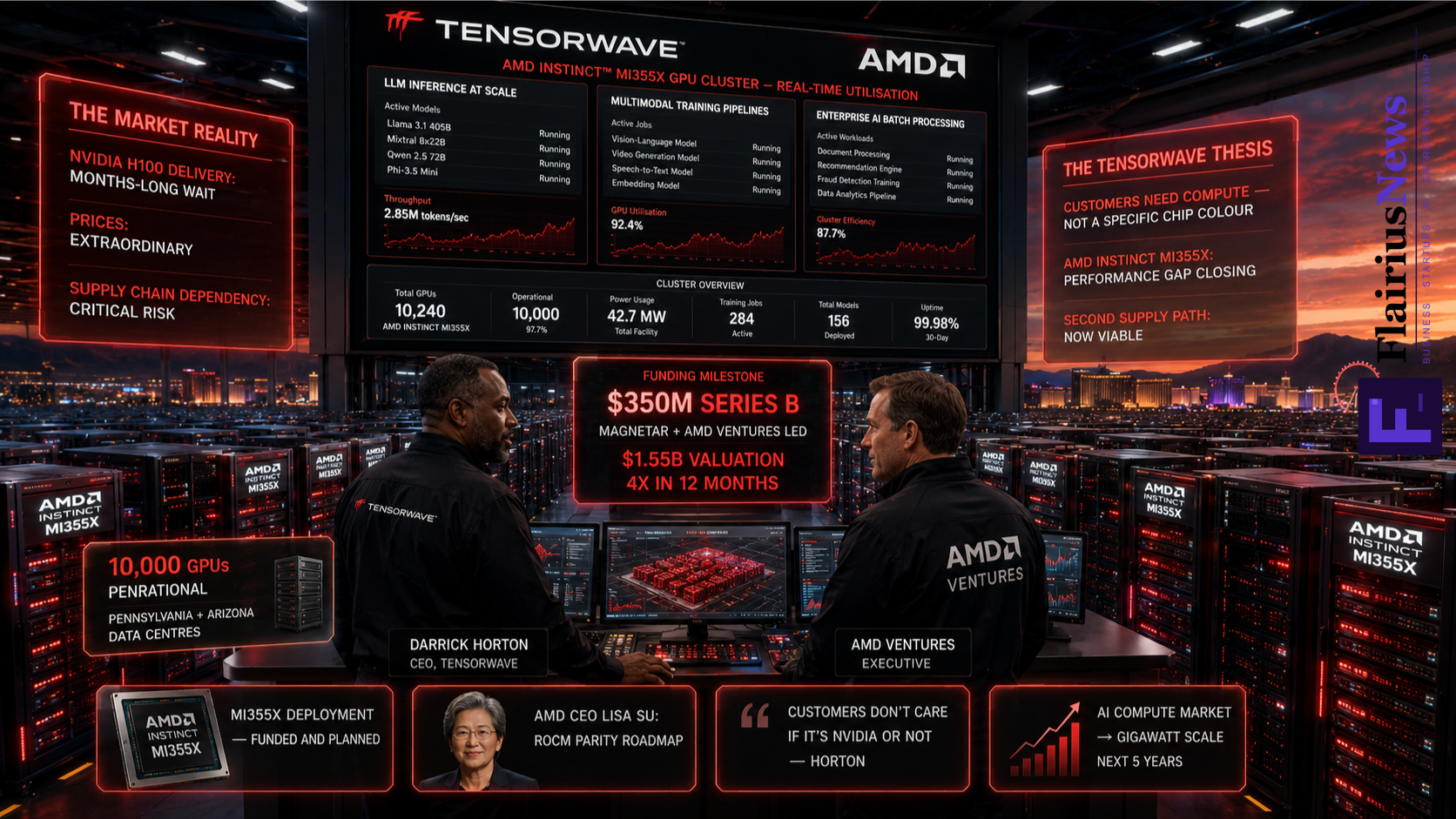
Every AI company in the world is trying to get NVIDIA GPUs. Specifically, the demand for NVIDIA H100 and H200 chips is so intense that delivery timelines extend months into the future, prices are extraordinary, and the resulting market power NVIDIA holds is unlike anything the semiconductor industry has seen since Intel’s PC-era dominance.
TensorWave looked at this situation and built a company on exactly the opposite premise. Moreover, it just raised $350 million to prove that premise is correct.
The Las Vegas-based AI cloud startup closed a Series B round co-led by Magnetar and AMD Ventures the venture capital arm of Advanced Micro Devices with additional participation from Maverick Silicon, Nexus Venture Partners, and Western Frontier. Furthermore, the round values TensorWave at $1.55 billion nearly four times its valuation from just 12 months earlier. Consequently, the market is assigning a meaningful premium to the single most differentiated position in AI infrastructure: a production-grade AI cloud that runs exclusively on AMD chips, with no NVIDIA dependency whatsoever.
What TensorWave Builds and Why AMD Exclusivity Is the Product
TensorWave provides high-performance AI cloud infrastructure compute access for model training and inference built entirely on AMD Instinct GPU clusters. Specifically, the company currently operates approximately 10,000 GPUs across data centres in Pennsylvania and Arizona. Moreover, with the $350 million raise, TensorWave plans to deploy AMD Instinct MI355X GPU clusters AMD’s most advanced AI accelerators and expand its infrastructure footprint toward significantly larger capacity.
Furthermore, the founding insight is commercially compelling. Specifically, CEO Darrick Horton noted that when TensorWave launched, “everyone was trying to get access to NVIDIA GPUs, and we started studying that opportunity more and found there was an insatiable demand for access to compute, and customers didn’t really care if it was NVIDIA or not.” Therefore, TensorWave’s thesis is not that AMD is technically superior to NVIDIA in every benchmark. It is that customers need compute, the NVIDIA supply chain cannot meet that need, and AMD-powered infrastructure at production quality creates a viable second supply path.
Moreover, AMD’s MI355X chips have been closing the performance gap with NVIDIA’s offerings consistently over the past 18 months. Specifically, several large language model training workloads now run comparably on AMD Instinct hardware particularly for inference tasks and for models below the very largest frontier scale. Consequently, TensorWave’s customers do not need to compromise on performance to choose AMD. They simply need to choose a provider willing to build and operate AMD infrastructure at scale and TensorWave is one of very few doing so.
Why AMD Ventures Co-Led the Round
AMD’s direct investment in TensorWave through AMD Ventures is one of the most strategically revealing aspects of the round. Specifically, AMD benefits directly from TensorWave’s success every GPU cluster TensorWave deploys is an AMD Instinct chip sale. Moreover, AMD’s investment gives TensorWave preferential access to new hardware generations, joint go-to-market support, and co-engineering relationships that pure cloud providers cannot access.
Furthermore, the AMD-NVIDIA competitive dynamic is intensifying in 2026 across the entire AI stack. Specifically, AMD CEO Lisa Su has made enterprise AI its primary growth strategy investing heavily in ROCm software compatibility, improving the developer experience for PyTorch and TensorFlow on AMD hardware, and building a growing ecosystem of AI software tools optimised for Instinct GPUs. Consequently, TensorWave sits at the intersection of AMD’s hardware strategy and enterprise AI’s compute diversification need making it a strategic asset for AMD as much as a financial investment.
What the $350 Million Builds and What the Broader Signal Means
The capital will fund three priorities. First, deploying AMD Instinct MI355X GPU clusters across expanded data centre capacity in the US. Second, building the enterprise sales infrastructure to convert compute-hungry AI teams into long-term TensorWave customers. Third, investing in software tooling to reduce the friction of migrating AI workloads from NVIDIA-based cloud providers to AMD-based infrastructure.
Moreover, the broader market signal from TensorWave’s $350 million round is clear. Specifically, investors are no longer treating NVIDIA’s dominance as permanent or uncontestable. Furthermore, the AI infrastructure market is large enough to support multiple compute ecosystems each serving different customer needs, price points, and supply chain preferences. Consequently, companies that build differentiated compute positions now whether AMD-based like TensorWave, custom silicon-based like CoreWeave, or hyperscaler-adjacent like Lambda Labs are positioned to capture meaningful share as the AI infrastructure market expands from its current size toward the gigawatt-scale capacity that the next generation of AI models will require.
Therefore, TensorWave is not simply a bet against NVIDIA. It is a bet that the AI compute market is becoming large enough that one chip architecture can no longer serve all of it.
Tags: TensorWave, $350M Series B, AMD AI Cloud, NVIDIA Alternative Compute, AMD Ventures TensorWave, AI Infrastructure Startup, AMD Instinct MI355X, TensorWave Las Vegas, AI Cloud Funding 2026, Darrick Horton TensorWave Author CTA: Follow Flairius News — sharp takes on AI, business, and India’s startup economy — flairiusnews.com
 Ahana Verma