
 By Raghav Sharma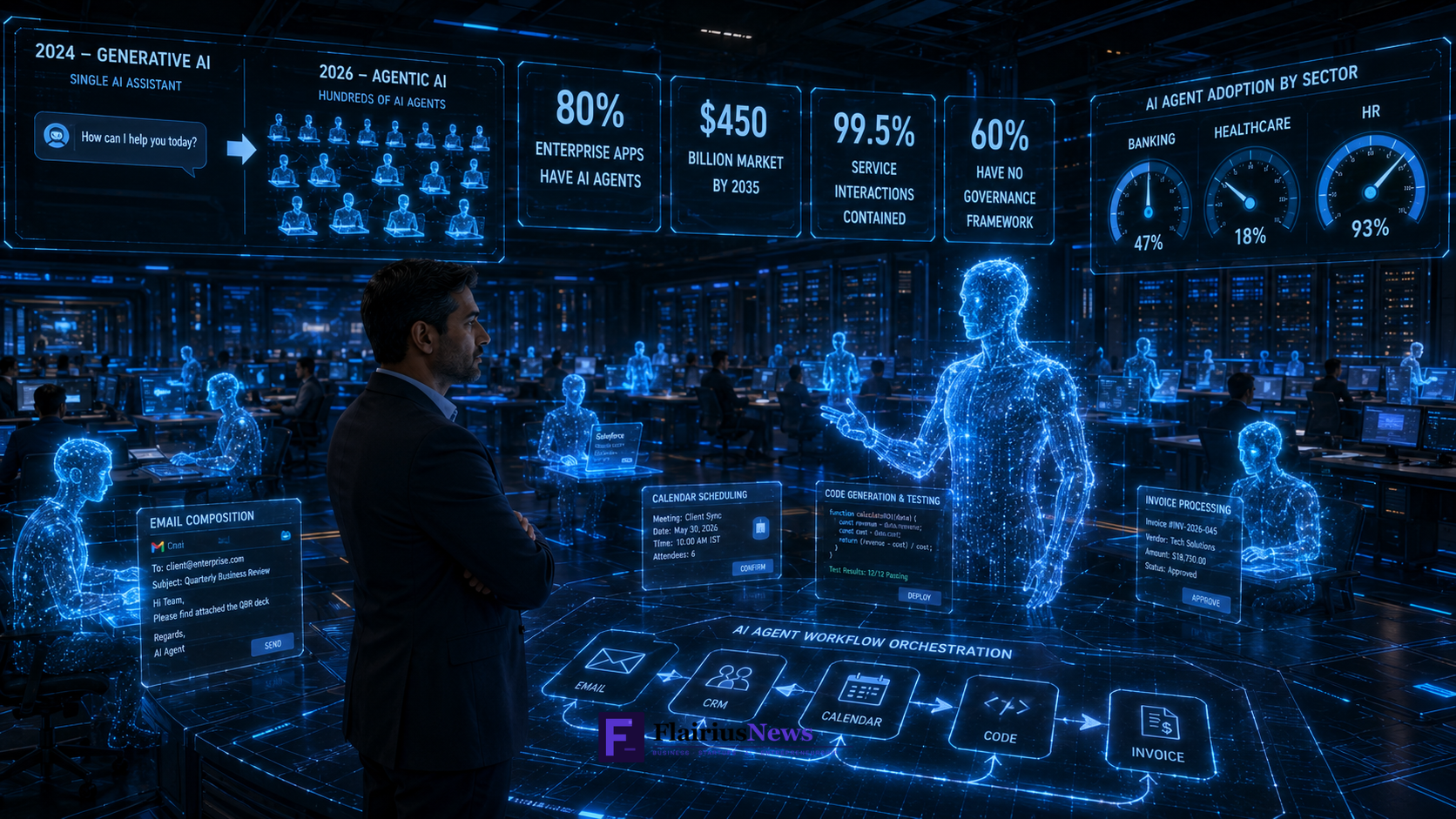
For the past two years, the AI conversation has been dominated by chatbots ask a question, get an answer. That era is over.
In 2026, the shift that technologists have been predicting has finally arrived, and it is happening at a speed that is catching even the most seasoned executives off guard. Agentic AI systems that don’t just answer questions but independently plan, decide, and execute multi-step tasks is no longer a research concept. It is in production, inside enterprise software, and quietly reshaping how work gets done across industries.

What Is Agentic AI? (And Why It’s Different)
The distinction between generative AI and agentic AI is not just technical it is fundamental. A generative AI tool writes a draft. An agentic AI system sends the email, schedules the follow-up, logs the interaction in your CRM, and flags unresolved issues for human review all without being asked to do each step individually.
This shift is what AI researchers have long called “tool use” the ability of AI to interact with external software, databases, and APIs to complete tasks rather than simply generate text. The Model Context Protocol, which standardized how AI agents connect to enterprise data systems, was the infrastructure unlock that made this practical at scale.
The Numbers Behind the Agentic AI Boom
According to Gartner data from Q1 2026, 80% of enterprise applications shipped or updated in the first quarter of this year now embed at least one AI agent up from just 33% in 2024. That two-year jump is steeper than any enterprise software adoption curve since cloud computing took hold between 2010 and 2012.
And it is not just experimentation. Real production data from AI deployment firm Druid, drawn from 15 months of usage across healthcare, financial services, higher education, and HR, shows that AI agents are now containing between 80% and 99.5% of service interactions before a human ever needs to get involved.
In healthcare alone, AI agents handle 87% of patient service interactions end-to-end from identity verification through appointment scheduling. In HR and IT, that figure reaches 93%.
The global AI agent market is projected to generate over $450 billion by 2035, with global AI spending across all categories expected to reach $1.3 trillion by 2029.
Where Agentic AI Is Already Working
The industries seeing the most traction are financial services, healthcare, and software development.
In banking and insurance, 47% of enterprises already have at least one AI agent running in production. In healthcare and government, adoption is lower 18% and 14% respectively partly due to regulatory caution and data sensitivity.
In software development, the transformation is arguably the most dramatic. Coding agents have moved far beyond autocomplete. They now work at the repository level understanding full codebases, writing and testing new features, and opening pull requests against shared repositories. For startups, this effectively multiplies the output of small engineering teams.
Microsoft’s 2026 AI trends watchlist describes AI as becoming “a real partner in teamwork, security, research, and infrastructure.” Tools like Microsoft Copilot Studio and Salesforce Agent force are now accessible to mid-market and even small businesses democratizing capabilities that, just two years ago, only the most well-resourced enterprises could access.
The Governance Gap Nobody Is Talking About
Despite the enthusiasm, there is a serious and underreported problem. While 72% of enterprises have agentic AI in production, 60% lack any formal governance framework for it. That is a massive gap, and it carries real consequences.
AI agents interact with sensitive data. They make decisions that affect customers, employees, and business outcomes. They often perform tasks that were previously the responsibility of human workers. Without clear oversight structures rules governing when agents can act autonomously versus when they must escalate to a human companies are flying blind.
Governance is not a barrier to innovation. It is what allows innovation to scale safely. The enterprises that will win with agentic AI are not necessarily those who move fastest, but those who build the right guardrails alongside the speed.
What This Means for Indian Startups and Businesses
India’s startup ecosystem is in a strong position to benefit from the agentic AI wave. Indian startups are increasingly AI-native building with agentic capabilities from the ground up rather than retrofitting AI onto legacy systems. For founders in the early stages, this is a genuine competitive advantage over incumbents weighed down by older architectures.
The practical implication is clear: the question for any business in 2026 is no longer whether to use AI. It is which workflows justify deploying agents, how to govern them responsibly, and how to redesign operations around systems that can act not just advise.
The age of asking AI for help is giving way to the age of AI getting things done. The transition is already underway whether you are ready for it or not.
Tags: Agentic AI, AI Agents, Enterprise AI, AI Governance, Indian Startups, Autonomous AI, Model Context Protocol, AI 2026 Author CTA: Follow Flairius News for sharp takes on AI, startups, and the future of business in India and beyond — flairiusnews.com
 Aditya Agarwal
  Ahana Verma