
 By Raghav Sharma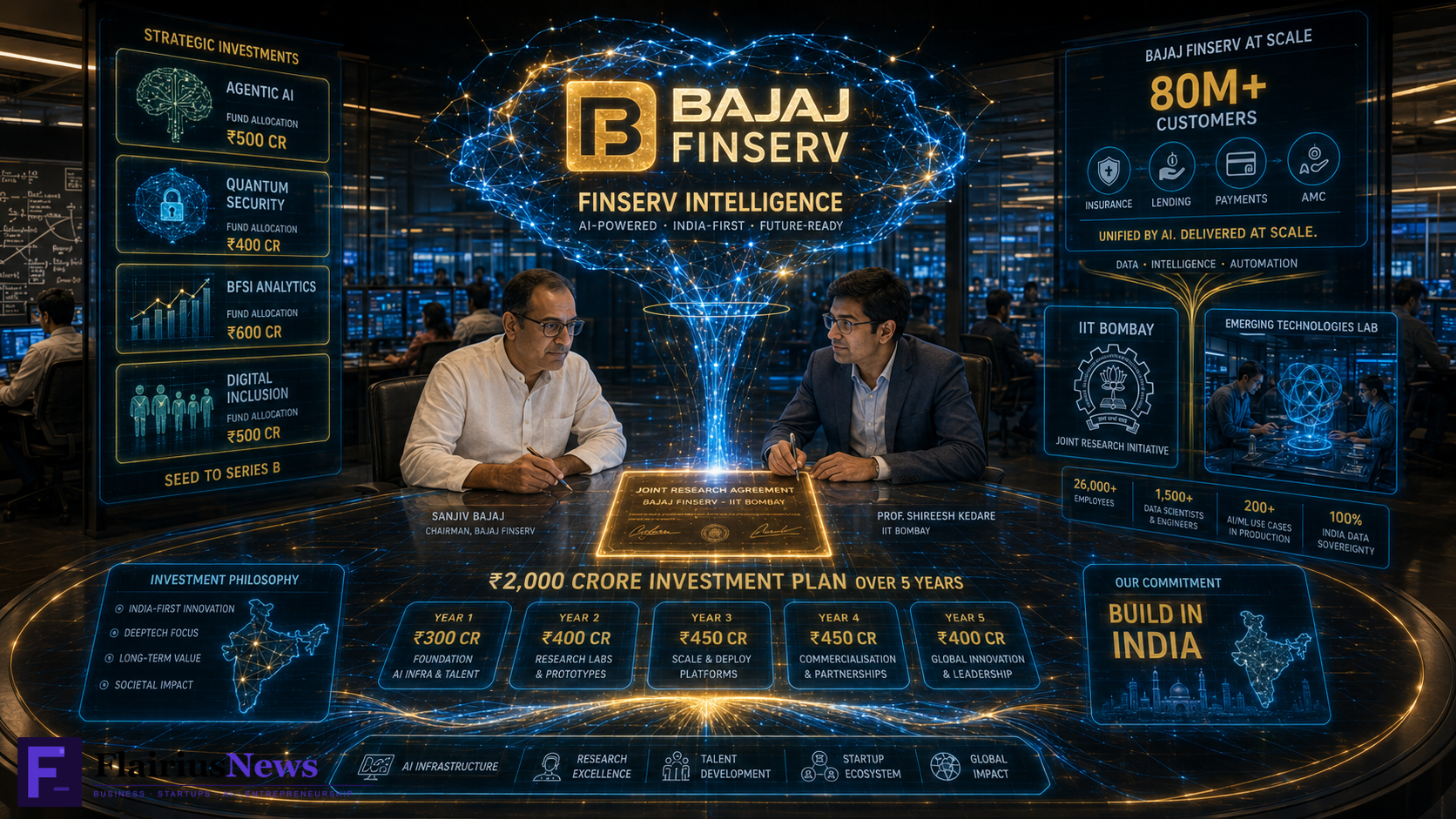
India’s largest financial services conglomerates are no longer content to use AI. They want to own it.
On May 28, 2026, Bajaj Finserv announced the launch of Finserv Intelligence a group-wide applied research and innovation platform focused on AI, cybersecurity, quantum technologies, and digital financial services. The plan is ambitious. Bajaj Finserv will invest ₹1,500–2,000 crore over five years in AI-led startups through the platform. Additionally, it has signed an MoU with IIT Bombay to establish a joint research centre in emerging technologies.
Consequently, one of India’s most conservative financial institutions is making its most aggressive tech bet ever.
What Finserv Intelligence Actually Is
Finserv Intelligence is not a rebrand. It is a structural commitment. The platform will prioritise early-stage companies from seed to Series B. Furthermore, it will focus specifically on scalable, low unit-cost solutions developed in India for domestic and global markets.
The internal team will comprise around 40 people. Moreover, portfolio startups will receive direct access to Bajaj Finserv’s commercial infrastructure its 80+ million customer base, its distribution network, and its enterprise procurement relationships. Therefore, the platform offers something most CVC funds cannot: immediate commercial deployment at scale.
Additionally, the IIT Bombay partnership creates a research pipeline. Specifically, the joint research centre will work on emerging technologies relevant to financial services quantum cryptography, AI model reliability, financial data infrastructure. As a result, Finserv Intelligence can both invest in startups and build proprietary research that supports them.
Why This Is a Strategic Signal, Not Just a PR Move
Sanjiv Bajaj, chairman and managing director of Bajaj Finserv, was direct: “The next decade of value creation in financial services will belong to those who build the technology that powers it. We have chosen to build, and to build in India.”
That statement contains two important choices. First, “build” rather than “buy” or “partner” a signal of long-term internal capacity development. Second, “in India” a deliberate sovereign positioning in a sector where global platforms dominate.
Furthermore, the timing is not coincidental. Bajaj Finserv Ventures separately led the ₹50 crore Series B in Lumiq just one week after the Finserv Intelligence announcement. Consequently, the investment in Lumiq is not an isolated deal. Instead, it is the first visible execution of the Finserv Intelligence strategy.
Moreover, Bajaj Finserv’s position in the market is uniquely advantageous for this kind of platform. It operates across lending, insurance, asset management, and payments. Therefore, any AI startup in its portfolio can be deployed across multiple business lines simultaneously dramatically compressing the go-to-market timeline.
The Sectors Finserv Intelligence Will Target
Based on the platform’s stated focus areas, three categories stand out as likely investment priorities.
First, agentic AI for BFSI. The launch of Lumiq’s LiteCone platform in February 2026 and Bajaj’s immediate investment signals strong conviction in autonomous AI systems for financial operations. Consequently, similar startups building agentic layers for insurance claims, lending decisions, and customer service automation are likely targets.
Second, quantum-safe security. Finserv Intelligence explicitly lists quantum technologies as a focus area. Furthermore, QNu Labs selected for SAP’s 2026 deeptech cohort demonstrates that credible Indian quantum security startups already exist. As financial infrastructure faces a mandatory post-quantum transition within a decade, early investment here is strategically timed.
Third, digital financial inclusion. Bajaj Finserv’s reach into Tier 2 and Tier 3 India is vast. Therefore, startups building AI-powered financial products for underserved Indian segments fit both the commercial and impact mandates of the platform.
What This Means for Indian AI Founders
Finserv Intelligence changes the calculus for AI founders building in financial services. Previously, the route to enterprise deployment in BFSI required months of procurement cycles, compliance reviews, and stakeholder sign-offs. Moreover, getting a bank or insurer to pilot new AI technology was slow and unpredictable.
Now, a founder backed by Finserv Intelligence has a direct route to commercial deployment inside one of India’s largest financial conglomerates. Additionally, the IIT Bombay partnership creates a talent pipeline and research credibility that makes regulatory conversations easier.
Furthermore, the ₹2,000 crore commitment over five years means consistent capital availability across market cycles. As a result, early-stage founders in BFSI AI do not need to time their raises to a favourable funding environment. They need to build the right thing and get in front of the right team.
The right team, in this case, just announced themselves publicly.
Tags: Bajaj Finserv, Finserv Intelligence, AI Investment India, BFSI AI Startups, Sanjiv Bajaj, IIT Bombay Partnership, Corporate Venture Capital India, Quantum Security India, AI Fintech 2026 Author CTA: Follow Flairius News — sharp takes on AI, business, and India’s startup economy — flairiusnews.com
 Aditya Agarwal