
 By Raghav Sharma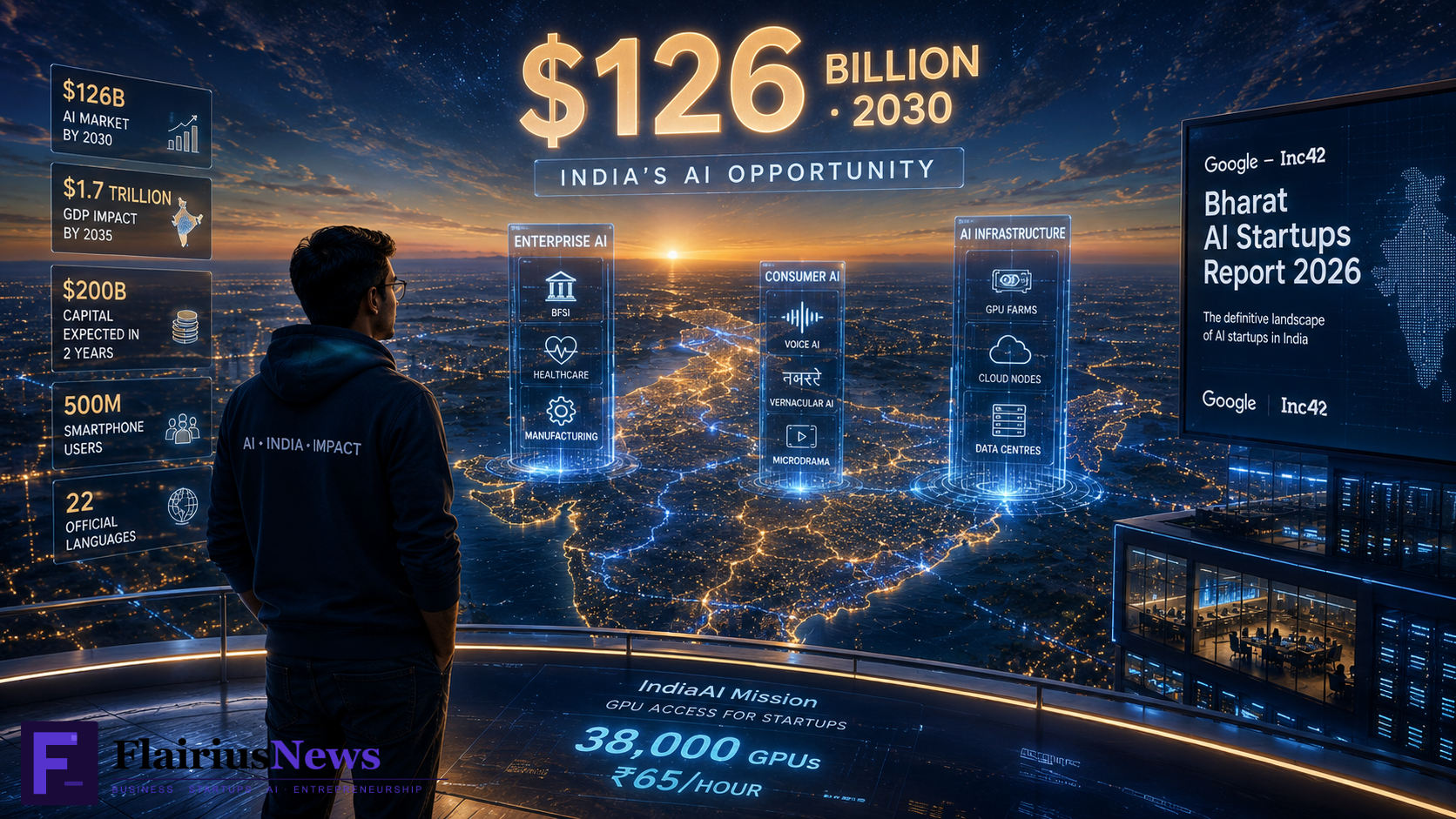
India’s AI story has a number attached to it. It is a large number. Furthermore, it is a credible one.
According to the Google and Inc42 Bharat AI Startups Report 2026, India’s AI market could become a $126 billion opportunity by 2030. Moreover, the potential GDP impact reaches $1.7 trillion by 2035. Additionally, the Centre is confident the sector could attract over $200 billion in capital over the next two years.
These are not aspirational projections from optimistic consultants. They come from a report backed by Google’s India data and Inc42’s startup ecosystem intelligence. Therefore, they deserve serious attention from every founder building in India today.
Why Enterprise AI Will Lead Growth
The report makes a clear distinction. Enterprise AI will lead growth first. Consumer AI will scale rapidly on the back of strong adoption.
This ordering matters. Enterprise AI typically generates revenue faster, faces less price sensitivity, and builds deeper integration moats. Furthermore, enterprise customers in India are actively spending on AI infrastructure right now. Specifically, banks, insurers, manufacturers, logistics companies, and healthcare providers are all running active AI procurement cycles.
Consequently, founders building enterprise AI particularly in sectors with strong Indian institutional presence like BFSI, healthcare, and logistics are entering markets with established budget lines and genuine willingness to pay.
Additionally, the evidence supports this. In the past two weeks alone, Bajaj Finserv committed ₹2,000 crore to AI startup investments through Finserv Intelligence, Lumiq raised a ₹50 crore Series B for BFSI data AI, and SAP Labs India selected five deeptech AI companies for its 2026 accelerator cohort. Therefore, enterprise AI capital is actively flowing.
The Consumer AI Wave Is Coming Second But It Will Be Bigger
However, consumer AI is not far behind. India has over 500 million smartphone users. Furthermore, it generates more than 20% of the world’s data. Moreover, it has 22 official languages and hundreds of millions of first-generation internet users who interact primarily through voice and vernacular text.
These characteristics create a consumer AI opportunity that is fundamentally different from the US or Chinese markets. Consequently, the platforms that win Indian consumer AI will not be adaptations of Western products. They will be built natively for Indian languages, Indian cultural contexts, and Indian interaction patterns.
The evidence is already visible. Meesho’s PRISM AI system drives over 75% of orders through AI discovery rather than search a model that was built specifically for how Indian consumers browse. Kuku FM’s AI-powered microdrama production generates 150 original shows monthly. Furthermore, Gnani.ai’s voice AI processes 30 million daily interactions in 12 Indian languages.
Three Sectors Where the Opportunity Is Clearest
First, AI for financial services. India’s BFSI sector is large, digitally active, and data-rich. Moreover, it faces clear productivity constraints too many customers, too few qualified advisors, too much data for human analysis. As a result, AI for credit decisioning, insurance underwriting, wealth management, and fraud detection all have clear ROI and willing enterprise buyers.
Second, AI for healthcare. India’s doctor-to-patient ratio is approximately 1:834 against WHO’s recommended 1:1,000. Furthermore, the healthcare system handles over 1 billion patient interactions annually. Consequently, AI for diagnosis support, patient triage, medical imaging, and treatment planning represents one of the most urgent and underfunded opportunities in Indian tech.
Third, AI for manufacturing and logistics. India’s engineering exports hit a record $122.43 billion in FY26. Moreover, the country is actively building manufacturing capacity to compete with China. As a result, AI for quality control, supply chain optimisation, and predictive maintenance is entering a market with strong government tailwinds and urgent commercial demand.
What Founders Should Do With This Information
The $126 billion number is useful context. However, it is not a strategy. Therefore, founders should use it differently.
First, pick a specific sector where Indian contextual AI has a decisive advantage over global platforms. Second, identify the exact problem within that sector where the data exists, the buyer has budget, and the current solution is clearly inadequate. Third, build the smallest possible version of the solution that proves the core AI capability works.
Furthermore, use the IndiaAI Mission’s subsidised GPU access 38,000 GPUs at ₹65/hour to build and validate before raising institutional capital. The compute access that used to require a Series A now exists at pre-seed.
The $126 billion opportunity is real. Moreover, it is accessible. The question is simply which founders will build the right things, in the right sectors, before the window closes.
Tags: India AI Market 2030, $126 Billion AI India, Enterprise AI India, Consumer AI India, IndiaAI Mission, Google Inc42 Report, Bharat AI Startups, AI Founders India, AI Opportunity 2026 Author CTA: Follow Flairius News — sharp takes on AI, business, and India’s startup economy — flairiusnews.com
 Aditya Agarwal
  Ahana Verma