 By Ahana Verma
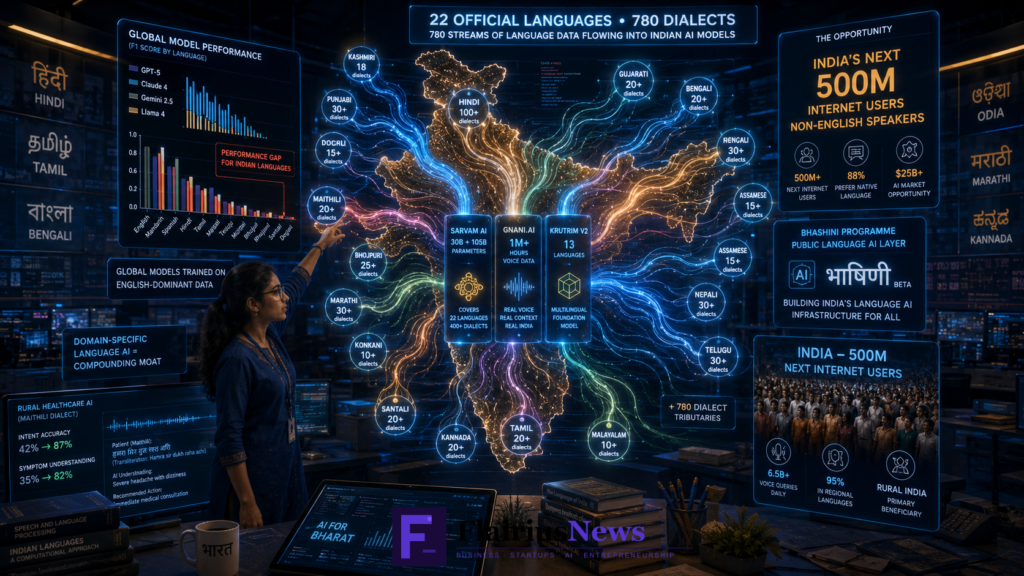
India has 22 official languages. Furthermore, it has approximately 780 dialects. Moreover, most of these dialects exist in populations large enough to have their own cultural identity, economic activity, and digital behaviour patterns that global AI models have never been trained to understand.
This is India’s most important AI opportunity in 2026. Furthermore, it is one that no foreign company can credibly pursue. Consequently, the Indian founders building AI for Bharat’s linguistic diversity are working on a problem that is both technically hard and commercially enormous and they face no serious global competition.
Why GPT-5 Cannot Solve India’s Language Problem
OpenAI’s GPT-5 is an extraordinary model. Moreover, it performs remarkably well in English, French, Mandarin, Spanish, and dozens of other languages with substantial training data. However, it performs significantly worse in Maithili, Bhojpuri, Santali, Dogri, or Bodo four of India’s 22 scheduled languages, collectively spoken by tens of millions of people.
The reason is training data, not model architecture. Specifically, the internet contains vastly more text in English and Mandarin than in any Indian language. Therefore, global models trained on internet data reflect global internet data distributions which dramatically underrepresent Indian linguistic diversity.
Furthermore, the problem extends beyond vocabulary. Specifically, Indian languages have different syntactic structures, different script systems, different transliteration conventions, and different code-switching patterns the practice of mixing English words into Hindi or Tamil speech that are deeply embedded in how Indian people actually communicate. A model trained primarily on English underestimates all of these complexities.
What India Is Building to Fix This
Several Indian AI companies are directly addressing the language gap. Therefore, understanding each approach matters.
Sarvam AI’s 30B and 105B models released at the India AI Impact Summit in February 2026 were pre-trained on datasets that explicitly over-represented Indian languages relative to their internet data prevalence. Moreover, the company has released Saaras V3, a streaming speech model that handles Indian accent variation and code-switching. Consequently, a user speaking Hinglish the Hindi-English mix that dominates urban Indian conversation gets better results from Sarvam than from any global model.
Gnani.ai’s Vachana STT model was trained on over 1 million hours of voice data across 1,056 domains and 12 Indian languages. Furthermore, it was specifically built to handle the acoustic challenges of Indian voice recording environments background noise, compressed audio, phone-quality microphones that are characteristic of how most Indians make calls. Therefore, it performs well precisely in the conditions that matter most for Indian enterprise deployments.
Krutrim’s AI assistant Kruti supports 13 Indian languages at launch. Moreover, Krutrim V2 was trained on a dataset that weighted Indian language content deliberately. Consequently, Kruti’s language understanding for Hindi and regional languages is materially better than any adapted global model.
The Commercial Scale of This Opportunity
India’s 500 million next internet users are primarily non-English speakers. Furthermore, they are the customers that every Indian enterprise bank, insurance company, hospital, logistics firm, government department needs to serve cost-effectively. Therefore, AI that communicates in their language is not a feature. It is a prerequisite for commercial viability.
Specifically, consider a rural healthcare worker in Bihar using an AI diagnostic support tool. If that tool communicates only in English, she cannot use it. Moreover, if it communicates in Hindi but not Maithili the primary language of Bihar’s Mithila region she cannot use it fully. Consequently, the AI that genuinely serves her needs to understand not just her language, but her dialect.
Moreover, the government’s Bhashini programme India’s national language translation mission is creating a public infrastructure layer for Indian language AI that gives any startup access to base language translation capabilities. Therefore, startups can build on top of Bhashini for common translation tasks and focus their proprietary development on domain-specific language understanding.
What Founders Should Build on Top of This Foundation
The Sarvam, Gnani, and Krutrim foundation gives Indian founders access to base-layer Indian language AI. However, the commercial opportunity lies one layer up domain-specific language AI that understands not just languages but industries.
Specifically, an AI that understands kirana retail language the pricing terms, product nicknames, and negotiation conventions of small grocery store owners is more useful than a general Hindi model for a B2B commerce platform. Similarly, an AI that understands the vocabulary of Indian micro-finance loan processing is more useful than a general financial AI for an NBFC serving rural customers.
Therefore, the most valuable Indian language AI products in 2026 are not general models. They are vertical models trained on domain-specific Indian language data and the founders who build them first will have competitive moats that compound over time.
Tags: India Bharat AI, Indian Language AI, 780 Dialects India, Sarvam AI Languages, Vernacular AI India, Bhashini Programme, India Language AI Opportunity, Non-English AI India 2026 Author CTA: Follow Flairius News — sharp takes on AI, business, and India’s startup economy — flairiusnews.com
 Aditya Agarwal
  Raghav Sharma