 By Ahana Verma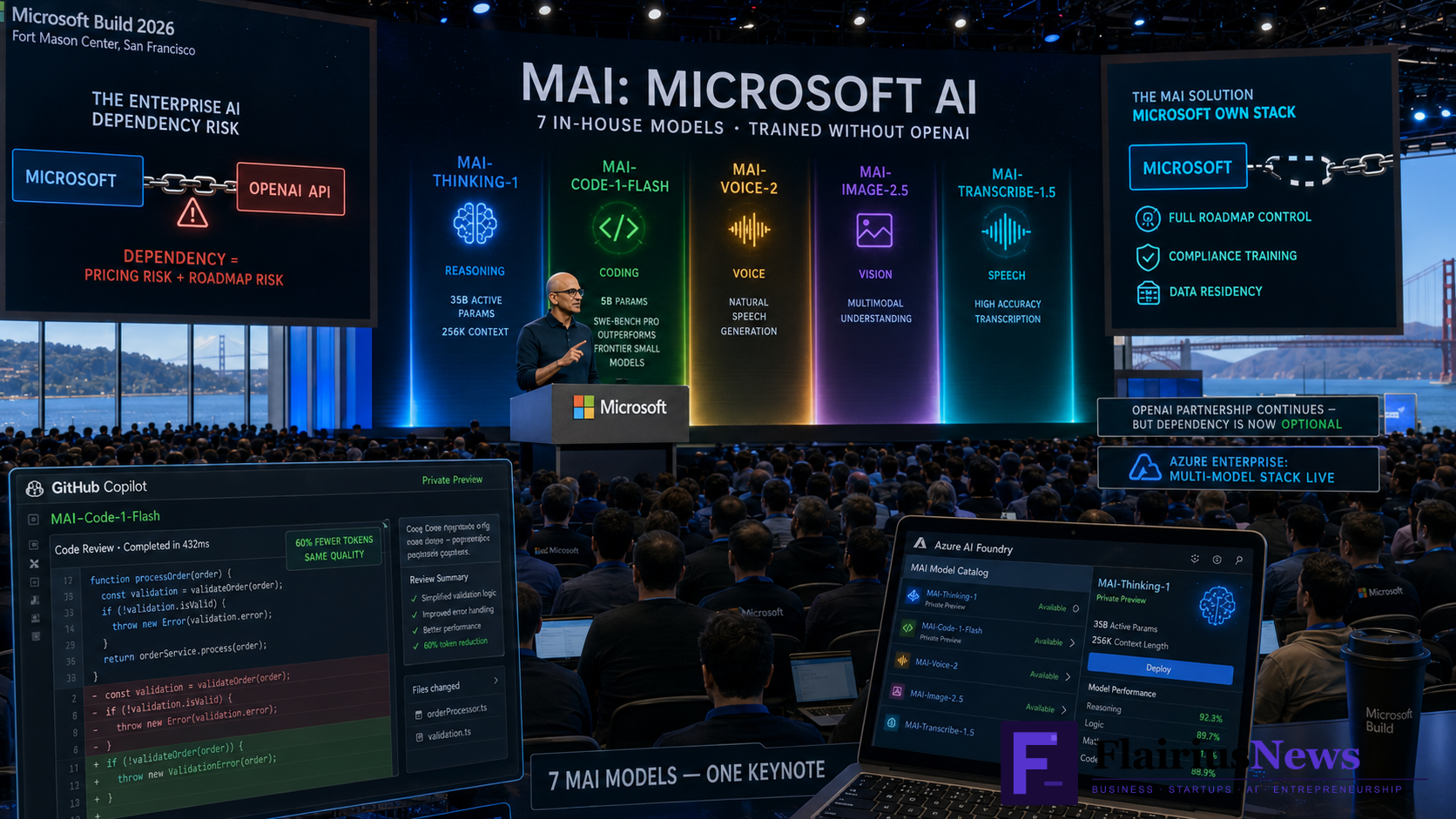
For years, Microsoft’s AI strategy was simple. It invested billions in OpenAI and distributed those models through Azure, GitHub Copilot, and Microsoft 365. Moreover, that strategy worked OpenAI’s models made Microsoft the most AI-integrated enterprise software company in the world.
On June 2, 2026, that strategy quietly changed shape.
At Microsoft Build 2026 in San Francisco, CEO Satya Nadella unveiled seven new in-house AI models under the MAI family name all trained from scratch on commercially licensed data, with no distillation from OpenAI, Anthropic, or any other third-party model. Furthermore, the flagship MAI-Thinking-1 became Microsoft’s first in-house reasoning model. Additionally, MAI-Code-1-Flash began rolling out immediately to all GitHub Copilot plans. Consequently, Microsoft has moved from AI consumer to AI producer in a single keynote.
What Microsoft Actually Launched
The MAI family covers seven distinct capabilities. Specifically, MAI-Thinking-1 is a sparse Mixture-of-Experts reasoning model with 35 billion active parameters and a 256,000-token context window. Moreover, it was trained end-to-end by Microsoft on commercially licensed enterprise data the first Microsoft reasoning model with no OpenAI DNA. Therefore, Azure customers now have a reasoning model that Microsoft controls entirely, including its roadmap, pricing, and deployment terms.
MAI-Code-1-Flash is the more immediately impactful product. Specifically, it is a 5-billion-parameter coding model trained directly on GitHub Copilot’s production workflows meaning it was optimised for the specific coding patterns that real Copilot users generate every day. Furthermore, its performance on SWE-Bench Pro outpaces several frontier-lab small models despite being far more compact. Consequently, enterprise developers using GitHub Copilot benefit from lower inference costs without sacrificing code quality.
Additionally, Microsoft launched MAI-Voice-2 covering 15+ languages with expanded emotional range, MAI-Image-2.5, and MAI-Transcribe-1.5 for speech-to-text across Teams meetings and Copilot summaries. Therefore, the full MAI stack now covers reasoning, coding, voice, image, and transcription a complete enterprise AI capability layer.
Why “Making Dependence Look Optional” Matters
The strategic read on Build 2026 is subtle but important. Specifically, the OpenAI partnership officially runs through 2030 and nothing about Build 2026 changes that. Azure remains OpenAI’s primary infrastructure. GitHub Copilot continues to support OpenAI models. Microsoft 365 Copilot continues to use OpenAI capabilities.
However, Microsoft now has operational, shipping alternatives at every tier of the developer stack. Furthermore, when OpenAI adjusted its API pricing earlier in 2026, the enterprises most exposed were those with deep dependencies and no fallback options. Consequently, the MAI family gives every Azure customer a diversified model portfolio where Microsoft controls the roadmap. Therefore, as one Build keynote analyst put it: Microsoft just made dependence look optional.
Moreover, the commercial signal is equally clear. Specifically, model capability is becoming a commodity layer. Differentiation is shifting toward enterprise infrastructure features compliance-boundary training, data residency, deployment flexibility, and audit controls. Therefore, Microsoft’s move positions Azure as the enterprise AI platform that owns the full stack, not just the API distribution layer.
What This Means for Enterprise AI Buyers
For enterprise AI decision-makers, Build 2026 removes the binary choice. Specifically, the most consequential enterprise AI decisions of 2024 and 2025 effectively came down to OpenAI versus everyone else. Today, Azure customers can mix MAI models, OpenAI models, Anthropic models, and open-source models on the same platform with the same governance controls.
Furthermore, the cost arithmetic has changed significantly. Specifically, MAI-Code-1-Flash’s 5-billion-parameter efficiency means high-volume repetitive coding tasks autocompletion, bug fixes, test generation can now run at dramatically lower inference cost on GitHub Copilot. Moreover, the expensive frontier models can be reserved for genuinely complex reasoning tasks. Consequently, enterprises building multi-model AI stacks in 2026 have a meaningful cost reduction path that did not exist six months ago.
Tags: Microsoft MAI Models, MAI-Thinking-1, MAI-Code-1-Flash, Build 2026, Microsoft OpenAI Independence, GitHub Copilot AI 2026, Enterprise AI Models, Satya Nadella AI, Azure AI Stack, Microsoft Reasoning Model 2026 Author CTA: Follow Flairius News — sharp takes on AI, business, and India’s startup economy — flairiusnews.com
 Aditya Agarwal
  Raghav Sharma