
 By Nayra Roy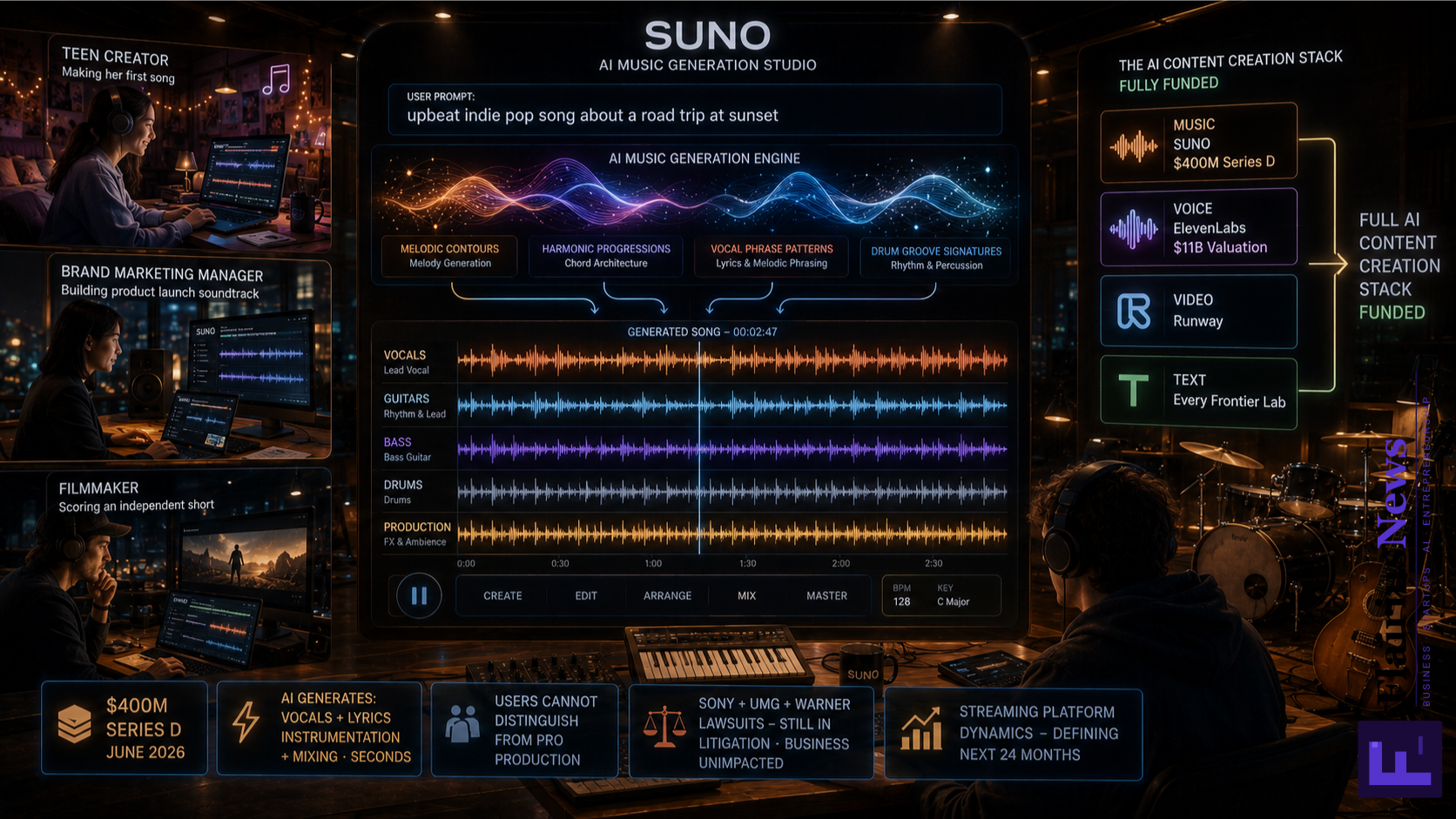
When text AI arrived, it disrupted writing. When code AI arrived, it disrupted software development. Now audio AI has arrived and it is disrupting music, voice, podcasts, and sound design simultaneously.
Suno, the AI music generation startup, raised $400 million in a Series D round in June 2026. Specifically, the Cambridge, Massachusetts-based company allows any user to generate full songs with vocals, instrumentation, and production quality from a text prompt in seconds. Moreover, it does this without requiring any musical training, any instrument, or any prior creative experience. Consequently, Suno is doing for music what Midjourney did for visual art lowering the barrier to creation so dramatically that it creates an entirely new category of creator.
The $400 million round reflects investor conviction that AI-generated audio will become a mass-market creative platform. Furthermore, the timing is not accidental. Specifically, ElevenLabs raised $500 million at an $11 billion valuation earlier in 2026 for AI voice. Moreover, Runway is building AI for video. Additionally, Stability AI continues developing audio generation tools. Consequently, the full AI content creation stack text, image, video, voice, and music is being funded simultaneously in 2026. And Suno is the clearest bet on the music layer.
What Suno Builds That No One Else Has Matched
Suno’s core product is deceptively simple. Specifically, a user types a prompt “upbeat indie pop song about a road trip at sunset” and Suno generates a full song within seconds: original vocals, lyrics, instrumentation, mixing, and production. Moreover, the quality of output has reached a threshold where casual listeners frequently cannot distinguish Suno-generated music from professionally produced tracks.
Furthermore, the technology architecture behind this quality is complex. Specifically, Suno trains its models on licensed music data across a vast range of genres, production styles, vocal techniques, and instrumentation patterns. Moreover, the generation process is not simply remixing existing music it creates genuinely original compositions that are new in every measurable musical dimension: melody, harmony, rhythm, arrangement, and production. Therefore, Suno’s output does not infringe existing copyrights in the way that simple audio sampling would.
Additionally, Suno’s product has iterated rapidly. Specifically, each major model version has produced measurable quality improvements in vocal naturalness, instrumental complexity, genre accuracy, and prompt adherence. Furthermore, the platform now supports custom styles where users can define a specific sonic aesthetic and collaborative editing, where generated tracks can be modified in the stems layer. Consequently, Suno is evolving from a music generation tool into a full music creation platform.
The Copyright Question and Why It Has Not Stopped the Business
Suno, like every AI audio generation company, faces copyright litigation. Specifically, major record labels Sony Music, Universal Music Group, and Warner Music Group have filed lawsuits arguing that Suno’s training data includes copyrighted recordings without proper licensing. Moreover, these cases remain in litigation as of June 2026.
However, the business continues to scale regardless. Specifically, Suno’s user growth and revenue trajectory have not been meaningfully impacted by the litigation suggesting that the product’s value proposition is strong enough that users do not require the legal questions to be resolved before adopting it. Furthermore, the $400 million round explicitly validates investor confidence that the copyright questions will either be resolved through licensing agreements or will not ultimately impair the business at scale.
Additionally, the music industry’s relationship with AI is more nuanced than the lawsuits suggest. Specifically, several major labels have explored licensing discussions with AI audio companies, recognising that a negotiated revenue-sharing model may ultimately be more valuable than pursuing litigation outcomes that could take years to resolve. Therefore, the copyright conflict is real but it is more likely to reshape the licensing economics of AI music than to prevent AI music from existing.
What Audio AI Means for Creators, Brands, and Platforms
The downstream implications of Suno’s scale are significant for three categories of stakeholder. First, independent creators. Specifically, a musician who previously needed a producer, recording studio, session musicians, and mixing engineer to create a commercially viable track can now generate that foundation in seconds and build original creative work on top of it. Therefore, AI music lowers the capital required to participate in music creation just as Canva lowered the capital required to participate in visual design.
Second, brands and advertisers. Specifically, every piece of branded content social media videos, podcast ads, product launches, in-store audio requires music. Moreover, custom-commissioned music is expensive and slow. Therefore, brands that adopt AI music generation can reduce production costs significantly while maintaining brand-specific audio identity. Consequently, this is one of the clearest near-term commercial applications for Suno’s platform.
Third, streaming platforms. Specifically, platforms like Spotify are both threatened and attracted by AI music. Moreover, Spotify has already begun exploring AI-generated content policies. Therefore, the relationship between AI music generation and streaming distribution will be one of the defining commercial dynamics of the audio AI market over the next 24 months.
Tags: Suno AI, $400M Series D, AI Music Generation, Suno Funding 2026, Audio AI Platform, AI Music Startup, AI Content Creation Stack, ElevenLabs Voice AI, AI Creator Economy 2026, Suno vs Record Labels Author CTA: Follow Flairius News — sharp takes on AI, business, and India’s startup economy — flairiusnews.com
 Aditya Agarwal