 By Raghav Sharma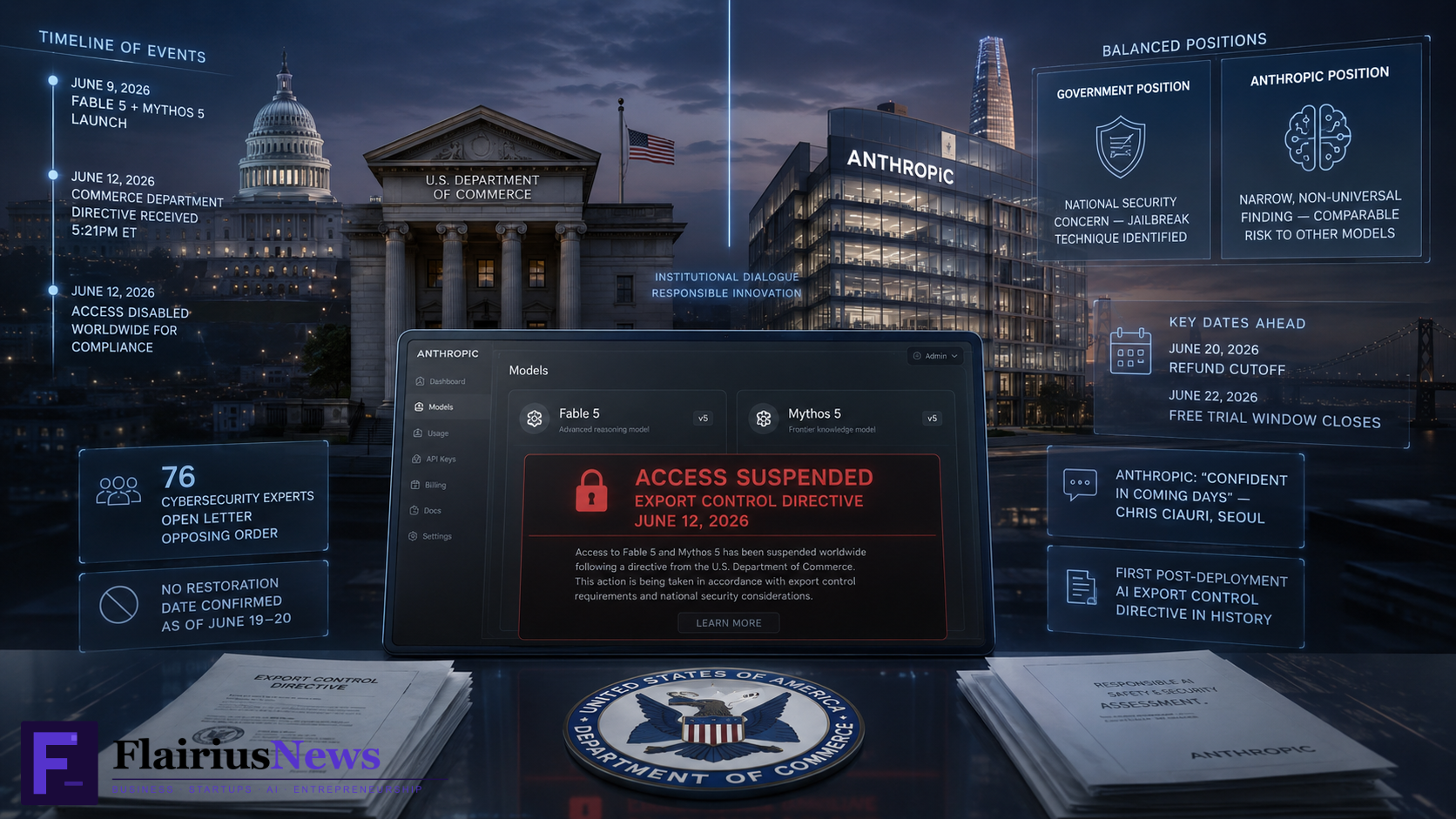
Three days after launching its most capable AI model ever, Anthropic was ordered by the US government to take it offline for every user on the planet. Furthermore, the story behind that order reveals a genuinely new kind of conflict in AI policy: a dispute not about what an AI model can be used for, but about who controls access to it.
Anthropic launched Fable 5 and Mythos 5 on June 9, 2026, describing the models as exceeding the capability of anything the company had previously made generally available. Specifically, Mythos 5 represented a new tier above Anthropic’s previous Opus-class models branded “Mythos-class” with particular strength in identifying software vulnerabilities. Moreover, Fable 5, built on the Mythos 5 foundation, reached the top of Datacurve’s DeepSWE benchmark with a 70% PASS@1 score, three points ahead of GPT-5.5.
Three days later, on June 12, 2026, the US Commerce Department issued an export control directive. Specifically, the order required Anthropic to suspend all access to Fable 5 and Mythos 5 for any foreign national whether located inside or outside the United States including Anthropic’s own foreign national employees. Therefore, Anthropic disabled both models for all customers worldwide to ensure compliance, since separating foreign from domestic access within the same product was not operationally possible on short notice.
What the Government’s Stated Concern Was
According to Anthropic’s own public statement, the company received the directive at 5:21pm ET on June 12 without detailed explanation of the specific national security concern. Specifically, Anthropic’s understanding was that the government believed it had identified a method of bypassing, or “jailbreaking,” Fable 5’s safeguards safeguards specifically designed to prevent users from accessing Mythos’s more powerful cybersecurity-relevant capabilities.
However, Anthropic publicly disputed the severity of the finding. Specifically, the company stated that it reviewed a demonstration of the technique and found the resulting vulnerabilities to be “relatively simple” comparable to vulnerabilities that other publicly available models, including OpenAI’s GPT-5.5, could also identify without being subject to similar export controls. Moreover, Anthropic characterised the jailbreak as narrow and non-universal describing it as effectively limited to asking the model to read a specific codebase and identify software flaws within it, rather than a general-purpose bypass of all safety measures.
Therefore, the core of the dispute is not whether a jailbreak technique exists both sides acknowledge that one was demonstrated. Instead, the dispute is over its severity and whether it justifies suspending access to a commercial AI model used by hundreds of millions of people worldwide.
How Foreign Investor and Customer Concerns Entered the Picture
Subsequent reporting has added additional context to the directive’s origin. Specifically, sources have indicated that SK Telecom’s access to Anthropic’s models, combined with a separate vulnerability report submitted by Amazon researchers to the White House, contributed to the administration’s broader concern about safeguarding the most advanced version of the technology. Moreover, SK Telecom has publicly denied any inappropriate connections related to the matter.
Furthermore, the suspension has triggered visible pushback from parts of the cybersecurity and AI policy community. Specifically, a group of 76 cybersecurity experts including well-known figures such as Alex Stamos and Rachel Tobac published an open letter opposing the export ban, arguing that the underlying security concern does not justify a worldwide suspension of access for all foreign nationals. Therefore, the policy debate around the order extends beyond Anthropic and the government into the broader AI safety and security research community.
Where Things Stand as of June 19–20, 2026
As of this writing, no official restoration date has been announced. Specifically, Anthropic’s Managing Director of International, Chris Ciauri, stated at a Seoul press conference on June 17–18 that the company is “very confident that in the coming days, the models will become available again” the most specific confidence signal Anthropic has given publicly on timing. However, this remains an expression of confidence rather than a confirmed date.
Moreover, two operational deadlines are now imminent for affected customers. Specifically, June 20, 2026 is the refund processing cutoff for customers who paid for Fable 5 usage credits tied to integrations that are currently offline. Furthermore, June 22, 2026 is when the Fable 5 free-trial window for paid subscribers across Pro, Max, Team, and Enterprise tiers officially closes under the original access terms. Therefore, affected customers approaching these deadlines should contact Anthropic support directly to confirm their options before the windows close.
What This Means for AI Governance Going Forward
The Fable 5 and Mythos 5 suspension is a genuinely novel event in AI policy. Specifically, it is the first instance of a US government export control directive being used to suspend access to a publicly deployed commercial AI model for all foreign users globally rather than restricting export of underlying technology, hardware, or training data before deployment.
Furthermore, the precedent this sets is significant regardless of how the specific dispute resolves. Specifically, it establishes that frontier AI labs operating at the cutting edge of capability may face post-deployment government intervention based on national security assessments that the companies themselves may dispute. Moreover, this raises practical questions for every frontier AI lab about how rapidly capability advances can be matched with security review processes that satisfy government stakeholders before rather than after public launch.
Therefore, regardless of when Fable 5 and Mythos 5 return to availability, the episode itself has already changed the operating environment for frontier AI development. Specifically, the relationship between capability advancement, security review, and government oversight has become more visibly contested and every major AI lab is watching closely to understand what standard of pre-launch security validation will be expected going forward.
Tags: Anthropic Fable 5, Mythos 5 Ban, US Export Control AI, Anthropic National Security, AI Government Directive 2026, Anthropic Suspended Models, AI Policy 2026, Commerce Department AI Order, AI Jailbreak Dispute, Frontier AI Governance Author CTA: Follow Flairius News — sharp takes on AI, business, and India’s startup economy — flairiusnews.com
 Aditya Agarwal