
 By Raghav Sharma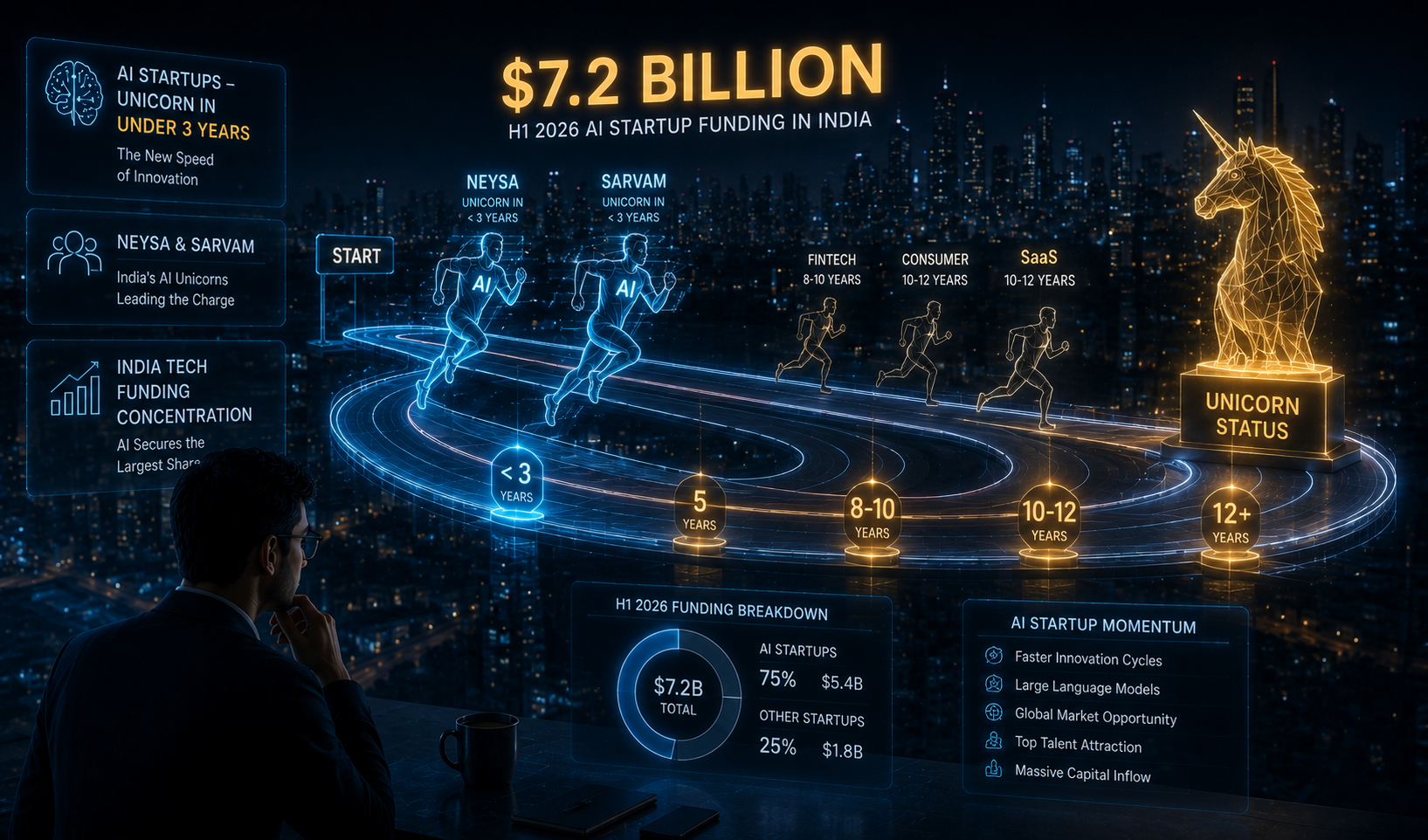
It used to take a decade to become a unicorn in India. Now, the fastest-growing companies are doing it in under three years and almost all of them are AI startups.
According to a Tracxn report released on June 25, 2026, India’s tech startup ecosystem attracted $7.2 billion in funding during the first half of the year, marking a 12% year-on-year increase. Moreover, that headline growth number hides a much more concentrated and AI-driven story underneath.
Fewer Deals, Bigger Cheques
Funding activity has become increasingly concentrated in a smaller set of companies. Specifically, the total number of funding rounds declined 43% to 652 between January 1 and June 24. Therefore, more capital is chasing fewer, larger bets a pattern consistent with investors growing more selective even as overall dollar amounts rise.
Furthermore, the top three funding rounds alone CRED’s $900 million raise, Nxtra’s $710 million round, and Neysa’s $600 million funding accounted for $2.2 billion, or nearly 31% of total capital deployed during the period. Consequently, a handful of mega-deals are doing most of the heavy lifting in this year’s headline growth numbers.
Why AI Startups Are Winning the Unicorn Race
Five companies crossed the $1 billion valuation mark in H1 2026. Specifically, AI startups Neysa and Sarvam both achieved unicorn status in less than three years. In sharp contrast, the other three new unicorns KreditBee, Skyroot, and Square Yards took between eight and twelve years to reach the same milestone.
Therefore, this gap is not a minor statistical curiosity. It reflects a structural shift in how quickly capital can scale a genuinely well-positioned AI company compared to traditional fintech, space tech, or proptech businesses, which typically require years of infrastructure-building before reaching comparable valuations.
The Exit Side of the Story
India recorded 13 IPOs in H1 2026, up slightly from 12 in the same period last year. Moreover, the largest listings included Fractal Analytics debuting at a $1.7 billion market capitalisation, followed by Amagi at $858 million and Shadowfax at $782 million. Consequently, India’s exit pipeline continues building steadily, even as overall deal-making narrows toward fewer, larger transactions.
What This Concentration Signals for Founders
The number of companies entering the soonicorn club fell 47%, while first-time funded startups declined 31% to 218. Furthermore, the number of unique institutional investors participating in the ecosystem fell to 488, compared with a peak of 824 in H1 2024. Therefore, the funding environment increasingly rewards proven categories and experienced teams over genuinely early-stage experimentation.
What to Watch Next
If this concentration trend continues, expect AI startups specifically to keep setting the pace for unicorn formation speed through the rest of 2026. Moreover, founders outside AI may need increasingly strong fundamentals to compete for the same shrinking pool of active institutional investors.
Tags: India Tech Funding H1 2026, India AI Unicorns, Neysa Sarvam Unicorn Status, India Startup Funding Concentration, Tracxn India Report, India IPO 2026, India Venture Capital Trends Author CTA: Follow Flairius News — sharp takes on AI, business, and India’s startup economy — flairiusnews.com
 Aditya Agarwal
  Nayra Roy