
 By Raghav Sharma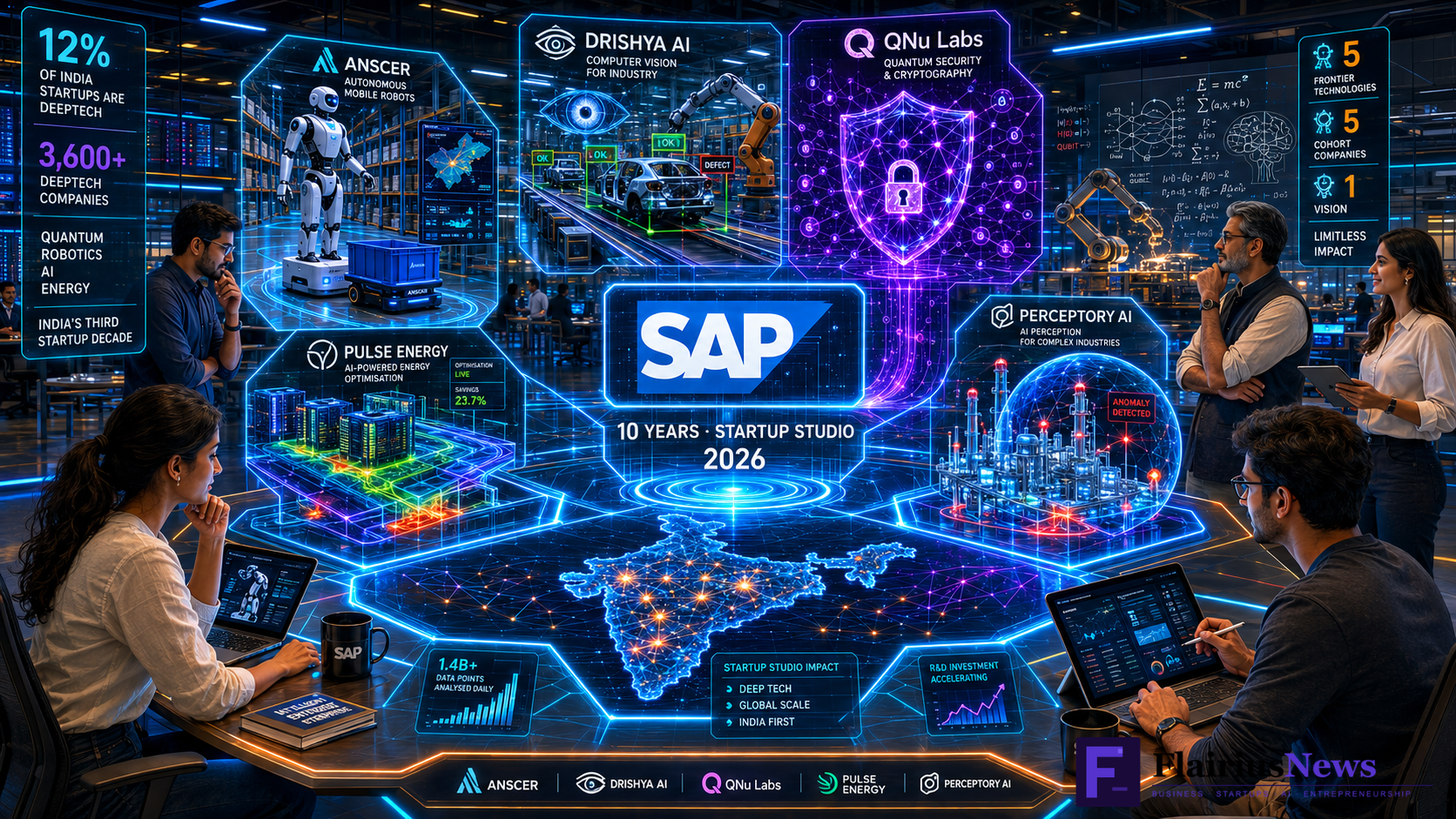
SAP Labs India has been running its Startup Studio accelerator programme for exactly ten years. In a decade of backing Indian startups, it has watched the ecosystem evolve from mobile-first consumer apps to fintech infrastructure to the current frontier: deeptech AI, robotics, quantum computing, industrial intelligence, and the foundational infrastructure of the next economy.
The 2026 cohort, announced on June 2, is the most technically ambitious the programme has ever selected. And the companies SAP chose to back say something important about where India’s most serious startup energy is now concentrated.
What SAP Startup Studio 2026 Selected and Why It Matters
The SAP Startup Studio Cohort 2026 marks ten years of the open-innovation accelerator programme. The six-month initiative supports startups in enterprise AI, agentic systems, robotics, cloud infrastructure, industrial intelligence, and quantum-safe security, providing access to SAP leaders, enterprise customers, and global commercialisation opportunities.
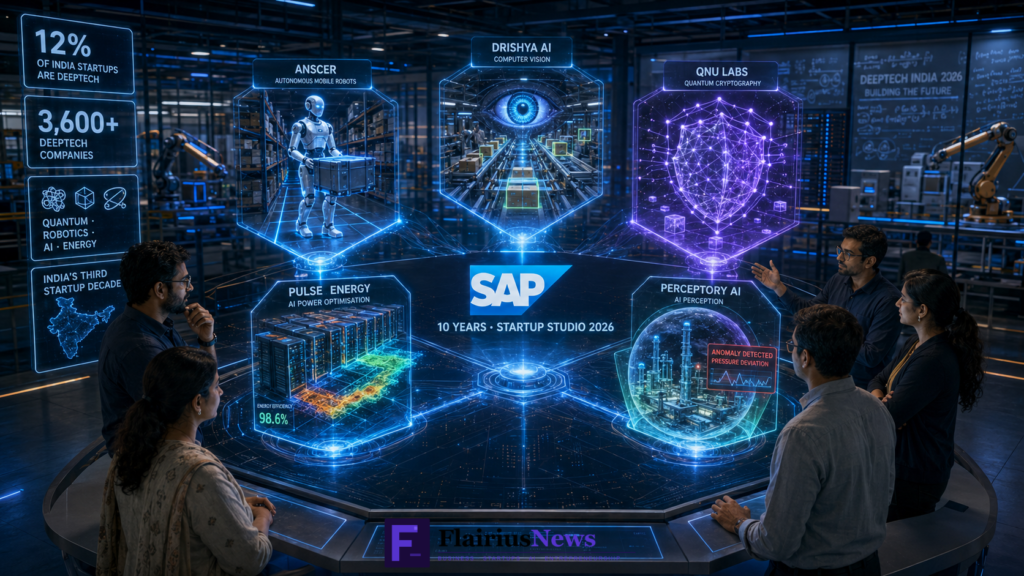
The selected startups read like a map of India’s deeptech frontier:
ANSCER Robotics — autonomous mobile robotics for industrial and warehouse environments. India’s manufacturing and logistics sectors are at an inflection point, with e-commerce growth driving demand for warehouse automation that previously only existed in Amazon’s US fulfilment centres.
Drishya AI — industrial computer vision and AI for quality control and operational intelligence. This is AI applied to the factory floor — a sector that employs hundreds of millions of Indians and has historically been the last to benefit from technology investment.
QNu Labs — quantum-safe security. This is arguably the most forward-looking selection in the cohort. Quantum computing will break most current encryption standards within a decade; companies that are building post-quantum cryptography infrastructure today are positioning for one of the largest forced technology transitions in history.
Pulse Energy — AI-powered energy management for commercial and industrial buildings. With India’s data centre boom driven by the $50 billion AI infrastructure investment, energy management AI is a directly adjacent and massively underserved market.
Perceptory AI Labs — enterprise AI perception systems for complex industrial environments. Think: AI that can see and understand a chemical plant, a power grid, or a defence installation as well as a human expert but faster and continuously.
Why Deeptech Is Having Its India Moment Right Now
Deeptech startups in AI, robotics, biotech, quantum computing, and related technical fields accounts for about 12% of India’s startup base, with more than 3,600 companies. Deeptech funding held up better than many expected through the funding winter.
This resilience is not accidental. Deeptech companies solve hard, specific problems with defensible technical moats. They are harder to build and harder to copy which makes them more durable in market downturns and more valuable in market upswings. The funding winter that decimated consumer apps and growth-at-all-costs fintech barely touched the companies building genuinely novel technology.
The Indian government’s policy environment is actively accelerating this. The IndiaAI Mission’s ₹10,371 crore infrastructure programme, the Atmanirbhar Bharat mandates pushing sovereign procurement, and specific sectoral programmes in space, defence, semiconductors, and clean energy are creating a procurement environment that did not exist five years ago.
The SAP Advantage and What It Represents
What makes the SAP Startup Studio selection particularly significant is not the funding or the mentorship it is the customer access. SAP’s enterprise customer base in India spans every major industry: manufacturing, retail, FMCG, banking, government. A deeptech startup that can demonstrate its product inside SAP’s customer ecosystem has effectively earned a sales channel that would take years and tens of crores to build independently.
The programme provides access to SAP leaders, enterprise customers, and global commercialization opportunities. For companies like ANSCER, Drishya AI, and Pulse Energy whose products need to be deployed inside large industrial environments to prove their value that enterprise access is worth more than any cheque.
The Decade Ahead
India’s first startup decade (roughly 2010–2020) was about consumer internet: food delivery, e-commerce, payments, ride-hailing. India’s second startup decade (2020–2026) built the financial and SaaS infrastructure underneath those consumer apps.
The third decade which the SAP 2026 cohort represents the opening chapter of will be about deeptech: robotics that work in Indian factories, quantum security protecting Indian financial infrastructure, AI that sees and thinks about Indian industrial environments, energy management systems for India’s data centre boom.
India now offers 207,000+ recognised startups, over 100 unicorns, $350B+ in ecosystem value, and nearly half of startups coming from Tier II and Tier III cities. The startup growth is built on structure, not just funding policy support, digital public rails, seed programs, and founder networks give repeatable ways to start and grow.
The bell has been rung. India’s deeptech decade has started.
Tags: SAP Startup Studio, India Deeptech, ANSCER Robotics, QNu Labs, Drishya AI, Pulse Energy, Indian AI Accelerator, Deeptech Funding India, Quantum Security India, Industrial AI 2026 Author CTA: Follow Flairius News for sharp takes on AI, startups, and the future of business in India and beyond — flairiusnews.com
 Aditya Agarwal
  Nayra Roy