
 By Raghav Sharma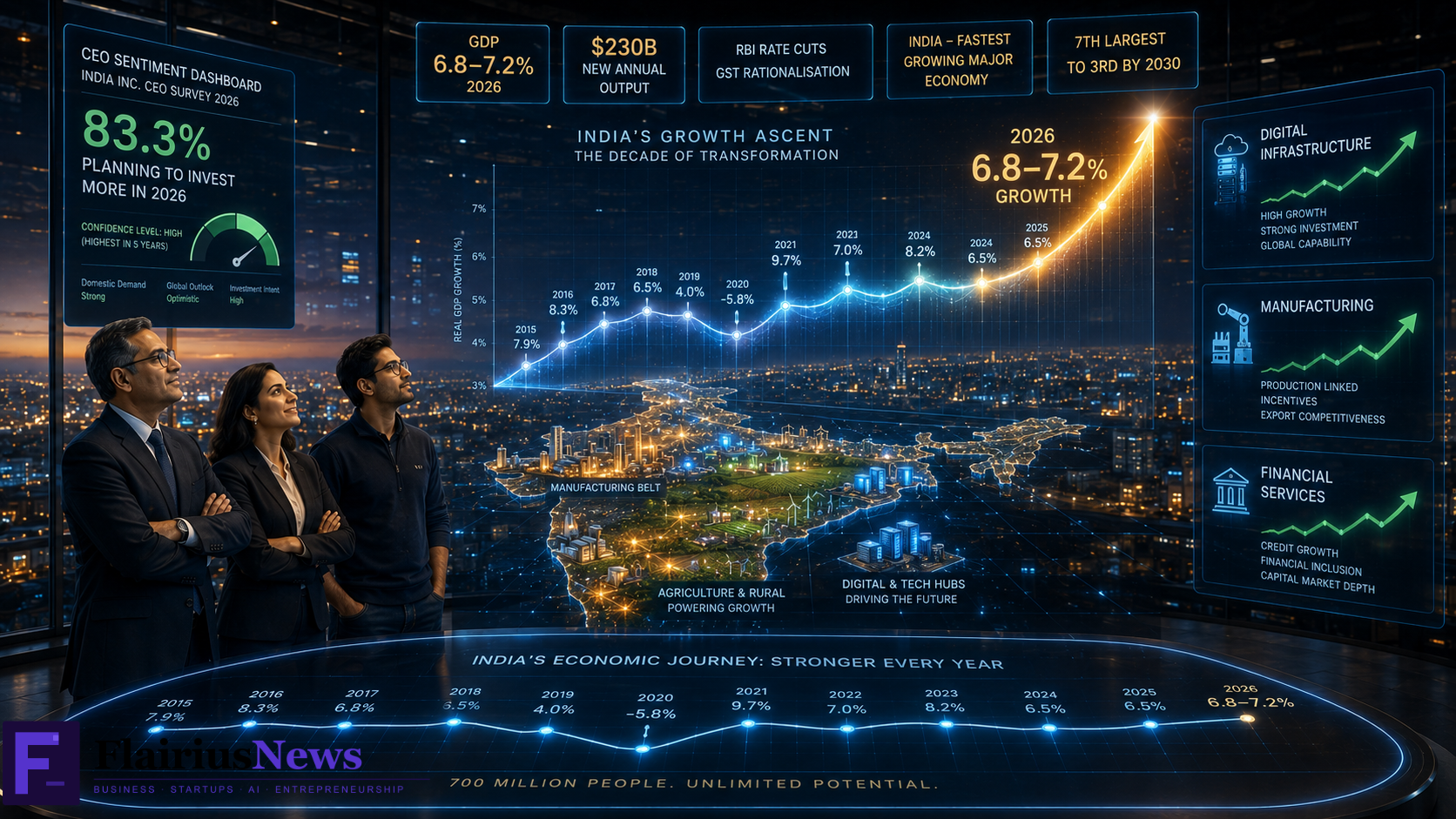
India’s economy is growing at approximately 7% in 2026. That fact gets repeated often. However, it rarely gets translated into what it actually means for the people building businesses in India right now.
M. Nagaraju, Secretary of the Department of Financial Services, stated clearly: “India remains one of the fastest-growing major economies in the world, with growth projected between 6.8 to 7.2 per cent this year.” Furthermore, 83.3% of Indian CEOs surveyed by Business Standard plan to invest more or expand capacity in 2026. Consequently, the growth is not just a macro statistic it is a real business decision being made across thousands of boardrooms simultaneously.
What 7% Growth Actually Means on the Ground
A 7% growth rate in an economy India’s size adds approximately $230–250 billion in new economic output annually. Furthermore, that output creates real demand for goods, services, infrastructure, software, and expertise.
Specifically, several things happen simultaneously when an economy grows at this rate. Consumer disposable incomes rise. Businesses invest in expansion. Government tax revenues increase, enabling higher public spending. Additionally, credit becomes more accessible as bank balance sheets strengthen with performing loans.
Moreover, India’s 2026 growth is happening alongside a policy tailwind. The RBI has implemented rate cuts. The government passed income tax exemptions that increased consumer spending power. Furthermore, GST rationalisation reduced input costs for several manufacturing sectors. Together, these measures amplify the compounding effect of base economic growth.
The Business Investment Signal
The CEO survey data is particularly telling. Specifically, 83.3% of India’s top CEOs plan to invest more or expand capacity this year. That is an unusually high level of corporate confidence. Furthermore, they are backing that confidence with balance sheet spending not just optimistic statements.
Additionally, concerns remain. Geopolitical uncertainty, currency volatility, and global tariff environments are the biggest boardroom worries. However, these external risks have not translated into investment hesitation domestically. As a result, India is seeing one of its strongest private capex cycles in recent years.
For startups, this matters directly. Growing enterprises buy more software, more services, more talent, and more infrastructure. Consequently, the enterprise sales environment for B2B startups is materially better in a 7% growth economy than in a 4% one.
The Sectors Growing Fastest Within That 7%
Three sectors are outpacing the overall growth rate in 2026.
First, digital infrastructure. Data centre construction, cloud migration, and AI infrastructure deployment are all accelerating. Furthermore, the global tech companies committing billions to India Microsoft, Google, NVIDIA are adding to this directly. Consequently, the companies supplying these projects construction, electrical, networking, software are in a high-growth environment.
Second, manufacturing. India’s engineering exports hit $122.43 billion in FY26. Moreover, the Production Linked Incentive schemes are driving domestic manufacturing in electronics, pharmaceuticals, and automotive components. Consequently, the Make in India transition from aspiration to execution is generating real revenue for real companies.
Third, financial services. India’s credit penetration remains low relative to GDP. Furthermore, insurance penetration is below global benchmarks. As incomes rise and financial literacy improves, these sectors capture a disproportionate share of new spending. Therefore, the BFSI-focused startups like Lumiq, HyperNorm AI, and Zopper’s ZENOVA are building in a market with structural tailwinds.
What Founders and Business Builders Should Do Differently
A 7% growth economy creates specific opportunities that do not exist in slower-growth environments. However, it also creates specific competitive dynamics.
Specifically, talent competition intensifies. Growing companies hire aggressively. Consequently, salary benchmarks rise. Therefore, startups that cannot match large corporate packages need to compete on equity, mission, learning opportunities, and flexibility.
Furthermore, customer expectations rise with incomes. Businesses and consumers alike demand better quality, faster delivery, and more personalised service as they become more prosperous. As a result, mediocre products that survived in a lower-expectation environment get displaced.
However, the overall opportunity remains compelling. India at 7% GDP growth is the best operating environment for building ambitious businesses that India has offered in its modern history. The founders who build the right things in the right sectors, with the right focus on quality will benefit from a rising tide that lifts structurally sound businesses the fastest.
Tags: India GDP 2026, India Economy Growth, 7% GDP India, India Business Opportunity, RBI Rate Cut, India Corporate Investment, India Fastest Growing Economy, India CEO Survey, India Business 2026 Author CTA: Follow Flairius News — sharp takes on AI, business, and India’s startup economy — flairiusnews.com
 Aditya Agarwal